





O.Carm
St. Teresa of Jesus 'de Los Andes' (OCD), Virgin
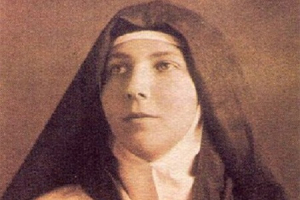
13 July Optional Memorial in Latin America
Juana Fernandez Solar was born on 13th July 1900 at Santiago in Chile, to Christian middle-class parents. Two days after her birth, she was baptized. The example and the teaching of her parents were the foundation of her Christian education. She was confirmed on 22th October 1909 and made her First Communion on 11th September 1910.
Vitam Coelo Reddiderunt

|
25-05-23 |
|
|
|
|
|
13-06-23 |
|
|
|
|
|
19-06-23 |
|
|
|
|
Celebrating At Home - 14th Sunday in Ordinary Time
Lifting the burden; lightening the load
(Matthew 11:25-30)
The Gospel today is a joyful, ecstatic outburst of feeling by Jesus.
Matthew’s community must have been deeply troubled by the fact that the ‘learned and clever’ religious leaders of their day did not accept the message of Jesus. Surely they, of all people, should have been able to recognise the truth. But in this passage, Matthew explains that it is not from a position of knowledge or power that one recognises who Jesus is. Rather, it is from an attitude of openness and simplicity, such as we often find in children.
Matthew also makes the point that Jesus does not approach us like a warlord, with threats of punishment, but in humility and gentleness.
The tone of the reading is set by Jesus’ warm and intimate address of ‘Abba’ (Father) which occurs five times in this short passage. This intimate relationship is characterised by God’s entrusting all of things to the Son, and the Son in turn revealing them to those who have faith. These, in turn, are drawn into intimate relationship with God.
The rules and laws of religious leaders in Jesus’ day often added to the burden experienced by those regarded as simple and sinful. Whereas Jesus always tried to lift burdens from people.
Jesus invitation in today’s Gospel is for everyone.
It could be an invitation for us to look at our lives and ask what burdens we impose on others. Do our concerns, anxieties, our need for power, wealth and status, exact a high price from others and ourselves?
Are we a burden or a blessing for each other? What can we do to make life easier for each other - to lift the burdens and share the load?
- pdf Celebrating At Home - 14th Sunday in Ordinary Time [PDF](3.76 MB)
- default Celebrating At Home - 14th Sunday in Ordinary Time [ePub](766 KB)
- pdf Celebrando en Familia - 14 Domingo del Tiempo Ordinario(423 KB)
- pdf Celebrando in Casa - 14 Domenica del Tempo Ordinario(425 KB)
- pdf Celebrando em familia - 14 Domingo do Tempo Comum(426 KB)
Celebration of the Anniversaries of St. Thérèse of Lisieux
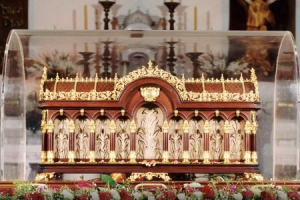
Each week Pope Francis meets with pilgrims from around the world in St. Peter’s Square. On June 7, he acknowledged the presence of the relics of Saint Thérèse of the Child Jesus and the Holy Face in St. Peter’s Square which are touring the world. Highlighting Thérèse as patroness of the missions, the pope said, “It is good that this is happening as we reflect on the passion for evangelization, on apostolic zeal. Today, then, let us allow the witness of Saint Thérèse to help us.”
The year 2023 is the 150th anniversary of the Carmelite saint’s birth and the 100th anniversary of her beatification. The pope has stated that he will dedicate an Apostolic Letter to her during this anniversary year.
During his catechesis, Pope Francis stressed the missionary spirit of Thérèse even though she never went on mission. “She recounts in her “diary” that her desire was to be a missionary, and that she wanted to be one, not just for a few years, but for the rest of her life, even until the end of the world. Thérèse was a “spiritual sister” to several missionaries. She accompanied them from her monastery with her letters, with her prayer, and by offering continuous sacrifices for them. Without being visible, she interceded for the missions, like an engine that, although hidden, gives a vehicle the power to move forward,” the pope recalled.
The pope asked rhetorically and encouraged his listeners to ask themselves the same “… where did all this zeal, this missionary strength, and this joy of interceding come from?” His answer led him to conclude that all Christians are called to be missionaries. “A missionary is also anyone who lives as an instrument of God’s love where they are. Missionaries are those who do everything so that, through their witness, their prayer, their intercession, Jesus might pass by.
He then reiterated that apostolic zeal “never works by proselytism—never—or constraint—never—but by attraction. Faith is born of attraction. One does not become Christian because they are forced by someone, but because they have been touched by love.”
The worldwide tour of the relics of Saint Teresa began in 1994, and has stopped in nearly 70 countries; the relics of Saints Louis and Zélie Martin, Thérèse’s parents, have traveled the world since 2015.
The Gothic reliquary will in Lisbon, Portugal during World Youth Day from July 25-August 6. It will also be in the Catalonian region of Spain from October 16-23, and in the Diocese of Nantes from October 30-November 13, 2023.
The Centenary reliquary has been visiting 53 dioceses in the Philippines, starting on January 2 and the visit will conclude on April 30, 2023. This is the 5th visit of the relics to that country. The reliquary will then go to the Diocese of Krakow in Poland from August 10-31.
From September 16-October 2, both the Centenary reliquary and the reliquary of Saints Louis and Zélie Martin will be at the National Shrine of St. Thérèse on the Aylesford Carmelite campus in Darien, Illinois. Both reliquaries will then be hosted by the Archdiocese of St. Paul and Minneapolis (Minnesota) from October 3-16, 2023.
Pope Francis Catechesis – June 7, 2023 General Audience
English: https://www.vatican.va/content/francesco/en/audiences/2023/documents/20230607-udienza-generale.html
Image captions:
- Centenary Reliquary
- Gothic Reliquary
- Louis and Zelie Martin Reliquary
Carmelite Nuns in Puerto Rico Celebrate Chapter
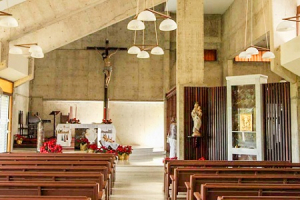
The Carmelite monastery of San José in Trujillo Alto, Puerto Rico, celebrated its triennial elective chapter on June 30, 2023.
In 1642, the noble lady, Anna de Lanzós, donated her palace for a monastery in San Juan. King Philip IV issued royal permission in 1646. Efforts to import Carmelite nuns from Seville were blocked because of the dangers of sea travel. So three Dominican nuns came from Queen of Angels monastery in San Domingo came to initiate Carmelite life according to the Carmelite Rule (1651) and the monastery was canonically erected. Lady Anna, who donated her house to be the monastery, and her sister entered the monastery. After the Dominicans returned to their monastery, Anna took over as prioress. The monastery was later transferred to the cities of San Germán (1903) and Santurce (1910) and currently is in Trujillo Alto.
The results of the elective chapter were as follows:
Prioress | Priora | Priora:
Madre Carmen Noemí Marrero Marrero, O. Carm.
1st Councilor | 1ª Consejera | 1ª Consigliera:
Sor Linda María Pérez González, O. Carm.
2nd Councilor | 2ª Consejera | 2ª Consigliera:
Sor Lutgarda María Reyes Maldonado, O. Carm.
Director of Novices | Maestra de Novicias | Maestra delle Novizie:
Sor Linda María Pérez González, O. Carm.
Activities of the Prior General for July 2023
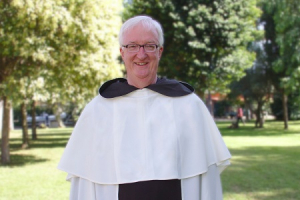
July 2 - 6 Celebrations and conference on Edith Stein, at The Friars, Aylesford.
July 10 - 18 Canonical visitation of communities in Cameroon.
July 19 - 27 Canonical visitation of communities in Burkina Faso.
Celebrating At Home - 13th Sunday in Ordinary Time
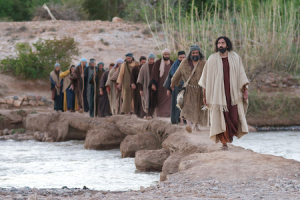
True discipleship
(Matthew 10:37-42)
Today’s Gospel is the final in this section of Matthew’s Gospel about the spread of the Kingdom and the role of the disciples.
Matthew often uses events as a beginning point for Jesus’ sermons. The section we have been listening to began with the call of Matthew and was followed by the instructions given to the disciples before setting out on mission. We heard part of that last Sunday.
So far in this sermon we have heard Jesus teach that the truly virtuous are those who exercise mercy; disciples are to proclaim the Kingdom of God with works of compassion and mercy; they are not to let fear compromise the message, but are to trust always in God.
Today’s Gospel passage highlights both the cost and rewards of true discipleship. The disciples’ relationship with Jesus must be the centre of their lives and the context for all other relationships.
Hospitality and welcome are concrete expressions of discipleship because the disciple is one who witnesses to the compassion and mercy of God with open hearts and concrete good actions.
Even though the first paragraph of today’s Gospel sounds like an exclusive choice must be made between Jesus and family, the idea behind the text is more that: in our relationship with Jesus, all other relationships fall into their proper context.
Without being in right relationship with Jesus we can’t learn how to be in right relationship with others. It is our relationship with Jesus which brings depth and richness to all our other relationships. So, for example, our family relationships become more thanjust fulfilling a social custom. They become true relationships filled with love, mercy, forgiveness and respect.
The Pharisees and Scribes seldom made good disciples because they thought that religion was about doing religious things. They went to the synagogue, kept the Law, fasted, and so on, but their hearts were never changed by their religious observance. They were self-righteous, despised the poor and the ‘sinners’, and acted without justice or mercy.
The truth about our conversion to Jesus (our becoming Jesus) is not so much seen in easily identifiably ‘religious’ things but in concrete good actions and right relationships.
Our religious observance is meant to support and nourish our relationship with Jesus. It is not a substitute for it. That relationship has the power to change and transform us so that we can bear witness to Christ through lives of mercy, compassion, justice and integrity.
- pdf Celebrating At Home - 13th Sunday in Ordinary Time [PDF](3.12 MB)
- default Celebrating At Home - 13th Sunday in Ordinary Time [ePub](4.27 MB)
- pdf Celebrando en Familia - 13 Domingo del Tiempo Ordinario(460 KB)
- pdf Celebrando in Casa - 13 Domenica del Tempo Ordinario(461 KB)
- pdf Celebrando em familia - 13 Domingo do Tempo Comum(462 KB)
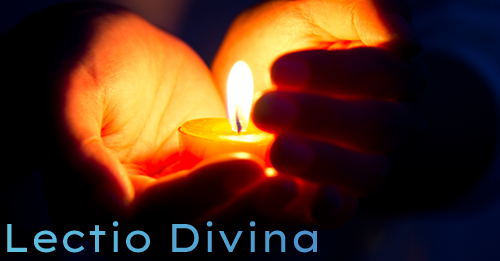
Lectio Divina July 2023
Opening Prayer
Father,guide and protector of your people,grant us an unfailing respect for your name, and keep us always in your love.We ask this through our Lord Jesus Christ, your Son, who lives and reigns with you and the Holy Spirit, one God, for ever and ever. Amen.- pdf Lectio Divina July 2023 [PDF] Download here(981 KB)
- default Lectio Divina July 2023 [ePub] Download here(258 KB)
- default Lectio Divina July 2023 [Mobi] Download here(1.28 MB)
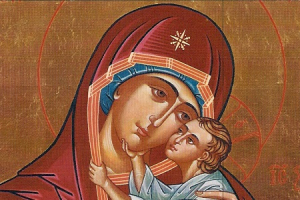
Cover image: Blessed Virgin Mary of Mount Carmel, Terenure College, Dublin, Ireland. Photo: William J. Harry, O. Carm.
The PCM Province Celebrates Its Triennial Chapter
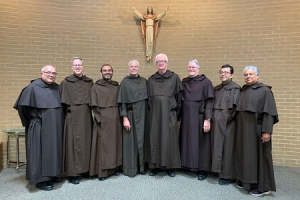
The Province of the Most Pure Heart of Mary held its triennial provincial chapter June 20-23, 2023. The gathering was held in Darien, Illinois at the Carmelite Spiritual Center. It was an open chapter with members from Canada, the United States, Mexico, El Salvador, Honduras, and the Provincial Commissariat of Perú participating.
The Prior General, Míceál O'Neill, and the General Councilor for America, Luis Maza, attended.
Besides the reports by the prior general and the prior provincial, sessions were held on synodality and the papal encyclical Laudato Si’. A one woman play on the life of St. Thérèse was presented one evening to celebrate the 150th anniversary of the Carmelite’s birth and the 100th anniversary of her beatification.
Almost 160 years ago, two Carmelites from the monastery in Straubing (Germany) journeyed to Louisville, Kentucky, to work among the German immigrants. Unable to secure a parish, they moved to St. Joseph’s parish in what is now Sellersburg, Indiana and later to Leavenworth, Kansas. The Vicar General of the Order, Angelus Savini, appointed Cyril Knoll as the General Commissary and houses were established in Scipio, Kansas (1865) and then in Englewood, New Jersey (1869) by a Dutch Carmelite who had previously lived in Merthyr Tydvil (Wales). The Carmelites also worked among the freed Black slaves in Maryland. In 1870 the Carmelites established a base at Paducah serving a wide area of Western Kentucky, a part of the Jackson Purchase. They also accepted a parish in Louisville, where they had originally immigrated to from Germany.
The monastery of Niagara Falls (Canada) was founded in 1875 in a house overlooking the famous waterfalls. In 1881 all the houses of North America were united into one General Commissariat.
The Province of the Most Pure Heart of Mary was established in 1890 with Pius Mayer serving as the first prior provincial. He would later serve as prior general of the Order.
From 1929 to 1949 the province had a house in Palestine; and then in 1949 foundations were made in Chile (now closed) and Perú. In 1995 a foundation was made in Torreón, Mexico. In 2014, the foundation in El Salvador was officially incorporated into the province. Today there are foundations in Canada, the United States, Mexico, El Salvador, Honduras, and a commissariat in Perú.
The following members were elected to leadership:
Provincial | Provincial | Provinciale
Carl Markelz, O. Carm.
Vice Provincial | Vice Provincial | Vice Provinciale
David McEvoy, O. Carm.
1st Councilor | 1er Consejero | 1o Consigliere
Rolf Nepi Willemsen, O. Carm.
2nd Councilor | 2do Consejero | 2o Consigliere
Luis Jesús Paz Acosta, O. Carm.
3rd Councilor | 3er Consejero | 3o Consigliere
Jorge Monterroso Mérida, O. Carm.
4th Councilor | 4to Consejero | 4o Consigliere
Samuel Citero, O. Carm.
Celebrating At Home - 12th Sunday in Ordinary Time
Be the living Gospel
(Matthew 10:26-33)
The first reading from the Old Testament book of the prophet Jeremiah reflects Jeremiah’s experience of rejection - no one wants to hear the message God has called him to give. In fact, they want to kill him.
Jeremiah sounds desperate and afraid. But then the reading turns into a prayer of confidence and trust in God’s companionship and spiritual protection - God and Jeremiah will win out.
Preaching in the name of God is a risky and frightening business, as Jesus knows. So he urges the disciples not to be afraid of small beginnings, of those who can kill only the body, or that God would abandon them. He reminds them that God is always mindful of them and accompanies them on their mission. He urges them to be brave and bold in proclaiming the truth about God and in confessing their belief in Jesus before others.
Matthew’s audience, like Jesus, Jeremiah and the disciples, knew all about persecution and rejection.
Their question is also ours: if we allow fear to silence us how will the Good News of Jesus Christ ever be heard in the world? If we don’t speak, who will? If we don’t act, who will?
It is not really a matter of talking at people and quoting at length from the Bible. As St Francis of Assisi said, ‘Preach the Gospel at all times. When necessary use words’.
- pdf Celebrating At Home - 12th Sunday in Ordinary Time [PDF](3.16 MB)
- default Celebrating At Home - 12th Sunday in Ordinary Time [ePub](4.86 MB)
- pdf Celebrando en Familia - 12 Domingo del Tiempo Ordinario(484 KB)
- pdf Celebrando in Casa - 12 Domenica del Tempo Ordinario(591 KB)
- pdf Celebrando em familia - 12 Domingo do Tempo Comum(591 KB)