










Displaying items by tag: Celebrating At Home
Celebrating At Home - 31st Sunday in Ordinary Time

Making assumptions
(Luke 19:1-10)
It is all too easy to make assumptions about other people which turn out not to be accurate. In the Gospel today, the crowd assumes that Zacchaeus is wicked and sinful, a traitor to his people because he is a tax collector.
The scene for the Gospel is, as usual, set by the first reading from the Book of Wisdom – in praise of a God whose love for what he has created allows him to overlook sins. God is all-powerful and all-merciful, the lover of all he creates and the lover of all life, ‘whose imperishable spirit is in all’. God corrects his people through forgiveness, drawing people away from evil and towards trust in himself.
This loving, forgiving action of God is on show in the Gospel story. Where we might have expected Jesus’ to condemn Zacchaeus, as the crowds do by excluding him and labelling him a ‘sinner’, Jesus recognises the good that Zacchaeus does even in his so-called ‘sinful’ situation (being a tax collector on behalf of the Roman government). Salvation does not lie in appearing to be good, but in being good. Such a person is truly a ‘son of Abraham’ – one of God’s chosen.
It might be helpful to note here that in Zacchaeus’ speech about intending to give half of his property to the poor and so on, the verbs are usually translated into future tense, as in the version which appears here. In the original Greek manuscripts, however, the verbs are unambiguously in the present tense. So Zacchaeus is describing how he presently conducts his life – a defence against the condemnation of the crowd that he is a ‘sinner’ and a traitor.
It is the crowd who turns out to be ‘what was lost’, not Zacchaeus.
Read against the background of Luke’s community, the story raises questions about judging on appearances, who is truly at rights with God, who is truly the sinner. An echo of last week’s parable about the Pharisee and the Tax Collector.
Most of all, building from the first reading, it is a story about the God who does not judge and punish as we would, but who loves, forgives, heals and reconciles people to one another.
When Jesus pronounces Zacchaeus a ‘son of Abraham’ he removes the barrier between the crowd and Zacchaeus and reconciles them.
- pdf Celebrating At Home - 31st Sunday in Ordinary Time [PDF](3.49 MB)
- default Celebrating At Home - 31st Sunday in Ordinary Time [ePub](3.18 MB)
- pdf Celebrando en Familia - 31 Domingo del Tiempo Ordinario(630 KB)
- pdf Celebrando in Casa - XXXI Domenica del Tempo Ordinario(629 KB)
- pdf Celebrando em Família - 31 Domingo do Tempo Comum(628 KB)
Celebrating At Home - 30th Sunday in Ordinary Time
We’ve all met them!
(Luke 18:9-14)
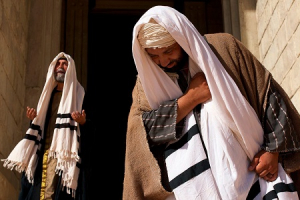
We’ve all met them: people who only seem to be able to bolster their self-image by putting everyone else down. We meet such a character in the Pharisee in the Gospel for this Sunday.
Like the Pharisee in this week’s Gospel, we can sometimes see religion as a set of personal rituals, actions and prayers that cause us to think we have been faithful to God’s calling because we have done this or that.
Spirituality, however, is about practising our ‘faith’ with a profound sense of God’s presence, God’s love for us, and ours for one another. We live work and pray out of our relationship with God, deeply aware of God’s gift of abiding love and mercy that surrounds us.
The background for the Gospel is set in the First Reading from Ecclesiasticus (35:12-14, 16-19) – God’s judgement is not fooled by outward appearances of wealth, or power, or religious shows of piety. God cannot be fooled into judging against the injured, the poor, the widow or orphan.
It is the person ‘who with his whole heart serves God’ whose prayers are accepted.
The parable in this Gospel, we are told, is addressed to ‘people who prided themselves on being virtuous and despised everyone else’.
The Pharisee (people well respected due to their personal piety) prays to God, reminding God (and himself) what a good person he is and all the religious things he has done. He has thus fulfilled the duties of a ‘religious’ and ‘righteous’ person – unlike, he says, the tax collector.
However, the tax collector (considered a sinner in Jesus’ time), doesn’t see himself worthy to even lift his eyes to God and acknowledges that he has sinned and considers himself unworthy to be in the presence of God. But, as Jesus says, he leaves the temple ‘at rights with God’. His relationship with God is from the heart. Overcome with a deep awareness of God’s love for him, and his own unworthiness of it, he does not dare to even lift up his eyes. Whereas the Pharisee, through his lack of humility and apparent self-righteousness, leaves assuming that he is at rights with God.
Our prayer and worship should never be empty words or merely symbolic actions. They must truly come from our hearts and so lead us not only into a deeper relationship with God but also into the willing service of all.
- pdf Celebrating At Home - 30th Sunday in Ordinary Time [PDF](3.47 MB)
- default Celebrating At Home - 30th Sunday in Ordinary Time [ePub](4.49 MB)
- pdf Celebrando en Familia - 30 Domingo del Tiempo Ordinario(632 KB)
- pdf Celebrando in Casa - XXX Domenica del Tempo Ordinario(631 KB)
- pdf Celebrando em Família - 30 Domingo do Tempo Comum(633 KB)
Celebrating At Home - 29th Sunday in Ordinary Time

Don’t give up!
(Luke 18:1-8)
Jesus tells this story of a persistent widow who wins the day against an unjust judge. St Luke says that the story is “about the need to pray continually and never lose heart”. God is not like the unjust judge, who delays in answering and finally gives in only when threatened. God will hear and answer the persistent cry of his people.
We, too, can be tempted to lose heart as we live in the midst of the evils of our own day. When will there be justice for the poor, the hungry, the disabled, and the disadvantaged, we wonder.
Sometimes in prayer, we realise that we are called to play our part with concrete actions which help to relieve the suffering of others. We know we cannot do it all by ourselves, but perhaps there is something that we can do.
St Luke uses this story to encourage his community of believers – to urge them not to lose heart as, surrounded by the evils of their day, they wait for the return of Jesus. They should keep faith and rely always on God’s goodness. Their persistence in prayer is an expression of their trust in God. Perhaps their prayer will show them what to do as they wait.
Just as Moses keeps faith with God in the battle against the Amalekites (first reading), so the disciples must remain in a faithful relationship with God. Prayer, understood as nourishing our relationship with God, rather than ‘saying prayers’, keeps us in this faithful relationship with God as we wait for Jesus’ return. That is the kind of faith Jesus wonders about in the final sentence.
- pdf Celebrating At Home - 29th Sunday in Ordinary Time [PDF](3.02 MB)
- default Celebrating At Home - 29th Sunday in Ordinary Time [ePub](3.37 MB)
- pdf Celebrando en Familia - 29 Domingo del Tiempo Ordinario(648 KB)
- pdf Celebrando in Casa - XXIX Domenica del Tempo Ordinario(646 KB)
- pdf Celebrando em Família - 29 Domingo do Tempo Comum(647 KB)
Celebrating At Home - 28th Sunday in Ordinary Time
An invitation for all
(Luke 17:11-19)
A major theme in St Luke’s Gospel is that the message of Jesus is for all: men and women, rich and poor, old and young, healthy and sick, gentile and Jew. No one is excluded.
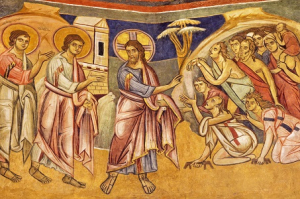
It is no accident that the one grateful leper in this week’s Gospel is not a Jew but a Samaritan – an outsider, excluded by race, religion and his illness. He joins the others in asking a Jewish Rabbi for mercy.
In curing the ten lepers, Jesus gives them back to their families, their communities, their religious practice. No longer confined to isolated places for fear of spreading disease, they are free to take up their lives again. In short, as well as healing them physically, Jesus gives them back their lives.
All ten are cured, but only one, the Samaritan, fully experiences his healing as a moment of salvation; a moment when the mercy of God has broken into his life. Jesus says that it is the Samaritan’s faith that enables him to see what the other nine do not. The man is so moved by this realisation that he turns back to Jesus breaking into shouts of joy, praising God at the top of his voice.
The Samaritan’s faith has drawn him deeper into his relationship with God who heals him and sets him free. And that is God’s great desire for each of us.
The way of Jesus (and, therefore, of his disciples) is not to exclude, but to proclaim God as the God of all by working for healing, restoration and the good of all people. And to recognise and celebrate the presence of God we read in the concrete realities of our lives.
- pdf Celebrating At Home - 28th Sunday in Ordinary Time [PDF](3.63 MB)
-
default
Celebrating At Home - 28th Sunday in Ordinary Time [ePub](6.70 MB)
- pdf Celebrando en Familia - 28 Domingo del Tiempo Ordinario(911 KB)
- pdf Celebrando in Casa - XXVIII Domenica del Tempo Ordinario(816 KB)
- pdf Celebrando em Família - 28 Domingo do Tempo Comum(820 KB)
Celebrating At Home - 27th Sunday in Ordinary Time

Does God listen?
(Luke 17:5-10)
“Are you listening, God?” That’s the cry of the prophet Habakkuk in the first reading for this Sunday.
Everyone can resonate with the Habakkuk’s feelings of frustration and anger at the appalling injustice he witnesses. ‘Why is God so slow to act?’, he complains.
God’s response to Habakkuk is a call to greater trust and faithfulness. God will answer, but not, perhaps, as quickly, or in the manner, Habakkuk would like.
The idea of faithfulness links the first reading with the today’s Gospel and the apostles asking Jesus to increase their faith.
What disciples on the ‘way of Jesus’ need more than anything is a deepening faith in the God of Jesus Christ who can and will rescue them from opposition and other destructive forces.
Jesus says that even a small amount of faith can bring about quite unexpected and seemingly impossible things - like uprooting a mulberry tree and planting it in the sea!
Essential to the faithful following of Jesus is letting go of the ego needs for power, wealth and position and living a life of faith in God and faithful following of Jesus which is expressed in true ministry to others.
Faithful disciples work diligently as servants of the Kingdom, not for rewards and honours, but keenly aware of God free graciousness to them and the need to extend that graciousness to others.
- pdf Celebrating At Home - 27th Sunday in Ordinary Time [PDF](3.37 MB)
-
default
Celebrating At Home - 27th Sunday in Ordinary Time [ePub](3.87 MB)
- pdf Celebrando en Familia - 27 Domingo del Tiempo Ordinario(634 KB)
- pdf Celebrando in Casa - XXVII Domenica del Tempo Ordinario(633 KB)
- pdf Celebrando em Família - 27 Domingo do Tempo Comum(631 KB)
Celebrating At Home - 26th Sunday in Ordinary Time

Fortunes reversed
(Luke 16:19-31)
The story Jesus tells in the Gospel is about a rich man, his five brothers and a poor man, and how their fortunes get reversed.
The rich man does nothing particularly evil. He lives like a rich man, dresses like a rich man and dines like a rich man. But he does not see the poor man sitting at his door. He does not even notice him.
The story is told against the background belief that riches were a sign of God’s blessing. By the time of Jesus, the teaching of the prophets that blessing brings responsibility seems to have been forgotten.
So the story asks the hearers: will they follow the example of the rich man or heed Jesus’ teaching (and that of the prophets) about the care of the needy and prove themselves true children of Abraham and take their place at the eternal banquet?
Injustice and greed breed violence and often result in the exploitation of the poor. As Pope Paul VI once said, “If you want peace, work for justice”.
We are not called to hoard God’s blessings, but to be distributors of them so that all have a fair share of this world’s goods and can live with dignity and respect.
- pdf Celebrating At Home - 26th Sunday in Ordinary Time [PDF](3.86 MB)
-
default
Celebrating At Home - 26th Sunday in Ordinary Time [ePub](5.05 MB)
- pdf Celebrando en Familia - 26 Domingo del Tiempo Ordinario(640 KB)
- pdf Celebrando in Casa - XXVI Domenica del Tempo Ordinario(638 KB)
- pdf Celebrando em Família - 26 Domingo do Tempo Comum(640 KB)
Celebrating At Home - 25th Sunday in Ordinary Time

Investing in the future
(Luke 16:1-13)
When bad things happen to us we are apt to spend a great deal of time being angry at what has taken place – especially if we feel that what has happened is unjust, unfair or unreasonable.
Today’s Gospel episode is often called the ‘Parable of the Unjust Steward’. But perhaps he is the one who is being treated unjustly. After all, the Master hears a rumour that the steward has been ‘wasteful with his property’. Without conducting an investigation to find out if the rumour is true, the Master decides to dismiss the steward.
The steward spends only a little time trying to decide what he will do once he loses his job. Knowing he is too weak to dig and too ashamed to beg, he sets about altering the contracts of sale for his masters’ debtors.
Is the steward stealing from the Master? No. In the ancient world such stewards were not directly paid by the master. Their ‘wage’ came from the commissions they added to bills of sale. So the steward is giving up his commission for the sake of his long-term future; to build goodwill among the debtors that they might return the favour in the steward’s coming hour of need.
For astutely investing in his future the steward is praised by the Master. Jesus uses this allusion to advise the disciples that they, too, should invest in their future through the sharing of all that they have.
The term mammon refers not only to money, but to all that a person has. The disciples, says Jesus, should be prepared to give away all that they have to the poor so that when the kingdom comes, in which the poor have the privileged places, the disciples will be welcomed into the ‘tents of eternity’.
The final sayings of this Gospel presuppose that Christian life is a stewardship in which the wealth that one handles is wealth God wishes the whole world to share, not one’s personal possession. Disciples must choose wisely and act decisively. When it comes to wealth, they must choose between the interests of God and their own self-interest.
If disciples do not share possessions, they will not be entrusted with the true riches of the kingdom. If they do share possessions, which are on loan from God, they will be given the treasure of heaven as their own. The disciples must give exclusive loyalty to God or succumb to the enslavement of mammon.
- pdf Celebrating At Home - 25th Sunday in Ordinary Time [PDF](2.88 MB)
-
default
Celebrating At Home - 25th Sunday in Ordinary Time [ePub](2.84 MB)
- pdf Celebrando en Familia - 25 Domingo del Tiempo Ordinario(465 KB)
- pdf Celebrando in Casa - XXV Domenica del Tempo Ordinario(302 KB)
- pdf Celebrando em Família - 25 Domingo do Tempo Comum(474 KB)
Celebrating At Home - 24th Sunday in Ordinary Time

Loss, recovery & celebration
(Luke 15:1-32)
The three parables which form the Gospel this week share a common pattern: loss, finding, celebration.
Jesus tells these parables in the context of a shared meal with the ‘tax collectors and sinners’. The scribes and Pharisees complain about Jesus welcoming sinners and eating with them. Jesus tells these parables to explain his actions and to invite the scribes and Pharisees into a new understanding of God’s love and mercy.
The parables of the lost sheep, the lost coin and the lost sons share a common theme: that the mercy of God breaks through all human and religious restrictions about how God should act toward sinners.
They are stories of lavish and undeserved love and mercy. What shepherd in his right mind will abandon ninety-nine healthy sheep to go after a lost one? What woman will spend all day turning the house upside down to find a coin of little value? What father will joyfully welcome home a wasteful and disrespectful son? What brother will do the same? Scribes, Pharisees and we ourselves may not, but God will.
The Gospel offers not just the hope of God’s mercy and forgiveness but the certainty of it.
These three parables are also an invitation to the scribes and Pharisees, and to us, to join in Jesus’ mission of mercy; to behave as God behaves towards our brothers and sisters – with mercy and forgiveness – and welcoming all to the Great Feast.
- pdf Celebrating At Home - 24th Sunday in Ordinary Time [PDF](2.80 MB)
-
default
Celebrating At Home - 24th Sunday in Ordinary Time [ePub](2.25 MB)
- pdf Celebrando en Familia - 24 Domingo del Tiempo Ordinario(431 KB)
- pdf Celebrando in Casa - XXIV Domenica del Tempo Ordinario(427 KB)
- pdf Celebrando em Família - 24 Domingo do Tempo Comum(269 KB)
Celebrating At Home - 23rd Sunday in Ordinary Time

Real reality
(Luke 14:25-33)
There is very little that is real in so-called ‘reality TV’.
We know that, in fact, situations and circumstances are highly contrived and rather artificial. People are deliberately set up to fail, tensions are fuelled and contestants often exploited emotionally and physically.
Today’s Gospel contains a rather heavy dose of real reality about what is required in order to be a disciple of Jesus.
The words of Jesus have to be read against the background of the Kingdom life God is inviting us into and the central message of Jesus that we need to place God in the centre of our hearts.
The language about hating family members and even our own lives comes from a Semitic idiom which expresses preference. If you prefer one person or thing over another you are said to ‘love’ the first and ‘hate’ the second. The Gospel is not calling us to hate either our relatives or ourselves.
When we let the presence of God flood our hearts and minds all other aspects of our lives, including our relationships, find their proper place. Relationships become more genuine and less exploitive; possessions have less hold over us and we begin to share them more generously, our need for power and status fades.
To do this, however, is no easy thing. It requires many daily decisions, choosing to see with God’s eyes, to feel with God’s heart and to act according to God’s vision for human life: to choose love over hate, generosity over hoarding, to let go of power and status and be of real service to our sisters and brothers. That is what ‘carrying the cross’ is all about.
Jesus warns that this is a difficult and demanding way, and that a disciple needs to be clear-eyed and ready to take up the task.
- pdf Celebrating At Home - 23rd Sunday in Ordinary Time [PDF](5.82 MB)
-
default
Celebrating At Home - 23rd Sunday in Ordinary Time [ePub](4.90 MB)
- pdf Celebrando en Familia - 23 Domingo del Tiempo Ordinario(539 KB)
- pdf Celebrando in Casa - XXIII Domenica del Tempo Ordinario(538 KB)
- pdf Celebrando em Família - 23 Domingo do Tempo Comum(540 KB)
Celebrating At Home - 22nd Sunday in Ordinary Time

Invitation to dinner
(Luke 14:1, 7-14)
It’s no accident that the Gospels contain many instances of shared meals, weddings feasts and miraculous feeding. In the Scriptures, meals always have something to do with the great meal – the eternal wedding feast.
We celebrate the sacred meal of the Eucharist anticipating the eternal feast of continual communion with God.
In this Gospel episode, Jesus has been invited to a meal at the home of a leading Pharisee. Luke tells us that they watched Jesus closely. No doubt, they are trying to make up their minds about him and his teaching.
Jesus, too, is watching closely and observes how those at the meal readily chose the places of honour for themselves. The fact that Luke calls the words of Jesus a ‘parable’ alerts us to the fact that this is more than just good advice about how to avoid embarrassment at a dinner party in the ancient world.
It turns out that the parable is about the feast in the Kingdom of God. In the Kingdom the usual conventions of this world are completely reversed, such that those who exalt themselves will be humbled and those who humble themselves will be exalted; the last will be first, and the first last.
It is not wealth, power and social status that gains us a high place at the eternal feast, but the good treatment (humble service) of the most disadvantaged. Being hospitable to the poor and disadvantaged now gains a person the only welcome that truly matters: the welcome into the everlasting hospitality of God.
The true disciple acts towards others with the same largeness of heart as God. Humility enables us to be open to God’s heart, and gentleness is the way of imitating his love.
- pdf Celebrating At Home - 22nd Sunday in Ordinary Time [PDF](3.14 MB)
- default Celebrating At Home - 22nd Sunday in Ordinary Time [ePub](4.39 MB)
- pdf Celebrando en Familia - 22 Domingo del Tiempo Ordinario(574 KB)
- pdf Celebrando in Casa - XXII Domenica del Tempo Ordinario(574 KB)
- pdf Celebrando em Família - 22 Domingo do Tempo Comum(576 KB)