


O.Carm
Solemnity of Our Lady of Mount Carmel, July 16, 2024
A Joint OCARM-OCD Letter for the Year of Prayer and the Solemnity of Our Lady of Mount Carmel
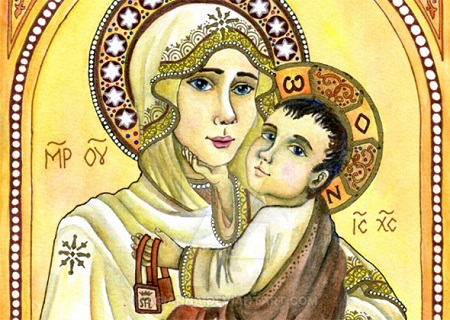
"In Mary a Dawn of Hope: In Mary Our Way of Praying"
A joint letter of the two general superiors, Míċeál O'Neill, O. Carm., and Miguel Márquez Calle, OCD is being published on the Solemnity of Our Lady of Mount Carmel in 2024 which coincides with the Year of Prayer called for by Pope Francis to mark a time of preparation for the Jubilee Year in 2025.
A Video Message for the Celebration of the Solemnity of the Blessed Virgin Mary of Mount Carmel – July 16, 2024 from Fr. Míċeál O’Neill, O. Carm., Prior General of the Order
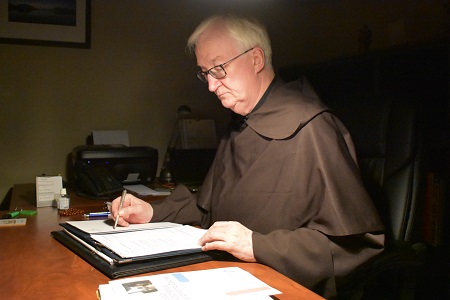
Dear sisters and brothers in the Carmelite family throughout the world:
the celebration of the solemnity of Our Lady of Mount Carmel this year coincides with the Year of Prayer, announced by Pope Francis as a time of preparation the celebration of the 2025 Jubilee. The desire of the Holy Father is that there should be a “symphony of prayer” throughout the world. His teaching on prayer is an invitation to the Carmelite family to play its part in praying and in helping others to pray.
IN SOLLEMNITATE B.V. MARIAE DE MONTE CARMELO
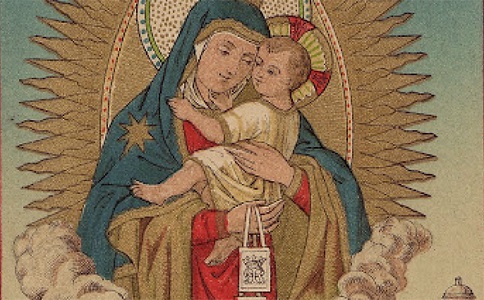
Flos Carmeli, vitis florigera,
splendor caeli, Virgo puerpera singularis.
Mater mitis, sed viri nescia,
Carmelitis esto propitia,
stella maris.
MÍCEÁL PRIOR GENERALIS
DOMUSQUE GENERALIS COMMUNITAS
16.VII.2024
Diocese of Málaga Features Interview with Carmelite Prior General to Highlight Devotion to Our Lady of Mount Carmel in July
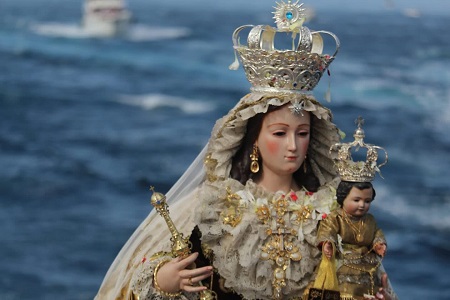
The July issue of the magazine of the Diocese of Málaga (Spain) focused on Our Lady of Mount Carmel. As July 16 is the feast day, several of the articles focused on the devotion of the people and how they celebrate the feast marking the Christian summer calendar. The cover of the magazine showed the image of Our Lady of Mount Carmel who is the patroness of Marbella.
Major Events Throughout History That Took Place on July 16th
On the occasion of the Solemnity of Our Lady of Mount Carmel, we can look back at the major events throughout History that took place on July 16th.
+ + +
We would like to hear how others are celebrating the feast in their local communities or ministries. Please send a short writeup and pictures to the Communications Office (Esta dirección de correo electrónico está siendo protegida contra los robots de spam. Necesita tener JavaScript habilitado para poder verlo.).
A Video Message to the Carmelite Family
A Video Message to the Carmelite Family for the Feast of Our Lady of Mount Carmel
Sisters and Brothers in Carmel,
I would like to wish all Carmelites a very joyful and fruitful celebration of the Solemnity of Our Lady of Mount Carmel, 2022. Our spirits are lighter because of the feeling that we will be able to celebrate our Lady's feast this year fully without the threat of Covid 19.
There is also the joy that we share because of the canonisation of Saint Titus Brandsma that we celebrated two short months ago, when Carmelites from around the world gathered in Rome in great numbers, while many more followed all that was happening through social media.
The good feeling generated by that event will remain with us for a long time, as we take up St. Titus’ legacy and offer it to the world as a wonderful expression of what it means to be a true follower of Christ in the Carmelite tradition.
Despite all the good things that are happening, all is not well in our world. The threat and the culture of war and violence never seems to leave us, because of a belief that people have that recourse to arms is a legitimate way to achieve one’s goals.
We come from a different culture, one that St. Titus Brandsma stood for and suffered for in his life. It is the culture of peace and forgiveness. It is that culture that says that we are all sisters and brothers to one another without exception, which makes it unthinkable that we should take up arms against one another.
Somehow through this culture we have to find the way to use the power of love and truth to overcome all our difficulties.
One of the expressions of our culture that we have seen this year is the hospitality given by various Carmelite communities, male and female to refugees from the conflict in Ukraine , a reason for all to give thanks.
I pray with all Carmelites this year that as we ponder on what the Holy Mountain means for us, we might know what it means to put on the armour of God (Rule 21) and answer the demand to turn our swords into ploughshares and our spears into pruning hooks. (Is 2).
Peace, joy and happiness to you all.
Míċeál O’Neill, O. Carm
Prior General
Watch on YouTube here
A Letter to the Carmelite Family
A LETTER TO THE CARMELITE FAMILY FOR THE FEAST OF OUR LADY OF MOUNT CARMEL 2022
Brothers and sisters in the Carmelite Family,
as the solemnity of Our Lady of Mount Carmel approaches, we find ourselves in festive mood. We want to celebrate and give thanks to God for everything that Our Lady of Mount Carmel represents for us. In a particular way, we want to give thanks to God and to Our Lady because the fear we had of Covid 19 this time last year has lessened and life for many is returning to some kind of normality. At the same time we continue to pray for Our Lady’s protection for us and for the world.
This year for us has been blessed by the canonization of Saint Titus Brandsma. Who will ever forget those days of joy and happiness in Rome, and that moment in St. Peter’s Square when along with nine other disciples of Christ our brother Titus was declared a saint?
Sadly, this year has also been marked by the invasion of Ukraine by Russian forces, to add to the many other ills that cause so much suffering to innocent people around the world. We think of the many displaced persons, without shelter, living in refugee camps, many of them women and children. Meanwhile the men continue to be drawn into unwanted armed combat.
The celebration of Our Lady of Mount Carmel and the example and inspiration of Saint Titus Brandsma, invite us this year to ponder, the gift of Carmel, seen through the experience of our new saint. We can see what Carmel offers us as the deepest motivation for the work of peace. We can contemplate and make our own God’s desire for peace and for the fullest dignity of the human person.
As Mary stood at the foot of the cross, along with John the beloved disciple and the other women, Jesus in that moment created a new kind of human family, built not on the bonds of blood, but on the reality of people caring for one another. Now it is the son who takes the mother into his home. Things are changed around. The dream and the project is that sons and daughters come into the world and as they grow up, they grow into the ability to care for all that is there before them in order to hand it on to the sons and daughters who will come after them.
Both the Corona virus and the welcome given to refugees from the conflict in Ukraine have given us in many instances new examples of how people care for one another, especially in times of deep suffering. As we observed the precautions around the Corona virus we knew that we were protecting ourselves and others also. As we accepted the restrictions on social contact, we did so in order to help stop the spread of the virus, something that now, thank God, seems to be within our grasp. Then the flow of refugees from the conflict in Ukraine arrived on our doorstep. Throughout Europe there has been a quality of welcome that has surprised even ourselves. Governments and private citizens have opened their offices and family homes to welcome people who in an instant found themselves having to leave their homes and their livelihoods in order to seek refuge from violent attack coming from the skies.
Mount Carmel represents for us the place both of mystical and fraternal encounter, where the members came to a deeper knowledge of God and of one another through all that they did by their life of solitude and by their coming together, pondering day and night on the law of the Lord. This is our way too. Under the patronage of the Blessed Virgin Mary, in allegiance to Jesus Christ, through our solitude and our coming together we build a culture of peace among ourselves and thus bring forth and give birth to a Word of Peace for the world.
Each week in the Liturgy of the Hours we repeat the canticle of Isaiah, that speaks of the mountain of peace.
It shall come to pass in the latter days
that the mountain of the house of the Lord
shall be established as the highest of the mountains,
and shall be lifted up above the hills;
The highest mountain is the one that is worthiest of honour. If it had a voice, its voice would be the one that we would listen to most. Amid the many voices that tell us what should happen in the world, we pay prayerful attention to the voice that speaks of truth, transparency and love, a voice and a vision that stand above every other vision, particularly the visions that are based on the preservation of the vested interests of the few, while millions of people go hungry, are homeless, have been displaced.
and all the nations shall flow to it,
and many peoples shall come, and say:
“Come, let us go up to the mountain of the Lord,
to the house of the God of Jacob,
that he may teach us his ways
and that we may walk in his paths.”
The mountain is there for all, but it needs people to lead the way. Here we get the sense of how we help and invite one another to seek the ways of the Lord, the highest way, the way that respects the full dignity of the human person, and that hears the cry of each child of God.
For out of Zion shall go forth the law,
and the word of the Lord from Jerusalem.
Mount Zion and Jerusalem the city built on a height, to which the people go up, singing their songs, today has become a place of conflict. They remain for those who believe, the representation of God’s commitment and closeness to his people, through a chosen people and a chosen place. It is in Jerusalem that God will establish peace for his people. “On Jerusalem peace”. (Ps 122)
He shall judge between the nations,
and shall decide disputes for many peoples;
Where are the leaders today who speak of right judgement, who look to the higher wisdom of God, in order to find the wisdom that will resolve conflict and mark out the path that leads to peace and wellbeing for all? Judgement, must be based on truth, and wisdom. Our wisdom comes from the Word of Wisdom. We find it in Mary, and in the saints of Carmel. It is the wisdom by which we are able to judge all that we see happening around us, and in that judgement see the workings of salvation, and add our yes and our collaboration to the work of God.
and they shall beat their swords into plowshares,
and their spears into pruning hooks;
nation shall not lift up sword against nation,
neither shall they learn war anymore.
Isn’t that what we would all love to see. In my years in Peru, I used to see the children parade in the town square on Independence Day, with imitation rifles and imitation machine guns in their hands. At that early age they were being taught to think that a weapon of destruction was more important that an instrument of honest labour, a pen, a shovel, knitting needles, a crucifix, as a way of defending the nation. The picture we have of Titus Brandsma is that of a peace maker, in the midst of his books, or pen or pipe in hand, in deep conversation with colleagues, fellow Carmelites, students. For him a newspaper was a way of defending the truth and the freedom of every human person.
Titus Brandsma looked for the deepest motivation for all that we do and hope for. He saw Carmelites as people who are bearers of the Word, just as Mary was a bearer of the Word. That Word is peace. Those who have received that Word, and cherish it, are people who can bear that Word for the world and give birth to it in the world. In his retreat notes Titus suggested that “From Mary we must learn how to remove from our hearts all that does not belong to God. From her we can learn how to open our hearts to God in a way that will make them full of his grace. Then Jesus will enter, and be born again in us and grow in us. He will become visible in the things that we do, and he will live within us. The less we are full of God, the poorer our lives will be. With Mary, full of grace, we will live the life of God and find in our union with the Lord our own glory and salvation”.
Our founders on Mount Carmel devised a way of life that was a formula of peace, as their response to the armed forces that prevented them from entering the Holy City, Jerusalem. Mary was at the heart of that plan of peace. They would not resort to armed conflict, but rather, they would put on the armour of God.
Just as St. Titus prayed that one day Germany and the Netherlands would walk together in the way of peace, my prayer for all of us as we approach the Solemnity of Our Lady of Mount Carmel is that we will truly learn the ways of peace from earliest childhood to the end of our days, and along with the prophet, I say, O house of Jacob, come, let us walk in the light of the Lord. Let Carmelites everywhere fulfill their vocation to be bearers of the Word, and let that Word truly be the Word that is Peace.
Fraternally,
Míċeál O’Neill, O.Carm
Prior General
Download the Letter pdf here(178 KB)
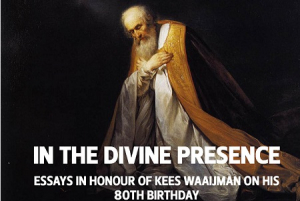
Festschrift in Honor of Kees Waaijman
2019 Constitutions Available in Portuguese
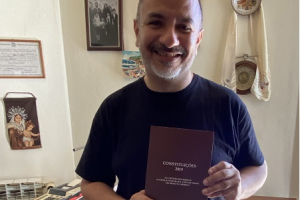
“It was with great joy that we received the 2019 Constitutions.”
After receiving the Italian language edition and the Spanish language edition, the Council of the General Commissariat of Portugal appointed a commission of three friars to create a translation and edition of the 2019 Constitutions in Portuguese.
In its meeting, the Commission opted to make the translation from the original text in the Italian language. After this work, the necessary corrections were made: standardization of criteria to be used in the text, notes, etc.
In order to minimally standardize the edition, we asked the Curia to send us the IT support for the Italian and Spanish editions. We had a very quick positive response, which we appreciated.
Then it was just a matter of placing the text and formatting it according to the criteria previously agreed upon by us and printing it in a printing company we trust with whom we usually work. The format of the Portuguese edition is exactly the same as the Italian and Spanish editions.
We therefore have a copy available for friars who speak Portuguese as an official language.
Requests can be made to: Esta dirección de correo electrónico está siendo protegida contra los robots de spam. Necesita tener JavaScript habilitado para poder verlo. (the General Commissioner of Portugal).
2019 Constituições Disponíveis em português
Foi com muita alegria que recebemos as Constituições 2019.
Depois de termos recebido a Edição em língua Italiana e a Edição em língua Espanhola, o Conselho Do Comissariado Geral de Portugal nomeou uma comissão de três frades para tratar da tradução e edição das Constituições 2019 em língua Portuguesa.
Reunida, a Comissão optou por fazer a tradução a partir do texto original em língua Italiana. Terminado este trabalho fizeram-se as devidas correcções: uniformização de critérios a usar no texto, notas, etc.
No sentido de uniformizar minimamente a edição, pedimos à Cúria que nos enviassem o suporte informático das edições Italiana e Espanhola. Tivemos uma resposta positiva, muito rápida, que agradecemos.
Depois foi só colocar o texto e formatá-lo conforme os critérios previamente por nós acordados e imprimi-lo numa gráfica da nossa confiança com quem habitualmente trabalhamos. O formato da edição Portuguesa é exactamente igual ao das edições Italiana e Espanhola.
Temos assim um trabalho disponível para os frades de língua oficial Portuguesa. Os pedidos podem ser feitos para o Comissário Geral de Portugal: Esta dirección de correo electrónico está siendo protegida contra los robots de spam. Necesita tener JavaScript habilitado para poder verlo.
Donum Dei Aggregated to Order
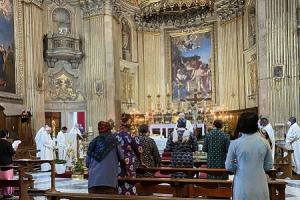
Donum Dei Becomes Society of Apostolic Life and Aggregated to the Order
As of December 8, 2020, Travailleuses Missionaire de l'Immaculée (TMI) – popularly known as Donum Dei – have had a new canonical status which has now resulted in them formally being erected as a Society of Apostolic Life under the Diocese of Marseilles in France.
This has been a long journey which goes back to 2014, when work began on studying and discussing the steps to be taken to find a new canonical form for what was then called the Famille Missionnaire Donum Dei (FMDD). After several consultations with the Dicastery for Institutes of Consecrated Life and Societies of Apostolic Life (DIVCSVA), the General Curia, the leadership of FMDD, and the French Bishops, with the decree of 10 July 2015, Fr. Michael Farrugia, O. Carm., the procurator general, was appointed as apostolic visitor and head of the visitation in collaboration with other visitors.
During the apostolic visitation, carried out together with three other persons, there were many meetings with the bishops and with all the members of the FMDD, residing in different parts of the world.
After considering the report of the visitators, on February 9, 2017, the DIVCSVA appointed Fr Farrugia and Ms Françoise Laplane of the Institut Notre-Dame-de Vie as apostolic assistants. Their task was to accompany the Travailleuses Missionaire de l'Immaculée in order to identify a new canonical form of consecrated life with which they would continue to be present within the Church.
In the course of this accompaniment, work had to be done on a new text of the Constitutions, with a view to adopting a new form of consecrated life: that of a Society of Apostolic Life. In agreement with the DIVCSVA, other religious, resident in France, experts in this form of consecrated life, were appointed to provide adequate assistance in the course of the work, which required several stages and many meetings.
In this context, it should be emphasised that throughout the process fraternal collaboration was received both from the General Council of TMI and the Commission appointed specifically to draft the text of the Constitutions, as well as from all the members of the Travailleuses Missionaire de l'Immaculée.
Following the drafting of the Constitutions, the Constitutive Chapter presided over by the apostolic assistants was held from January 12-27, 2019 in Grace Dieu, France. During this Chapter, the text of the Constitutions, later presented to the DIVCSVA, was approved, and the new government of the new Society of Apostolic Life was elected. On the last day, the Archbishop of Marseilles, France, was present. Following the indication of DIVCSVA, the Donum Dei Society of Apostolic Life, named Travailleuses Missionaire de l'Immaculée, will for the first years be a Society of diocesan right under the jurisdiction of the Archbishop of Marseille. On 8 December 2020, there was the decree of erection as a Society of Apostolic Life by the Archbishop of Marseille.
In response to their request, the Donum Dei Society of Apostolic Life, was then aggregated to the Carmelite Order on 21st June 2021.
Unfortunately, the Covid-19 pandemic prevented any possibility of celebrating their new status and affiliation to the Carmelite Family. However, on 29th May 2022, the prior general, along with all the members of the General Council and Curia present in Rome at that time, celebrated Sunday Eucharist together with the members of Donum Dei in the Basilica di Sant Eustachio in Campo Marzio (Rome) to mark both their new canonical status and their affiliation to the Carmelite Family. Afterwards, everyone went to the nearby restaurant of Donum Dei, L'Eau Vive, for a celebratory lunch.
Celebrating At Home - 15th Sunday in Ordinary Time

Towards a love beyond labels
(Luke 10:25-37)
Pope Francis says society creates “an adjective culture” that prefers to immediately label people as good or bad. Jesus, he says, breaks the mentality that separates, excludes, isolates and belittles the person.
A good example of what the pope says is found in the parable in today’s Gospel. The very fact that we know the story as, ‘The Good Samaritan’ seems to imply that he is the exception, that most Samaritans are ‘bad’. That’s certainly how Jesus’ audience would have viewed Samaritans.
Ideas of hospitality, welcoming the stranger and caring for those in need held a very high place in Jewish scriptures, spirituality and practice. The practise of these virtues was long recognised as responding to the Word (God’s Law) placed in the believer’s heart.
That is, acting after God’s own heart.
Asking who is my neighbour (who is ’in’ or ‘out’) is the wrong question according to Jesus. Rather, one should ask, “How should a member of God’s chosen people act?” In the parable it is not a member of the Chosen People who acts after God’s heart, but an outsider, a Samaritan. It is he who shows how a member of God’s people should act towards those in need. He does not
ask, “Who is my neighbour”; he shows himself to be a neighbour and a person after God’s own heart by the lavish way he helps the man in need.
This is ‘loving with all one’s heart’. Can we go and do the same?
This encounter of mercy
between a Samaritan and a Jew
is highly provocative;
it leaves no room for ideological
manipulation
and challenges us to expand
our frontiers.
Fratelli tutti n. 83
- Celebrating At Home - pdf 15th Sunday in Ordinary Time [PDF](3.99 MB)
- Celebrating At Home - default 15th Sunday in Ordinary Time [ePub](2.43 MB)
- Celebrando en Familia - pdf 15 Domingo del Tiempo Ordinario(573 KB)
- Celebrando in Casa - pdf XV Domenica del Tempo Ordinario(572 KB)
Memorial of Bl. Jane Scopelli, Virgin
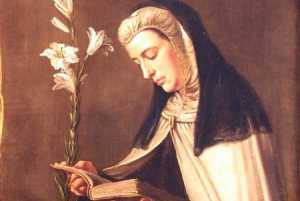
From the Ashes, New Flames
By the second half of the 18th century, religious life had been hollowed out by the continual interference of Catholic monarchs in the Order’s internal affairs. Joachim Smet, in his monumental history of the Order, writes “the frontal attack of the French Revolution, Napoleon, and the liberal governments left only ruins.”
He continues “The enemies of the Church failed to realize that they were robbing religious not only of their material possessions but also that pearl of great price for which they had sole their all: a life of intimacy with God in prayer in the goodly company of brothers. The destruction of their life of prayer in community was the severest deprivation religious suffered. Also, by being unjustly deprived of their right to exist as corporate bodies, religious could no longer live the life of evangelical poverty to which they were committed in conscience by the most solemn promises.”
The secretary of the Congregation of the State of Religious Orders, in a preliminary report to Pope Pius IX (1847) painted a dark picture of the state to which religious life had been reduced. Yet for the Carmelite Order, now on the point of extinction, this period saw an increasing number of its members being recognized by the Church as “blesseds.” In addition to Jane Scopelli, the 15th century Carmelite nun, in 1771, the Church honored Angelus Augustine Mazzinghi (1761), Aloysius Rabata (1841), Avertanus and Romaeus (1842), Louis Morbioli (1843), Jacobinus (1845), Frances d’Amboise (1863), Archangela Girlani (1864), John Soreth (1866), and Baptist of Mantua (1885).
Read more about Blessed Jane Scopelli here
Encountering Titus as a Young Journalism Student
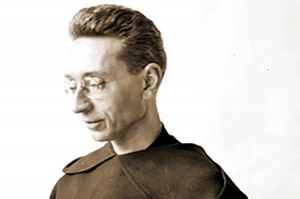
A reflection by Bill Bayci
As a junior high student at the Cathedral of St. Raymond’s in Joliet, Illinois I was given the opportunity to attend a journalism class at Joliet Catholic High School, run by the Carmelites. I jumped at the chance. It was titled the “Titus Brandsma Journalism Class.”
As an eighth grader. I had no idea who Titus Brandsma was. I would soon find out. Our instructor, Father Kevin Shanley, O. Carm., made Titus’ life story required reading. It was a compelling read. I was struck by how one man dared to stand up to the Nazis, their ideology and their inhumane treatment of those who stood in their way.
Most impressive to me, was the fact that those persecuted shared little in common with Titus other than their humanity. He needed no other reason to stand up for them, those without a voice. Given multiple opportunities to walk away, he chose to stand by his beliefs.
Father Kevin focused our attention to Titus the journalist. Even while founding the Catholic University of Nijmegen, he still edited a newspaper. He championed freedom of the press and freedom of educational well before the start of World War II. He hailed his heroic efforts to bring a letter, written of his urging, from the Council of Bishops of Holland to the editors of 17 Catholic publications. It detailed how they were to deny the Nazi efforts to add content to and censor their publications. These letters were hand delivered by Titus.
His continued ministry while imprisoned in Dachau has been well documented, as have his mistreatment and murder. His life and death as a martyr for the freedom of the press led to his beatification and canonization.
All of the above are well documented facts but what impact did this have on me? What impact should this have on all of us.
Personally, I witness daily those in need, the homeless, the hungry, those battling substance abuse and personal demons, they too need a voice. I have found numerous agencies in my area to work with such as Habitat for Humanity and the Northern Illinois Foodbank. I hope to provide a voice for my neighbors in need. I do not pretend to have the personal courage of Titus; I am not sure if I have the conviction of faith to give my life for a cause. That does not mean that, inspired by Titus and others, I cannot make a difference in the lives of others. The impact may not be as significant, the results as momentous, but nonetheless an impact.
All of us can benefit from the inspiration of Titus, whether it be in our community, nationally or internationally, life presents us with limitless opportunities to follow his lead.
This leads us to the legacy of Titus. We need to tell his story to our children. We live in a world where the truth can, at times, seem elusive. Our young students would be well served hearing the story of one man. Committed to the truth, compelled to share that truth and show the conviction of his principles.
The lesson of the true costs of freedom and what one man was willing to sacrifice need to be shared with future generations. If not for Father Kevin, I can truthfully say that I would know little of Titus’ legacy. His veneration to sainthood would have gone almost unnoticed. All in spite of receiving my high school education at a Carmelite high school.
While we have all read of the heroic efforts of soldiers on D Day and at the Battle of the Bulge, little time is spent passing along the narrative of lives such as Titus. It was no less heroic than the afore mentioned. He also provides an example of how all us can and should resist crimes against humanity. He provides a wonderful narrative of a human being who was willing to fight for those who shared neither a common faith, ethnic origin or national roots. Most Importantly, they shared humanity and needed to be protected and their story needed to be heard.
If we hope to find a Titus in among us, his story needs to be told, unedited. It is easy to ignore crimes against humanity when we are not personally affected. History, specifically Titus’ story, shows us this is not a good idea.
As we celebrate the legacy of Titus at occasion of his canonization, there is no better way to do so than by telling his story.
Zelo zelatus sum pro domino deo exercituum.
Bill Bayci
“Joliet Catholic High School - Class of 1974"
Training Course on Current Archives
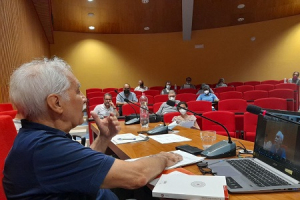
From June 30 to July 2, 2022, a course for archivists and secretaries was held at the auditorium of the Marianum Pontifical Theological Faculty entitled "The Current Archives of a Religious Institute." The course, provided by the Servite Historical Institute (OSM), with the collaboration of the Institutum Carmelitanum, was organized and directed by both the OSM and OCARM General Archives.
Initially the course was designed for members of the OSM and OCARM religious families. It was later opened to all and number of participants, in person and online, surpassed 100.
The course was conducted in Italian and was structured with both theoretical and practical components. The introduction to archives and documents was covered by Amalraj Arockiasamy, osm. Simona Serci presented the history of archives and the example of the archives of the Carmelites while Odir J. Dias provided the example of the Servants of Mary archives. Mario Alfarano, O. Carm., described the life of the archive in its articulations, while Alessandro Decupis spoke on Archiveconomics and Alessandro Alfier on the electronic document and archive. Finally, Emanuele Atzori presented some basic tools of the current archives such as the titular, protocol, preservation plan and a management manual.
It is hoped to continue providing such courses to assist and promote collaboration with those working in the archives of the religious institutes.