





O.Carm
Condolence Letter for the Four Carmelite Nuns
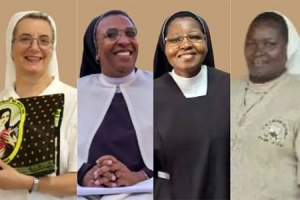
Letter of Condolences and Support Sent to Santa Marinella Sisters from General Chapter
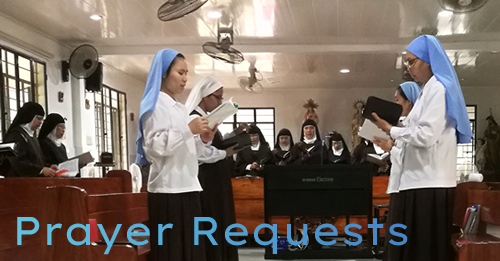
Four sisters from the Congregation of Carmelite Missionary Sisters of St. Thérèse of the Child Jesus (Congregazione Suore Carmelitane Missionarie di S. Teresa del Bambino Gesù) and their driver were tragically killed in an automobile accident in Tanzania. A fifth sister remains in very serious condition in the hospital.
More details have become available. The sisters were on their way to the airport for a flight to Dar es Salaam. They had participated in the perpetual profession of three sisters on Saturday and visited the local bishop on Sunday morning. The accident occured around 11PM in Mwanza, Tanzania.
The deceased are Sr. Lilian Gladson Kapongo, general superior of the Congregation; Sr. Maria Nerina De Simone, a general councilor and the general secretary; Sr. Damaris Matheka, provincial councilor for the Province of East Africa; Sr. Stellamaris Muthini; and their driver, Mr. Boniphace Msonola. Sr. Paulina Crisante Mipata is in hospital and is in serious condition.
We remember the sisters, their families, their co-workers and the Sisters of the Congregation in prayer during this time.
pdf Read the letter of the General Chapter to the Congregation(358 KB)
After Celebrating Culture on Sunday, Work Resumes
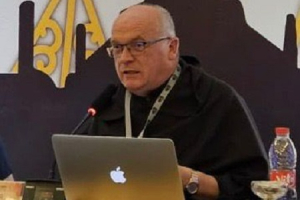
Sunday Day Off Becomes a Celebration of Culture. Monday Is Back to Work Completing the Reports to the General Chapter
Sunday was officially a day off, but the members of the Indonesian Province offered a tour of sites around the city and a show by the Carmelite students and representatives of the school. Included in the tour was the Cathedral of Malang. The diocese has had only Carmelite bishops since its establishment as a Apostolic Prefecture in 1927. There was also a visit to Masjid Jamik, the oldest mosque in Malang. It is located in the heart of Malang which is almost 90% Muslim. Not far away is Sacred Heart Catholic church, originally built by the Jesuits but turned over to the Carmelites in 1923. The complex is the site of the original Carmelite provincial office which is being restored to once again house the offices. The group then traveled to Karmel Paranti Jati Prayer Garden and Kolumbarium. This site also contains two residences with one Carmelite community as well as the Padmawlyata Museum, a prayer garden, and the chapel with the tomb of Bishop F.X. Hadisumarta, former bishop of Malang and Sorong and the ashes of many of the Carmelites who served in the province.
The Padmawlyata Museum has displays of items from the early days of the Indonesian missions and a story board explaining the history of the Carmelite in Indonesia.
In the afternoon, students from St. Albert’s Carmelite High School welcomed the Chapter members with a Balinese dance. Later the Carmelite students presented a Balinese meditative dance inspired by the ancient Indian epic of Ramayana. (A separate CITOC article will cover this beautiful welcome.) The day finished with a festive meal at the Batavia Reso, a vintage restaurant which serves traditional Javanese food.
A few Chapter members left the Chapter site early to celebrate Mass at the House of Mercy for abandoned elderly. Afterwards, they visited the hospice for the poor in Gempol operated by the Indonesian NGO before meeting up with the other Chapter members for lunch.
On Monday morning, the Chapter members reunited for Morning Prayer and Mass in the Chapel, followed by four more reports, including that of the International Formation Commission, the General Commission for the Coordination of New Foundations, the Delegate for the Affiliated Congregations, and the General Delegate for the Nuns. The reports were completed by prior of CISA, the student house in the city of Rome.
International Formation Commission
First up to report was the Vice Prior General, Benny Phang Khong Wing, who has responsibility for formation. The International Formation Commission highlighted formation as a lifelong process, “a continual process of conversion of heart and spiritual transformation, love being the driving force.” It should be done within the Carmelite tradition and grounded in the socio-anthropological-cultural context were the persons live.
The report has three parts: an evaluation of the six-year plan, the programs held, and the future and concerns to be addressed. With regards to the six-year plan, the only part not achieved was to introduce the idea of a General Delegate for Formation. Two people were appointed but neither worked out.
As of June 2025, there were 150 pre-novices, 100 novices, 322 simply professed, and 234 solemnly professed with the last five years. While the total number of young Carmelites is 796, Asia-Oceania counts 387 of them. The Order as a whole has 2038 members.
Among the activities of the Formation Commission were: an international program on how to engage Generation Z; a course for new provincials; a course on St. Titus Brandsma in the Netherlands and Germany; a formators gathering dedicated to the revision of the RIVC; and the revision and updating of the RIVC 2013. Benny was also invited to give a talk at FOCAM in 2021 and 2023. He was also invited to speak in Vietnam at the Asia-Oceania student and formator gathering.
The Commission is encouraged by the presence of young Carmelites and good vocations. It is also hopeful that there are dedicated your formators. The Constitutions of 2019 call for community-based formation—so that the formation is based on real life rather than on theory. Those in formation experience and follow the Carmelite lifestyle witnessed by the older, solemnly professed brothers living in community. There is also concern that the life as lived in the formation houses starkly contrasts with how life in lived in the non-formation communities. There is also concern about the family no longer providing strong faith formation, much less the idea of a religious vocation. So there is a tremendous need to evangelize the family as a way of promoting religious vocations to the youth. There is also a call to form the students as being brothers—fratres—brothers who can assume the different roles necessary for a good community life. There is also a need for formation to stress one belongs to the Order and not to a province or country or house. Now it is essential that one learn one of the three official languages of the Order.
International Community of CISA
Saint Albert International Center in Rome “is an expression of the unity of the whole Order.” All Carmelites living there are appointed by the General Council and are under the jurisdiction of the Prior General. In 2021, several changes were made, especially regarding the length of time and conditions for admission to the CISA community.
CISA government is a prior, vice prior, bursar, and regens studiorum. Tadeusz Popiela, of the Polish province, is the current prior and delivered the report to the Chapter. Also residing at CISA are the president and secretary of the Institutum Carmelitanum, the General Archivist, the Archivist of the General Curia, and the Librarian. These members are considered the “stable” community. The community also includes students from different provinces and geographical areas of the Order. Since 2019, the number of students in the community has been between 6 and 16.
Studies completed include theology (4), biblical studies (2), philosophy (1), psychology (1), formation (1). In progress are theology (3), biblical studies (2) and liturgy (1).
Various activities took place between 2019-2025 including the Carmelite School, a formation course in September for new members to the community but open to other members of the Carmelite Family in Rome; members doing formation courses for novices in Salamance; various retreats to religious communities in Rome; pastoral work in the area; and language courses in locations around Europe.
CISA hosts many meetings and provides accommodations for scholars using the Carmelite library or archives. It is estimated that the community has welcomed around 2,000 people during the sexennium.
A number of renovations have taken place or are currently taking place including restoration of bedrooms and bathrooms; new furniture in the kitchen, laudry room, and bursar’s office; renovation of the air conditioning and heating systems as well as an upgrade to the electrical system, separating it and the water and gas from the hotel portion of the building.
General Commission for the Coordination of New Foundations
This International Commission was created by the 2019 General Chapter for the purpose of maintaining a close relationship between the General Council and the superiors responsible for the new foundations. The main objective was to study the new presences (less than twenty-five years old), evaluating the resources and real needs of each.
During the six-year period, four meetings were held, all in early 2021. Luis Maza, the chair of the commission, summarized the Commissions work into four areas. A study project was elaborated to show where areas of collaboration between the Order and the new foundations could take place. However, a survey sent to the new foundations received only three responses. Finally, criteria were drawn up for possible financial aid to the missions.
As addressed in the Bursar General’s report earlier, a fund has been established to assist in the Order’s development and formation.
General Delegate for the Affiliated Congregations
Luis Maza also worked with the Congregations and Institutes affiliated to the Order. Currently there are 15 women’s and 1 men’s congregations present in 46 countries. Their presence contributes significantly to the richness of our family. They work in a variety of ministries including missions, schools, spirituality houses, nursing homes, and vicarages.
Many of these religious men and women belong to Congregations that are in the existential and geographical peripheries, where they are dedicated to evangelization and social justice.
The Delegate General was involved in various activities: the centenary of the Carmelite Sisters of the Sacred Heart, the centenary of the Carmelite Sisters of Mother Candelaria, the bicentenary of the birth of Blessed Maria Teresa Scrilli, as well as some events with the Carmelite Missionary Sisters of St. Teresa of the Child Jesus. During visits to America and India, he also visited some of the sisters. In May 2023, the sexennial meeting of the Superiors General was held in Rome. Twenty religious men and women participated.
The members of the Curia have maintained a friendly relationship with the members of the affiliated congregations. The Order has provided some assistance in the area of Canon Law as well as participation in some General Chapters.
Having completed the reports from the various geographica areas and international commissions of the Order as well as from the directors offices under the General Curia, the General Chapter now moves to another phase. On Monday afternoon, two sessions with members in language groups for one, discussed the Instrumentum laboris.
On Tuesday and Wednesdays, the days were dedicated to outside presenters. On Tuesday was Sr. Patricia Murry, IBVM, speaking on Today’s Social and Eccledial Context. On Wednesday, Carmelite bishop and former member of the General Council, Wilmar Santin, spoke on Carmelite Missions “Ad Gentes.”
St. Albert of Jerusalem, bishop and lawgiver
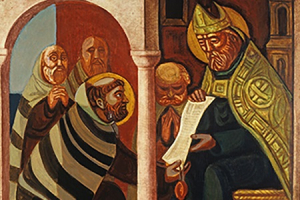
September 17 | Feast
In 1205, Albert was appointed Patriarch of Jerusalem and a little later nominated Papal Legate for the ecclesiastical province of Jerusalem. He arrived in Palestine early in 1206 and lived in Acre because, at that time, Jerusalem was occupied by the Saracens.
At some point between 1206 and 1214, Albert was approached by the hermits gathered on Mount Carmel, "near the font of Elijah," and asked to set down their way of life in the form of a Rule. Albert's formula vitae (way of life), a relatively short document, encouraged the daily practices of the hermits in order to "follow Christ."
During his time in Palestine, Albert was also involved in various peace initiatives, not only among Christians but also between the Christians and non-Christians and he carried out his duties with great energy and dedication. On 14th September 1214, during a relgious procession, he was stabbed to death.
A list of books available from Edizioni Carmelitane on St. Albert and the Carmelite Rule are listed at the bottom of this paragraph.
Read more about the life of St. Albert ...
Read about the Carmelite Rule | Text of the Rule ...
Books Published by Edizioni Carmelitane on St. Albert of Jerusalem:
Celebrating St. Albert and His Rule. Rules, Devotion, Orthodoxy and Dissent
Edited by Michelle Sauer and Kevin Alban, O. Carm.
The Bollandist Dossier on St. Albert of Jerusalem
Daniel Papenbroeck, SJ | Edited and translated by Patrick Mullins, O. Carm.
St. Albert of Jerusalem and the Roots of Carmelite Spirituality
Patrick Mullins, O. Carm.
The Life of St. Albert of Jerusalem. A Documentary Biography. Part 1
Patrick Mullins, O. Carm.
The Life of St. Albert of Jerusalem. A Documentary Biography. Part 2
Patrick Mullins, O. Carm.
Albert and His Rule
Michael Mulhall, O. Carm.
A Pattern for Life. The Rule of St. Albert and the Carmelite Laity
Patrick Thomas McMahon, O. Carm.
The Carmelite Rule. Proceedings of the Lisieux Conference. 4-7 July 2005
Various Authors
International Commission and Curia Office Reports
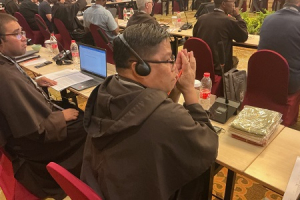
Reports from International Commissions and Curia Offices Become the Focus of the General Chapter
The General Chapter turned its attention to the work of the offices in the General Curia and the International Commissions on Friday and Saturday. This includes reports from the Bursar General, the Procurator General, the International Commission for Safeguarding, the International Justice, Peace and the Integrity of Creation Commission, the International Commission for Liturgy and Prayer, the General Secretariat for Carmelite Laity, the International Commission for Youth. Saturday afternoon saw reports from the Office of the Postulator General, and the Order’s Communications Office, the Institutum Carmelitanum, and the International Commission for Communications.
The Chapter then adjourned to the chapel for Evening Prayer, followed by dinner. Sunday was a free day. An optional trip to various parts of Malang in the afternoon and evening was offered. It will be the subject of a future update.
All of these reports will be published in Analecta (2025) #2 by Edizioni Carmelitane.
Bursar General and Finance Commission
Friday began with a report on the financial condition of the Order. The Bursar General, Christian Körner, outlined the work of the General Finance Commission which meets each year and explained the work of his office. He also spoke about the November 2024 bursars meeting in Fatima and the revisions to the Order’s Economic Directory. Issues regarding the former Domus and CISA, the Institutum and Order’s archives were explained. Grants from the General Curia to the Order’s mission areas were also explained. The Society of the Little Flower (UK and Ireland) no longer accepts donations and is in the process of being completely closed. A central fund was established in September 2022 for development and formation using only the interest earned by the fund. The fund for the nuns, created by the General Council in 2008, has allowed the Order to respond to requests of various monasteries around the world. Fr. Christian concluded by outlining what some of the challenges in the months and years ahead. Members of the General Chapter then had the opportunity to react to the report or raise other issues.
Procurator General
The financial presentation was followed by that of the Procurator General, Michael Farrugia. This was done over two sessions. The first presentation referenced the work of the procurator’s office in general. He highlighted that some changes have been made to adapt Canon Law to new challenges and situations arising in the life of the Church. Consequently, the Order’s Constitutions must be updated as well to reflect these changes.
His final area dealt with liturgical texts and the approval of the Order’s own calendar. However, other requests (such as, the elevation of the celebration of St. Titus Brandsma to feast) and liturgical texts remain in process at the appropriate dicastery. The procurator general also participated in several provincial and general Chapters of the Carmelite sisters and helped revise the texts of the Constitutions.
International Commission of Safeguarding
The next session, also led by the Procurator General, was dedicated to the work of the International Commission of Safeguarding. Since its establishment, the Commission worked to prepare a manual, subsequently approved by the General Council, that each province will be expected to implement. The members of the General Chapter expressed thanks for this important work being finalized.
In recent years, the Order, the General Curia, and the International Commission for Safeguarding have made an effective and targeted commitment to ensure that every abuse or mistreatment of minors or vulnerable persons is prosecuted in accordance with the law.
The reform of the Dicasteries by Pope Francis in 2022 simplified the governing structures but is constantly evolving. Michael then reviewed the documents of the Holy See from October 2019 through September 2025 which are closely related to the life and mission of Order. He also reviewed new canons in the 1983 CIC regarding the life of the Order’s members and topics dealt with within the Order.
International Commission of Justice, Peace, and the Integrity of Creation
Saturday also held a full day of presentations to the Chapter members. The morning started with a report on the International Commission of Justice, Peace, and the Integrity of Creation by Conrad Mutizamhepo, General Councilor for Africa, who heads the commission.
The overarching goals for the six-year period included: promotion fo the personal and communal encounter and relationship with the Lord; promotion of the formation, development, and animation of Carmelite JPIC structures; planning and international Carmelite Family JPIC Conference to share experiences on working in JPIC ministries as well as exploring ways to implement the document From Contemplation to Action. It was hoped that accessibility to the document would help to deepen reflection and discussion of JPIC issues within affiliated congregations, provinces, and regions.
The Commission failed to realize greater collaboration with the Carmelite NGO and setting up a JPIC blog on topical issues as it hoped to do. Technical difficulties stopped an online survey of Carmelites working in JPIC ministry in provinces, commissariats and institutes affiliated to the Order. The JPIC Conference, scheduled to take place in July 2024 in Fatima had to be cancelled because the enrollment fell short of the number necessary for the event to be viable.
However, the Commission was able to offer webinar presentations on four well researched topics with time for questions and discussions.
A weakness is that JPIC ministries in geographical regions are generally not networked or well-coordinated. JPIC ministerial activities are often erroneously associated with political party activism. Conrad concluded, “The ball is in our court as an Order to revive this prophetic dimension (of Elijah) of our charismatic identity by incorporating justice, peace, and integrity of creation according to the ecclesiastical and Carmelite traditions in the formation program.
The Commission’s report ends with four recommendations and the statement that JPIC ministry is not a peripheral ministry for Carmelites. The values of JPIC are constitutive values of the Kingdom of God as well as part and parcel of the Carmelite prophetic heritage and charismatic heritage.
The time following the report was short, but a number of observations were made by the members regarding the work of JPIC throughout the Order.
International Commission of Liturgy and Prayer
The report of the International Commission of Liturgy and Prayer followed, presented by its chair, Richard Byrne. The General Council approved to continue updating the liturgical rites and books of the Order. The Council also approved preparing additional materials from Carmelite authors for the Carmelite Office of Readings for the BVM on Saturday and other days with particular devotion to Our Lady of Mount Carmel. There was also to be a collaborative project with the Formation Commission regarding the liturgical preparation of students in formation, liturgical studies as part of ongoing formation, and the promotion of good preaching. There was to be promotion of ways of celebrating the liturgy from a Carmelite perspective, to foster the shrines of the Order at an Order level, and congresses and meetings organized that foster the liturgical and prayer life of the members of the Carmelite Family.
Noting low numbers of young Carmelites studying liturgy, it was decided one scholar from each of the four geographical areas would be selected to earn a doctorate in liturgy. Liturgy is now one of four areas of postgraduate study the Curia will fund.
A document on the ministry of Carmelite shrines was developed. The document offered some ideas as a way of giving guidance to the renewal of shrines within the Order.
A liturgical conference was held in May 2025 with an emphasis on the pastoral and lived dimension of our liturgical and prayer lives. The overall theme was Encountering the Risen Lord: Liturgy and Prayer in Carmel Today. Eighty people attended the Congress.
Richard then reviewed the status of the various liturgical texts, including the Rite of Profession, the Third Order Ritual, the Office of Readings/Saturday Memoria of Our Lady, and the texts for the Spanish martyrs, Blesseds Angelus and Luke, and the celebration of St. Titus Brandsma being raised to a Memorial for the whole Order. It will be a Feast in those provinces where Titus is the patron. There continue to be difficulties in getting the Proprium Missarum and Liturgia Horarum to completion.
International Secretariat for Carmelite Laity
Following a break, Luis Maza, a member of the General Council, presented on the work of the General Secretariat for Carmelite Laity. At the beginning of the six-year period, an International Secretariat for the Laity was set up. All meetings were held online. Two training meetings were organized over zoom in Spanish and Portuguese for the TOC leaders.
The Secretariat prepared the 4th International Congress of the Carmelite Laity in September 2024. The Congress was based on four fundamental areas: formation, service, fraternity, and prayer. These themes were developed in lectures and workshops that encourages reflection and dialogue. Two hundred Carmelites from 30 countries participated.
A General Assembly of Carmelite Tertiaries was held in Fatima from February 25-March 2, 2025. The assembly aimed to enhance the identity and unity of the Carmelite Family through better communications, collaboration, and formation. The Assembly recognized the vital role of lay people witnessing as inspiring the transformation of secular society.
Because of references in the TOC rule to parts of the Constitutions that no longer exist, the rule needs to be revised. Among the areas suggested for further regulation are tertiary priests, use of the traditional habit or scapular, formation, admission, discernment time, and profession.
A key outcome of the Assembly was the creation of a provisional (2025-2027) International Council (Task Force) charged with drafting rules of procedures for governance of the TOC and preparing future assemblies.
Partial statistics indicate that there are 16,482 Solemn Tertiaries; 3,003 Temporary Tertiaries; 1463 in formation; and 542 communities.
International Commission for Youth
General Councilor Robert Puthussery reviewed the work of the Carmelite Youth during the last six-year period. Recognizing the significance of youth engagement, the 2019 General Chapter mandated the creation of an International Commission for Youth to explore new methods and contemporary approaches for involving young people in the life of the Church and the Order. Seven key action areas were identified by the Commission to be worked on: an in-depth study of Christus vivat; assistance with organizing Carmelite events at World Youth Day; strengthening geographical area youth ministry through regional commissions; developing and delivering online formation content; organizing Carmelite Youth Days within geographical areas; promoting communication between regional youth commissions; and establishing and supporting a network of Carmelite schools.
Robert then reported on the activities of the Asia-Australia-Oceania Youth Commission. He later gave a random overview of youth ministry across the Order. He also spoke about the Carmelite Day during the World Youth Day 2023 in Lisbon. He concluded with some thoughts on challenges of the commission including personnel, structural integration, financial, and transitioning from occasional to integrated ministry.
Postulator General
Following lunch and a pause, the Postulator General, Giovanna Brizi, gave updates on the various current and future causes her office is dealing with as well as other activities her office participated in during the last six years. She made her report via zoom from Rome.
She began with the 70-year process that culminated on May 15, 2022, with the canonization of St. Titus Brandsma by Pope Francis. There are currently seven causes for individual Blesseds to be canonized, as well as groups of martyrs of the Spanish Civil War. Four causes, all women, are at the Venerable stage. Fifteen cases are at the Servant of God level. The postulator then reported eight cases in the diocesan phase. There are three cases to be opened soon and eight cases under study. Three cases have been suspended.
Communications Office of the Order
This was followed immediately by a report from William J. Harry, the director of the Order’s Communications Office. He made an appeal that the Order take seriously its responsibility to create the most effective communications program throughout the Order to make the Carmelite charism, its spirituality and history, available not only to the Carmelite Family but to other seekers of ways to holiness. He reminded the Chapter members that the Order has made significant contributions to the life of the Church over the last 800 years in writings, art, and the model lives that many of the members live.
His report included a review of the work of the Task Force which established a single office of communications and redesigned the website. He highlighted the popularity of Lectio divina and the weekly reflection on the Sunday Gospel reading, originating from the Australia-Timor Leste province. Both are emailed to over 20,000 email addresses. CITOC-online emails average 186 messages per year although the CITOC-online Updates include 3-5 news items per mailing. Twitter and Facebook are also utilized for CITOC messages.
A considerable percentage of the work in Communications is actually spent working with the authors and printing houses on publishing new books. Because of the business model for Edizioni Carmelitane established at an earlier Chapter, considerable time and expense is spent mailing the books to the communities. The value in investing this amount of time and expense is that all members of the Order will have these resources available to them in their own communities. Various proposals to improve this model will be proposed to this Chapter by the International Communications Commission.
Since the change from the previous Edizioni Carmelitane website to a Shopify store, book sales have increase significantly. Between July 1, 2024 and January 2025, there was a 183% increase in customers. As of July 1, 2025, the clients increased to 594 or a 225% increase. No longer is a company other than Edizioni receiving 50% of the profit. All profit comes directly to Edizioni. In addition, we now know who our customers are and their purchasing patterns. We can direct market them. In 2015, Edizioni sold €12.799,90 worth of books to non-Carmelite communities. In the year July 1, 2024 – June 30, 2025, gross sales was €50.848,63.
William outlined a number of other initiatives that have been undertaken during the last six years to improve Edizioni’s name recognition and presence in various markets. Some have been sucessful. Some have not.
The director also reported on the three-part meeting held in January 2025 with communications directors from around the Order. This included a professional development component of three days at Santa Croce University in Rome, a celebration of journalism as part of the 2025 Jubilee, and a zoom call with those around the world who could not be present in Rome to discuss steps the Order as a whole should take to make its communications program more effective. A follow-up online meeting was held by request of those attending.
Reform of the Institutum Carmelitanum
In 2019 the General Chapter voted to reform the Institutum Carmelitanum, A committee was appointed and two years later they presented the text of the revised Norms to the General Council for review and approval. As a result, the Carmelite Library and the General Library of CISA were merged to become the Carmelite General Library. The reform makes explicit the type of interdisciplinary research, collaboration with other research bodies and scholars, the link between research and pastoral activity and between research and formation. A dozen areas were emphasized.
During the presentation, the new leadership of the Institutum Carmelitanum, the archives, and the library were introduced, although one is not a member of the Chapter and was absent.
International Communications Commission
The report from the International Communications Commission was given by its chair, Richard Byrne. He stated that the objective of the Order’s communications program is to communicate Christ’s Word through our Carmelite charism. It does this through both internal and external aspects. The General Council first established a Communications Task Force which functioned from 2019-2022. Twenty-five meetings were held online.
The Task Force proposed a single office of communication (which was accepted), that the online presence would extend beyond the news of the General Curia, the website would be reconfigured to enable people to learn about Carmelite spirituality and tradition as well as finding out about the Order. A single director was appointed and a lay man, Marco Pellitero was hired as Communications Assistant. Technical assistance for the website is outsourced. Bookkeeping for Edizioni is part of the General Bursar’s office.
A Communications Commission was appointed and has functioned until the current day. It has met 11 times, 7 times online. Primary among its work was the development of a communications plan with professional input from José Maria La Porte from Santa Croce University’s Department of Communications. During the Commission’s final meeting, a meeting was held with the Vatican Dicastery for Communications, including the prefect, Dr. Paolo Ruffini and Dr. Nataša Govekar, director for the Theological-Pastoral Department.
Finally, the Commission made some recommendations to change the current business model for Edizioni Carmelitane. That model, approved of by a previous chapter, calls for each house to receive a copy of each of its publications. This makes the resources available to all members of the Order where they live and helps pay for the expenses of the Communications Office. Four different models for distribution and four financing models were proposed for the Chapter’s consideration.
The report concluded that while much work had been done in the previous six years, challenges remain. Members of the General Chapter were reminded that we hold a precious treasure that is to be passed on, a treasure that brings light and hope.
The chapter members then celebrated Vespers in the chapel, followed by dinner.
On Monday, the Chapter finished listening to the reports of the various offices and commissions.
Celebrating At Home - 25th Sunday in Ordinary Time

Investing in the Future
(Luke 16:1-13)
When bad things happen to us we are apt to spend a great deal of time being angry at what has taken place – especially if we feel that what has happened is unjust, unfair or unreasonable.
Today’s Gospel episode is often called the ‘Parable of the Unjust Steward’. But perhaps he is the one who is being treated unjustly. After all, the Master hears a rumour that the steward has been ‘wasteful with his property’. Without conducting an investigation to find out if the rumour is true, the Master decides to dismiss the steward.
The steward spends only a little time trying to decide what he will do once he loses his job. Knowing he is too weak to dig and too ashamed to beg, he sets about altering the contracts of sale for his masters’ debtors.
Is the steward stealing from the Master? No. In the ancient world such stewards were not directly paid by the master. Their ‘wage’ came from the commissions they added to bills of sale. So the steward is giving up his commission for the sake of his long-term future; to build goodwill among the debtors that they might return the favour in the steward’s coming hour of need.
For astutely investing in his future the steward is praised by the Master. Jesus uses this allusion to advise the disciples that they, too, should invest in their future through the sharing of all that they have. The term mammon refers not only to money, but to all that a person has. The disciples, says Jesus, should be prepared to give away all that they have to the poor so that when the kingdom comes, in which the poor have the privileged places, the disciples will be welcomed into the ‘tents of eternity’.
The final sayings of this Gospel presuppose that Christian life is a stewardship in which the wealth that one handles is wealth God wishes the whole world to share, not one’s personal possession. Disciples must choose wisely and act decisively. When it comes to wealth, they must choose between the interests of God and their own self-interest.
If disciples do not share possessions, they will not be entrusted with the true riches of the kingdom. If they do share possessions, which are on loan from God, they will be given the treasure of heaven as their own. The disciples must give exclusive loyalty to God or succumb to the enslavement of mammon.
- pdf Celebrating At Home - 25th Sunday in Ordinary Time [PDF](2.88 MB)
- default Celebrating At Home - 25th Sunday in Ordinary Time [ePub](2.84 MB)
- pdf Celebrando en Familia - XXV Domingo del Tiempo Ordinario(503 KB)
- pdf Celebrando in Casa - XXV Domenica del Tempo Ordinario(496 KB)
- pdf Celebrando em família - XXV Domingo do Tempo Comum(503 KB)
Tragic Automobile Accident in Tanzania
Tragic Automobile Accident in Tanzania. Four Carmelite Sisters of Santa Marinella Killed
Four sisters from the Congregation of Carmelite Missionary Sisters of St. Thérèse of the Child Jesus (Congregazione Suore Carmelitane Missionarie di S. Teresa del Bambino Gesù) and their driver were tragically killed in an automobile accident in Tanzania. A fifth sister remains in very serious condition in the hospital.
The deceased are Sr. Lilian Gladson Kapongo, general superior of the Congregation; Sr. Maria Nerina De Simone, a general councilor and the general secretary; Sr. Damaris Matheka, provincial councilor for the Province of East Africa; Sr. Stellamaris Muthini; and their driver, Mr. Bonifasi. Sr. Paulina Crisante Mipata is in hospital and is in serious condition.
The members of the Carmelite General Chapter being held in Malang, Indonesia, received the news in the early morning hours of September 16th by email from Sr. Zelia da Conceiçao, vicar general. The sisters and the members of the Congregation, and the family of Mr. Bonifasi were remembered at the morning Eucharist.
As further information becomes available, we will let you know.
Councilors Report on Global Areas at General Chapter
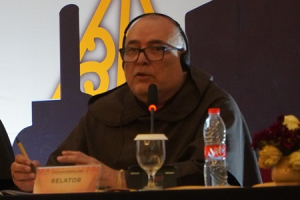
General Chapter Continues With Reports from General Councilors on the Four Geographical Areas of the Order
There is a strong fraternal part of a General Chapter during the daily celebration of Mass and the Liturgy of the Hours as well as during meals and casual gatherings following the evening meal. However, much time during a Chapter is spent in the Chapter Hall updating the members about the situations in each area of the Order, outlining the activities that have taken place during the last six years and highlighting areas of concern. CITOC highlighted the prior general’s talk during its September 10th update. We now turn to other reports.
The four General Councilors gave their reports on Wednesday and Thursday. Each presentation was followed by period for small group discussion and then a plenary session reporting on the small group discussions. The full report of each General Councilor will be published in Analecta (2025) #2 by Edizioni Carmelitane.
General Councilor for Europe
First to report was the General Councilor for Europe with its 15 entities divided into three regions. The Area’s six-year plan was to facilitate meetings of the vocations promoters, to continue the work of the Awakening Project and its ministry to young people, to establish an ad hoc Ongoing Formation Commission, to facilitate a process for preserving faithfully the charism of the Carmel in Europe, to explore and facilitate the unification of provinces, to organize and facilitate an annual meeting of the superiors of the area’s entities, and to research the possibilities for a common European student house for those in simple vows.
The annual meetings took place (two were online because of the covid pandemic), each with a distinct theme or topic. A committee developed an online program of formation, each meeting lasting for 90 minutes. The common student house has been a topic for about ten years. Three potential locations were selected but there was no consensus around any of the three.
A gathering and retreat of “young Carmelites” was held in the summer of 2024 in Nocera Umbra, Italy. Thirty-three Carmelites took part. Participants thought more such gatherings should take place. The Carmelite European Youth Committee (CEYC) held a gathering for the Jubilee of Youth in the summer of 2025. Approximately 240 young people and leaders took part and was in conjunction with Pope Leo’s prayer vigil at Tor Vergate and the Sunday Eucharist.
Several events connected with the canonization of St. Titus Brandsma were coordinated by the General Councilor for Europe and Benny Phang, the Vice General including Eucharistic celebration in churches around Rome before and after the canonization. Leaflets were created examining different aspects of Titus’s life and spirituality as well. For the Jubilee Year a series of leaflets on various Carmelite themes were also developed but can be used beyond the Jubilee Year.
Together with Christian Körner a Jubilee Year celebration for the two General Councils (OCARM and OCD) was organized. Finally, much information was also given about the activities of the various regions within the European area.
General Councilor for Africa
Conrad Mutizamhepo, General Councilor for Africa, spoke on the situation of the Order in his area, focusing on statistics, realities, challenges, and opportunities for the Carmelites. The Order is now present in six African countries, five being dependent on European provinces and one on a province in South America. Vocation discernment, formation, and ongoing formation are focuses of the area. While formation programs take place in each country, there is a common novitiates in English in Zimbabwe. The Final Message of African Leaders and Formators Conference in 2024 acknowledged some areas to be addressed in the formation program, including the publication of the Constitutions in French.
While there are some challenges to life in common, overall, the general approach to communal life is good. Priors are being trained to take a lead in developing stronger community life. Members are being offered periodic workshops on community dynamics and some practical issues that if dealt with properly could improve community life.
The Carmelites in Africa are serving in a wide variety of ministries, from twenty houses. Carmelites minister in twenty-two parishes. Carmelite houses are centers of prayer and spiritual accompaniment. An increasing number of lay people commence their day participating in Morning Prayer and Eucharist in some Carmelite communities.
Founding provinces have made large financial investments in Africa. These provinces have continued to bear the financial burden. So, along with the absence of missionary Carmelites, two of the major questions for the future concern leadership and the financial viability of entities. Of course, socio-political and economic instability is beyond the control of the individuals or the Order. Unfortunately, a dependency syndrome has developed in some places. It is felt that more reflection by the Carmelites in Africa is needed for healthy development to take place.
Carmel in Africa is young, vibrant, and hopeful. There are many opportunities for Carmel to live on her own resources from the fruits of her labors. But to counteract the dependency syndrome, African Carmel needs capacitation and fraternal accompaniment to enable her to grow the Carmelite charism and values as she grows numerically.
General Councilor for the Americas
The first report on Thursday, September 11, was dedicated to the General Councilor for the Americas, Luis Maza. Communities of Carmelites are present in 12 countries in the Americas. Each of these countries has its own challenges and difficulties. There has been an increase of vocations in Hispanic America and Brazil. While there is concern around the reduced number of vocations in Canada and the United States, there is great dedication to vocation ministry in the area.
There is an online formation program for the Portuguese and Spanish-speaking Carmelite Family, sometimes open to English speaking Carmelites. The long-established project of formation for formators of Latin America (FOCAL) has been changed to include the two North American provinces (FOCAM) and to include as well the nuns, religious, and lay people. FOCAM was held twice this six-year period. ALACAR (Latin American Carmelite Association), a joint project with the OCDs, was not held during this six-year period.
Considerable work has been done with the presence of Carmelite youth in the Americas (JUCAR). Many young people participated. Some participated in the World Youth Day in Lisbon and the Youth Jubilee in Rome. Other initiatives have been quite successful: 600 people participated in a July 4, 2021, online youth meeting. They shared their Carmelite experiences in a WhatsApp chat. Local efforts also result in week long missions, camps, retreats, formation presentations, charity work, virtual rosary prayers and discussions with young people which is called “A Coffee with Titus.”
A Mission was carried out for 10 days in the Prelature of Itaituba in March 2024. Carmelite bishop, Wilmar Santin, is the local bishop. The participants learned about the pastoral reality of the region and its many challenges. Besides Bishop Santin, the Sisters of the CDP and the CMSTMJ Congregations are present in the prelature.
Finally, Luis concluded by enumerating the meetings that took place in each of the years of the sexennium and highlighted the scheduled ALACAR meeting in October 2025 and the III FOCAM meeting in Camocin de São Felix, Brazil in September 2026.
General Councilor for Asia/Oceania/Australia (AAO)
The final report from the four geographical areas of the Order was given by Robert Puthussery, the General Councilor for Asia/Oceania/Australia. While it is one of the most vibrant and dynamic areas of the Order today, it is marked by immense cultural, religious, and linguistic diversity as well as the presence of the world’s major religions and a multitude of indigenous and traditional spiritualities.
There is an ever-growing number of young vocations testifying to a flourishing spiritual thirst and missionary zeal. In March 2025, there were five provinces, one general commissariat, and two provincial commissariats with a total of 793 members— 530 solemnly professed, 192 temporarily professed, and 71 novices.
The global plan for the Area called for canonical visitations; regular meetings of the regional superiors; encouraging members to develop expertise in Asian/Oriental spirituality; foster intra-geographical collaboration; organize area wide programs in initial and ongoing formation; explore and support forming international communities throughout the Order; promote initiatives to support young Carmelites in higher studies; and, collaborate with the JPIC Commission.
Some challenges were highlighted for reflection: approaches for accommodating and forming the increasing number of vocations; innovative strategies and methods to engage the younger generation in vocation ministry; cultivating “vocation-friendly communities.”
There are 47 formators in the Asia/Oceania/Australia area. While initial formation and the novitiate are seen as working well, there is growing concern that after first profession, the formation in Carmelite spirituality—both in terms of knowledge and lived experience—tends to become vague and diluted. To foster a deeper sense of internationality within the Order, there should be a concerted effort to encourage the learning of the three official languages of the Order from the earliest stages of formation. There is a recent decision to plan and implement a formators’ training program within this geographical area.
Principal among the major activities that took place during this sexennium is, perhaps, the erection of the Eastern Indonesian Province (Ordo Karmel Provinsi Indonesia Timur) on March 25, 2025. The province has 21 communities with 4 canonically erected houses. There are three formation houses. The province consists of 117 solemnly professed, 65 simply professed, 33 novices, and 60 postulancy candidates. Its territory included the ecclesiastical provinces of Makassar, Ende, Kupang, and Merauke.
To promote inter-geographical collaboration and to coordinate key initiatives, three commissions were established: the Commission for Formation; the Youth Commission; the Commission for Justice, Peace, and the Integrity of Creation (JPIC). Each commission met 4 times each year. A list of the activities of each commission was outlined.
Robert concluded with a reflection on the Area’s future challenges: collaboration (intra-inter-geographical); financial stability; and development of regional expertise to better serve the Order and society.
Friday and Saturday’s presentations are from the various International Commission and the Curia officials who head up offices within the General Curia.
Carmel Adapts to Indonesian Culture
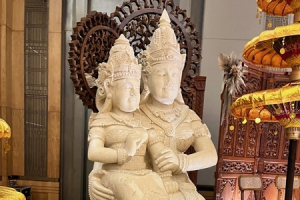
Malang has provided the members of the General Chapter with some wonderful experiences of the Indonesian culture. The opening ceremony, a traditional Javanese welcoming ceremony for important guests, was just the beginning of inculturation. Many of the Indonesian Carmelites, dressed in traditional garb, handed out kain batik, a dyed fabric with Javanese pattern, to each participant. This cloth was then carried into the Chapel over the shoulders of the members.
The chapel, used for daily mass as well as Morning and Evening Prayer, provides a blending of the traditional Church and Indonesian culture. Perhaps most prominent of many examples is the statue of Our Lady of Mount Carmel and the Child Jesus.
Fr. Fernando Millán Romeral, a former prior general, who has visited Indonesia on many occasions posted this on his Facebook page: The vitality of a charism is manifested in its ability to incarnate itself in different cultures, to manifest itself in different languages, and to express itself in the artistic styles of different peoples.
He was speaking directly about Our Lady of Mount Carmel in the chapel of the chapter.
Logo Captures Spirit of 2025 General Chapter

Chapter Logo Captures Spirit of 2025 General Chapter
On the first day of the Chapter, Christian Buenafe, president of the preparatory commission of the General Chapter, took a few moments to introduce the logo and its significance to the members of the Chapter. We thought is useful to bring to your attention the creative logo for the 2025 Chapter. It seems to have capture well the spirit present in the Chapter as well as our lives together as Carmelites.
Open Hands: As a Symbol of Prayer, Also Hard-Working Hands
The Carmelite charism is a gift from God to the Church and the world. One of them is Prayer: Prayer is the root and support all working activities in the Carmelite Order including fraternity and service. The colors refer to national flag of Indonesia.

Carmelite Shield: Shows the Uniqueness of the Carmelite Order: Prayer, Fraternity and Service Inspired by the Prophet Elijah and Mother Mary
The symbol of a brown mountain on a white background area, has the meaning of the majestic name of Carmel as the charisma of the Order which always longs for and fights for unity with God through a life of prayer and contemplation which has begun since the beginning of the Carmelites.

The Cross of Christ: Symbol of Christ, the Source of Life for the Carmelites
The cross is the source of strength for the Carmelites. They work not because of their abilities or their individual charisma but the Christ’s cross as their power.

Five People Gathered Symbol of Fraternity
The Carmelite Fraternity is a brotherhood born of contemplative life. This brotherhood is bound by one strength, the cross of Christ. Differences will always exist but they are called to be one in community. Living in community bound by the cross of Christ will bring the spirit of mission to all continents represented by 5 colors:
- white: Europe,
- green: Africa,
- red: America,
- blue: Oceania/Australia,
- yellow: Asia
Five People with Outward Movement as a Symbol of Service
The Carmelite Service is born from brotherhood. There is no personal work. There is only shared work, because it is bound by one power, namely the cross of Christ. Together moving outward, having achieved union of love with Christ.

General Chapter of the Congregation of St. Elias Held
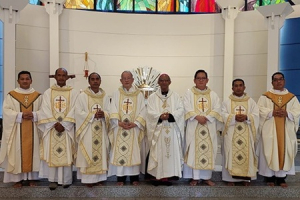
The Congregation of Saint Elias held their Third General Chapter in Cikanyre, Indonesia, on August 5-11, 2025
While the Congregation was founded in July of 1986, it was aggregated to the Carmelite Order on December 19, 2002. In 2023, there are just over 100 members residing in 10 houses.
Its website is www.carmeliaindo.org.
The following members were elected to leadership:
Minister General | Ministro General | Ministro generale
Sergius Paulus, CSE
1st Vice | 1er Vice | 1o Vice
Elisa Maria, CSE
2nd Vice | 2o Vice | 1o Vice
Joseph Krisostomus, CSE
1st Councilor | 1er Consejero | 1o Consigliere
Eugene de Jesus, CSE
2nd Councilor | 2o Consejero | 2o Consigliere
Georgius Paulus, CSE
3rd Councilor | 3er Consejero | 3o Consigliere
Athanasius Maria, CSE
4th Councilor | 4o Consejero | 4o Consigliere
Epiphanius Maria, CSE