







O.Carm
Carmel Celebrates World Book Day
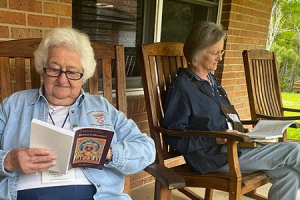
Carmel Celebrates World Book Day Connecting People Around the World
On Tuesday, April 23, people in over 100 countries around the world will celebrate World Book Day. Melody Triumph, of The Black Curriculum website, captures the importance of the Day, "How special and exciting it is to be able to have someone’s story from the past, or from the other side of the world, in your hands. ... It reminds us that everyone has a story to tell, everyone has an experience we can get joy and learn from, and perhaps most the most important of them all, is that every reader has a story that shows them that they are not alone."
World Book Day is a perfect opportunity to remind children of the importance of reading and it really helps to spark their enthusiasm and get them excited to pick up a new book. Stories offer a child so much and play a vital role in their growth and development.
The day is not just for children!!! Carmelites can use the day as a starting point to gain new insights into the Order's history and spirituality.
The benefits of reading at all ages are multiple. For example, reading can reduce stress levels, preserves brain health and lowers the risk of Alzheimer’s and dementia, helps your sleep and relieves symptoms of anxiety and depression.
There are plenty of other benefits of reading, including making you smarter. Reading provides a workout for our brains, a bit like physical activity for our bodies. Reading also increases vocabulary, helps us to understand different ideas and theories, increases knowledge and keeps our memory sharp.
In 1995, UNESCO decided that the World Book would be celebrated on 23 April, as the date is also the anniversary of the death of William Shakespeare as well as that of the birth or death of several other prominent authors.
To choose a book to enjoy, see Edizioni Carmelitane
Story Behind an Icon of Saint Titus Brandsma
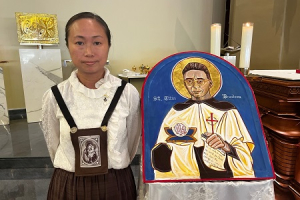
Interview With Its Writer
Story Behind the Icon for the 100th Anniversary of the Indonesian Province
An icon written for the 100th anniversary of the Indonesian Province which concluded a short time ago has an interesting history and an interesting writer. The Icon will find a permanent home in the provincial house of the Indonesian Province. It is hoped that it becomes both a tool of prayer and a sign of courage to be the true light of God to others and the good follower of Jesus Christ.” according to its creator.
She was born into a Christian family although her mother, born in Bali, was Buddhist. Her parents enrolled her into a Catholic secondary school under the care of the Sisters of Perpetual Help. One of the nuns, Sr. Flora took care of her when she was sick and became her private teacher after school in the area of math, religion and catechism. Two years later, Sr. Flora invited her to become a Catholic and gave her the baptismal name of Cecilia. “However, as she was filling out the form for the baptism, Sr. Flora received a message in prayer that her name should be Marina Carmel. So Our Lady of Mount Carmel became my patron saint. This was my first contact with the Carmelites.”
Following an accident involving her hands, Marina Carmel had the opportunity to learn from Orthodox nuns and priests how to write icons. “They encouraged me, improving my ability to use my injured hands. I also asked for God’s healing in my soul. A few months later, some priests borrowed my icon for a public session of prayer. They saw God’s work and compassion through the icons. They saw the tears and peace of those who came to pray.”
“They advised me to listen my calling from God to see whether I should be an icon painter or not. After many years of my unwillingness and discernment, an invitation to write icons about the Our Lady of Mount Carmel came from the Discalced Carmelites in Taiwan, the Carmelites in Hong Kong and Our Lady of Mount Carmel church in Hong Kong.”
What would such icons represent for their author? “It acts as a connection between myself and others in the tender hand of God. It is a way of communion with our Father in heaven, his constant presence to us. I am so grateful to be one of his tiny tools as iconographer serving in the Catholic, Orthodox, and Christian churches, religious communities, and monasteries both overseas as well as in Hong Kong.”
“The Carmelite saints I was invited to write are Lady of Mount Carmel, St. Jospeh, the Prophet Elijah, and St. Titus Brandsma. I do all of the icon writing as a result of an invitation, not because of my own wishes.
The icon of Titus is striking. It was written for a specific purpose. “There is an icon of Elijah created from icon material which was donated by an Orthodox person in gratitude for the of Carmelites prayers and kindnesses. However, that icon was sent to the new retreat house in Sumatra last year with Fr. Heru Purwanto, O. Carm. So, a Catholic sponsored icon material for me to write another icon for Carmelite evangelization. Fr. Albertus Herwanta, O. Carm., suggested that I write an icon of the recently canonized saint Titus Brandsma. So, I began to study about the life of St. Titus Brandsma. I received guidance from Fr. Benny Phang, O. Carm., other Carmelites in Rome, and the brothers of Mount Athos. Fr. Phang summed up the advice of those Carmelites, and asked me to include some signs on the icon which represent the virtue of the saint.
The Carmelites gave me the story of St. Titus and quotes from the saint to read for my spiritual preparation. I took a week for retreat and tried to reflect on my relationship with God through the poem which was written by St. Titus regarding Eucharist. Since Eucharist often comforted him in his suffering, Titus kept close to Jesus on the Cross. He really experienced the loneliness of the Lord and was devoted to the Eucharist through sacrifices and standing with weakness.”
“How do I stand with the weak through the icon writing in prayer, the pain of illness, and the grace that God gave me in His plan? How did I get to know His plan and the vision of God? From St. Titus I learned that I should be present to the Lord. I learned from the Prophet Elijah to have the courage to walk with Jesus in weakness. Those questions appeared in my mind when I was writing the icon. I feel the heaviness of my heart and brush. I beg for the mercy of God for my weakness in service, especially in my sacred harp music. With the icon for the illness, I kept praying by invoking Jesus' name, a kind of aspirative prayer in Carmelite spiritual and early Chrisitian faith. Hoping the Lord accepts my compassion, and lets me be his tiny tool to finish the icon in his way. Glory be to the Lord!”
According to the theology of traditional icons, there are special meanings in the icon of St. Titus Brandsma. Those colors were made with rare crystal and metal stone in prayer. The icon panel of special wood was made by carpenter in prayer. Those colors were mixed with egg, vinegar, and water in prayer. As iconographer, we cannot make any changes or put our on creative touches into the icon. All the colors of traditional icons were written from dark color to bright color. Because it means “Lord save us from sin,” it reminded me of the words of St. John of the Cross: "Even in the darkness, there is light.”
The dark blue color of the background is a sign of a martyr with purity in the soul. The shape of nose is straight, it means the breath of Holy Spirit is present in the life of the saint. The prominent, slightly out of proportion head of saint means the saint is full of wisdom in the Lord. St. Titus holding a pen and paper because he is a reporter and wrote to bring about justice.
“There also a quote of the saint written on a scroll of paper ‘He who wants to win the world for Christ must have the courage to come in conflict with it.’ It reminds us to be brave in following Jesus Christ. The mirror effect of the halo was made with real gold. Gold means the true light of God. It acts as the mirror of the heart which reflects our prototype of God's image. How did St. Titus Brandsma come to reflect the true light of God in his life, in the darkness? How he can he guarantee himself to be present before our Lord Jesus Christ? How enormous his courage be in order to savor the loneliness on the cross of Jesus Christ?”
Preparations Underway for the Jubilee Year in 2025

Preparations Underway as 2025 Designated a Jubilee Year by Pope Francis
Pope Francis has designated 2025 a Jubilee Year with the theme “Pilgrims of Hope.”
The last Jubilee year was in 2015, considered an “extraordinary Jubilee year” as Jubilees normally take place every 25 years. That extraordinary year was dedicated to mercy, a central theme of Francis pontificate. A Jubilee year normally begins just before Christmas and ends at the Epiphany of the following year. Special rites include the opening of the Holy Door—actually doors on the four major basilicas of Rome with St. Peter’s Basilica the first to be opened.
In 2025, the door of St. Peter’s will be opened on December 24. Days throughout the year have been specified for particular celebrations such as January 24-26 as “Jubilee of World Day of Communications”; July 28-August 3 as “Jubilee of the Youth”; October 8-9 as “Jubilee of Consecrated Life”; December 14 as “Jubilee of Prisoners.” The door of St. Peter’s basilica will be sealed up in January 2026. A full calendar of events can be found at: https://www.iubilaeum2025.va/en/pellegrinaggio/calendario-giubileo.html
Jubilees have biblical roots, as the Mosaic era established jubilee years to be held every 50 years for the freeing of slaves and forgiveness of debts as manifestations of God's mercy. The practice was re-established in 1300 by Boniface VIII. (It was Pope Boniface VIII who removed the Council of Lyon’s restrictions on the Order. We were now approved unconditionally.) Pilgrims to Rome were granted a plenary indulgence. Between 1300 and 2000, 29 jubilee years were held in Rome.
The city of Rome has been spending the last few years preparing for expected large crowds. Some 35 million people are expected throughout the year. (An estimated 20.4 million people participated in the 2015 Jubilee in Rome.) Rome has allocated approximately $2.5 billion for 87 public works projects, though people suspect this figure will almost double to $4.3 billion.
Among project are plans to improve public transport and public bathroom facilities, repave roads, build underground parking and pedestrian underpasses, and clean up the area around the city’s main train station, Termini.
Major construction is taking place in various parts of the city, including the Coloseum and Piazza Venezia, as a new line of the metro is added. A pedestrian mall, with an underground passageway, is being constructed between Castel San Angelo and Via Conciliazione to separate vehicular traffic and pedestrians.
Joan Lewis, the author of the book A Holy Year in Rome: The Complete Pilgrim’s Guide for the Jubilee of Mercy is quoted as saying “Be prepared for crowds. Bring patience along with your comfiest walking shoes.”
Official information about the Jubilee Year can be found at the Vatican website: https://www.iubilaeum2025.va/en/giubileo-2025.html
Additional information can be found on this webite: https://www.giubileo-2025.it/en/jubilee
European Youth Committee Plans for the Jubilee
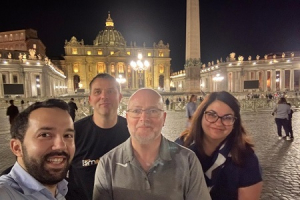
European Youth Committee Meets to Plan Jubilee Celebrations
The Carmelite European Youth Committee (CEYC) met in St Albert's (Rome) from 12th to 14th April 2024. On this occasion, only four members of the committee were able to travel to Rome for the meeting: Antonella Brincat, João Manuel OCarm, John Toryusen and Richard Byrne OCarm.
Responding to Pope Francis' invitation to young people for the Jubilee Year, CEYC had previously decided to organise a gathering in Rome of young adults from across Europe so as to celebrate and journey together in Carmel as part of the Jubilee of Youth in 2025. While in Rome, the Carmelite European Youth Committee continued with its planning of a programme for this gathering and the collection of supporting information. The committee also visited the Jubilee offices as part of its work.
During the gathering in 2025, we hope to accompany the young adult participants as together we explore and deepen our common Carmelite identity. We hope this will also be a springboard to rebuild a network of young adults across Europe. The participants will also spend two days in the city of Rome celebrating with the Jubilee Year with the wider Church.
The details for the gathering are being finalised and they shall be published and shared among the different European provinces, commissariats and delegations in the coming weeks.
Causa Nostrae Laetitiae
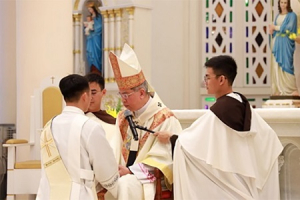
PROFESSIO SOLEMNIS
19-03-24 Mary Anastasia Mwikali of Christ the King (MAC) Machakos, Kenya
07-04-24 Pierpaolo Marcotullio (Ita) Pianella, Italia
ORDINATIO DIACONALIS
10-02-24 Rafael Dorgival Alves Fonseca Neto (Pern) Pernambuco, Brazil
Focus on Emotional and Spiritual Intelligence

Glen Attard, O. Carm.
Emotional and spiritual intelligence are two fundamental pillars of the human “inner cosmos”, each offering unique insights into the complexities of the human experience. This seminar aims to delve deeply into these two intelligences separately before exploring possible areas of convergence. The first session will begin by dissecting emotional intelligence, unraveling its components of self-awareness, self-regulation, empathy, and social skills. Following this, the focus shifts to spiritual intelligence, probing the depths of meaning and transcendence, the measure of spiritual growth, its areas of development, its method, its barriers, and its types. In the final session, the seminar brings emotional and spiritual intelligence into dialogue, highlighting their shared principles and areas of convergence. Participants examine how self-awareness and self-deception, empathy and relationships, common values and limits bridge the gap between the emotional and spiritual realms, fostering holistic well-being and personal growth.
Program:
Friday 26 April 2024 (6-8 pm)
Saturday 27 April 2024 (9:30 am – 12:30 pm)
(Central European Time)
Language: English
Venue: Online via Zoom
How to register: Send an email to Esta dirección de correo electrónico está siendo protegida contra los robots de spam. Necesita tener JavaScript habilitado para poder verlo.
Carmelite Elected Rector of School in Malang
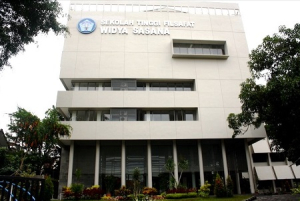
Carmelite Edison Tinambunan Elected Rector of Widya Sasana School of Philosophy and Theology in Malang
On April 15, 2024, Edison Tinambunan, O. Carm., a member of the Indonesian Province, was unanimously elected as the rector of Widya Sasana School of Philosophy and Theology in Malang. The university was founded by Indonesian Carmelites and Vincentians in 1971 in Malang, Indonesia. This school offers academic degrees in both philosophy and theology from the baccalaureate, master, and doctoral levels. Today the school has around 400 students from different religious congregations, dioceses, and lay persons.
Edison earned licentiate and doctoral degrees in patristics from the Augustinianum and the Angelicum Rome. He completed his studies in 2001 and has taught extensively since then. He was the librarian of the Order at CISA from 2004 to 2010 and is a member of the Institutum Carmelitanum. He is the editor of the series Corpus Constitutionum Ordinis Fratrum Beatissimae Virginish Mariae de Monte Carmelo with the two part 5th volume in preparation.
Celebrating At Home - Fourth Sunday of Easter
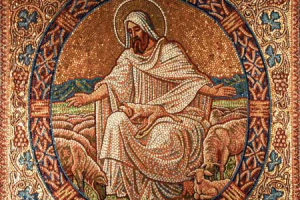
The Good Shepherd Lays Down His Life,
the Sheep Know Him and Listen to Him (John 10:11-18)
The Fourth Sunday of Easter is often called “Good Shepherd Sunday” because no matter what reading cycle we are in, the Gospel always focusses on the image of Jesus as the Good Shepherd.
This year, the Gospel reading talks about Jesus as a true shepherd prepared to lay down his life for his sheep. He is not like the hired man who runs away when danger appears. He knows his sheep and one day will gather them all into one flock.
Jesus acts towards us like a good shepherd: feeding, nurturing, defending and even laying down his life for us. Our Good Shepherd is deeply concerned about us, the flock and there is a deep sense of warmth and intimacy in the realisation that Jesus knows each one of us by name. Like a good shepherd Jesus is the source of life, nourishment, and safety for the sheep.
Any reflection about Jesus as the Good Shepherd also serves as a reminder that shepherding each other in Jesus’ name is part of the vocation of every disciple.
We are very used to thinking about Jesus as the Good Shepherd, but we also need to think about being/ becoming good shepherds to each other.
One of the very encouraging things about the pandemic was the number of people who became good shepherds to others, providing safety and security to vulnerable people, supporting health workers, providing meals and companionship.
That is what it means to lay down our lives for each other.
- pdf Celebrating At Home - Fourth Sunday of Easter [PDF](5.07 MB)
- default Celebrating At Home - Fourth Sunday of Easter [ePub](4.20 MB)
- pdf Celebrando en Familia - Cuarto Domingo de Pascua(546 KB)
- pdf Celebrando in Casa - Quarta Domenica di Pasqua(544 KB)
- pdf Celebrando em família - Quarto Domingo da Páscoa(642 KB)
Blessed Baptist Spagnoli, a Frog, and an Ant
17 April Memorial
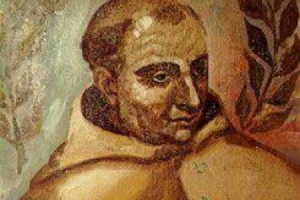
One of the controversies between the Order and the Mantuan Congregations involved the habit for the members to wear. The General Chapter of Asti in 1472, with no small assist from Pope Sixtus IV it was commonly believed, elected Christopher Martignoni, a prominent members of the Mantuan Congregation. Yet Martignoni’s generalate was to be marked by continual conflict with the Mantuan Congregation. According to the Carmelite historian Joachim Smet, Martignoni was passionate about good order: uniformity of dress, life, and doctrine in the Order.
Besides a major shift in the alignment of houses of the Order in Italy, Martignoni sought to unify the habit throughout the Order and attempted to do so with a decree from the Chapter of 1471. The Mantuan Congregation began a campaign of opposition. For them, the original form of the habit symbolized their attempt to return to the sources of the Order’s spirit. To adopt the habit of the conventuals seemed equivalent to dissolving the reform. In 1475, the pope suspended further discussion, pending a decision on his part only to have the question reopened by Martignoni’s successor in 1483.
By this time, the vicar of the Mantuan Congregation was the famous poet Baptist Spagnoli. He included in his Eclogues a dialogue between a frog (a reformed friar) and an ant (a conventual) over the color of the habit. He managed to keep the question open, until on May 26, 1484, he obtained from Sixtus IV a final decision in favor of the Mantuan Congregation—to maintain the grey habit.
Presentation of a book on Saint Angelus of Sicily
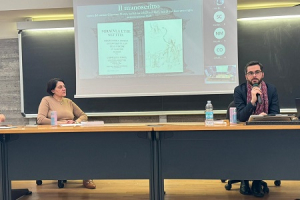
On Tuesday, April 09, 2024, at 4 p.m. in the Paolo Radicciotti Lecture Hall of the Department of Humanistic Studies at the University of Roma Tre, the book "Miracula et benefitia" the story of disease and thaumaturgy and Licata, Sicily and devotion to Carmelite Saint Angelo was presented by its author Marco Papasidero. The book is published by Edizioni Carmelitane.
Speaking at the presentation were Professor Maria Chiara Giorda and Professor Paolo Broggio from the University of Roma Tre, Giovanna Brizi, Postulator General of the Carmelite Order, and the author.
The book traces, in a cultural-historical perspective, the miracles, healing practices, diseases, beliefs and society described within the book " Miracula et benefitia," the title of the inquiry into miracles conducted between 1625 and 1627 in Licata, Sicily, which aimed to collect the miraculous testimonies of 113 witnesses following the wave of plague that had struck the island since 1624.
Professor Maria Chiara Giorda praised the author's work and mentioned how he managed to bring out "the great Sicilian cultural and religious heritage, both tangible and intangible" of that historical period.
For Papasidero, a researcher in the History of Christianity at the University of Palermo, "today the cult of St. Angelo is alive and so it is demonstrated by the return of the Carmelites as it happens especially on the feast of the saint."
In the words of Prof. Paolo Broggio, the volume contains "an account of the mentality, beliefs, medical practices and procedures of the protagonists of the time."
In the discussion around the book, it emerged how the text can also be an important source for medical historians. According to Papasidero many times they only "draw on medical treatises and forget to report the religious aspects of the healing practices of the time."
For Maria Chiara Giorda, "a clear link is evinced between the history of religions, disease and medicine, between how it was considered at the time to the epistemological change that is considered by modern anthropologists as a perfect example of healing with a combination of medical systems and magical practices defined today as ontological systems that have proven effective over time."
The author thanked Giovanna Brizi, Postulator, and Fr. Mario Alfarano, Archivist and General Librarian of the Carmelite Order, as well as the publishing house Edizioni Carmelitane for the trust they have placed in him.
For more information about the book Miracula et benefitia ...