


O.Carm
Affiliated Congregations Meeting Evaluation
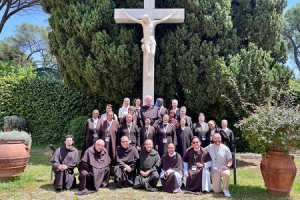
The leadership of the Congregations and Institutes affiliated to the Carmelite Order met at the Passionist Retreat Center in Rome from May 22-26, 2023. The meeting, which is held every six years, was focused on the theme "Carmelite Identity and Experience." Some 20 members participated this year.
At the end of the meeting, the participants returned to their communities of origin enriched by the intense days of prayer, reflection, and sharing in which they strengthened their spiritual closeness to the Carmelite Family.
The General Delegate for Congregations and Affiliated Institutes, Luis Maza Subero, who is also General Councilor for the Americas, invited the sisters and brothers from the various groups they represent to share their evaluation of the meeting held in Rome.
Among the questions asked of the participants were:
1. What is the value of this gathering for your congregation?
2. How can we move forward as members of the Carmelite Family?
3. Were you satisfied with the organization of this gathering?
4. What are your suggestions for the next gathering?
In the answers given by the sisters and brothers, we can appreciate the importance given to the meeting which served to "cultivate the sense of belonging to the Carmelite Family in the spirituality of communion." They also highlighted the centrality of the theme of Carmelite identity and experience and the themes of the conferences, which were "good and enriching." The various days of the meeting were an excellent occasion to, in their own words, "cultivate cooperation and dialogue among us" and "work together in vocation ministry, evangelization, and in formation."
The participants highlighted that to move forward as members of the Carmelite Family, the key is to "stress communion and participation, each one from his or her reality, with our gifts and limits, as St. Paul tells us."
Likewise, proposals were received to "organize meetings of the Carmelite family more frequently" at the geographical area and international level and to "implement the practical proposals for collaboration that emerge from the study groups during these conferences."
In particular, it was proposed to move forward as a Carmelite Family. “As a bigger family likes to gather, [we would like gatherings] not only of the affiliated congregations, but also with the Friars. [Then we will be more] ready to collaborate as one family."
The sisters and brothers agreed in highlighting the excellent organization of the conferences, the fraternal climate, and the wonderful hospitality provided by the Passionist Retreat Center in Rome, the venue of the meeting. Among the evaluations received, it was stressed that "the ambience was very conducive to reflection and prayer" and that "the fraternal and serene atmosphere was an excellent ‘glue’ for all of us." They also remarked that the conferences "were all interesting" and pointed out the usefulness of "having the texts of the conferences translated into the different languages."
A special thanks was given to the translators for their excellent work and patience.
Finally, the participants reaffirmed the need to "continue with the periodic meetings, deepening the Carmelite charism and the themes related to evangelization and pastoral work." They also commented that "the liturgical resources were well prepared," but they lacked "a multilingual hymn booklet and a guitar to animate the Eucharistic celebration."
Conference on Disability, Edith Stein at Aylesford
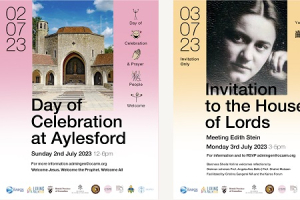
From July 2-6, 2023 The Carmelites at Aylesford Priory in England will host a series of events to celebrate the gifts of creative people experiencing disability and the wisdom of St. Edith Stein.
This a one of the first international events of its kind, introducing new areas of study, including issue around disabilities.
Event 1 (July 2, 2023)
A Day of Celebration – the perfect opportunity for a parish pilgrimage, discovering the gifts of symbolic catechesis and liturgy – Please do join us!
Event 2 (July 4-6, 2023)
Three-day Conference – Dignitas Personas et Amor Dei: The Value of the Human Person and Divine Love. Meeting with Edith Stein
- Day 1: The Value of the Human Person
- Day 2: The Person in Community
- Day 3: The Human and Divine
You are invited to sponsor a member of your parish by inviting them. In return, they can give a short report or talk to your parish following the summer break. In this way, the value of the human person, Edith Stein, and ways to enable belonging can be shared throughout all that we do as Church.
Participation in the conference includes: BSL interpreters, symbols, creative student theater, and physical access to all events. Cost per person: including lodging (July 4 and 5) and conference fees: FB: £259; HB: £209. Conference only: £100.
For more information about events, contact: Cristina Gangemi: Esta dirección de correo electrónico está siendo protegida contra los robots de spam. Necesita tener JavaScript habilitado para poder verlo.
For reservations and cost information, contact: Manuela Montagner: Esta dirección de correo electrónico está siendo protegida contra los robots de spam. Necesita tener JavaScript habilitado para poder verlo.
This event is sponsored by The Kairos Forum, the Pontifical Dicastery for Culture and Education and the Carmelite Order-British Province
Vitam Coelo Reddiderunt
|
09-05-23 |
|
|
|
|
|
23-05-23 |
|
|
|
|
|
23-05-23 |
|
|
|
|
Celebrating At Home - The Most Holy Trinity
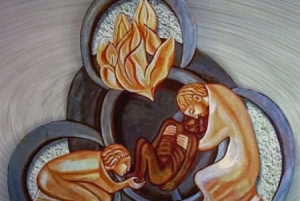
God enfleshed in us
(John 3:16-18)
A quick look at the readings for today shows very clearly that the Feast of the Trinity is a celebration of God's love for humankind. It is a day for reflecting on who God is, not for trying to figure out how there can be three persons in one God.
The Church’s focus today is on experience, not theology.
In intellectual terms, God remains a mystery. For people of faith, God is known not by the mind, but by the heart. That is what spirituality and mysticism are about - exploring our experience of God.
In the first reading God is proclaimed as a God of tenderness and compassion, slow to anger and rich in mercy; a God who walks with his people.
Paul’s words in the second reading are born out of his belief that, having been made in the image and likeness of God, Christians must always act in the image and likeness of God.
Through our public liturgy, private prayer and contemplation we come to experience - to ‘know’ and feel in our hearts - that God loves us, accepts us, forgives us and constantly invites us into an ever deeper experience of love.
When we allow God’s heart to speak to ours in love we begin to absorb more of God’s life into our own.
We are being transformed. Our values and attitudes, our ways of looking at and being in the world start to change. We begin to see with God’s eyes and feel with God’s heart.
We become passionate about the things God is passionate about: speaking truthfully, acting with justice and integrity, looking out for each other and especially for the vulnerable, promoting peace and understanding, ending competition and discrimination, respecting life.
That makes us better people and our lives become a blessing for each other and for the world.
That is what it means to live out of God’s great gift to us, the Spirit of Jesus Christ which God has placed in our hearts. God becomes enfleshed in us and we become stewards of God’s grace and life.
- pdf Celebrating At Home - The Most Holy Trinity [PDF](5.53 MB)
- default Celebrating At Home - The Most Holy Trinity [ePub](2.81 MB)
- pdf Celebrando en Familia - Domingo de la Santísima Trinidad(486 KB)
- pdf Celebrando in Casa - Santissima Trinità(484 KB)
- pdf Celebrando em familia - O Domingo da Santíssima Trindade(579 KB)
Communications Commission Sets Future Directions
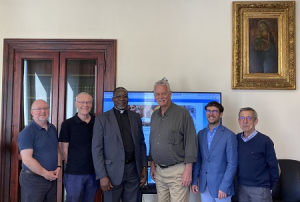
In its fourth meeting (22-23 May), the international Communications Commission discussed future directions for communications within the Order. Among the directions planned are:
- Forming a network of those working in communications at all levels of the Order – friars, nuns, TOC, affiliated religious and Carmelite laity - to share knowledge, information, technical expertise and explore ongoing formation needs and resources.
- Online meetings of this network to develop a sense of communion among those working in communications, for ongoing professional and technical formation and to suggest ideas for future initiatives.
- A survey of communications activity in the various Carmelite entities. For example, names of communications personnel, what communications resources (human and material) these entities have, what communications material is produced (print, video, audio, social media, web presence, and so on). This will provide an overview of communications activity in the Order and allow for the possibility of sharing resources.
- Exploring the possibility of an ongoing formation course in Communications before the next General Chapter.
- Developing a Communications plan for the Order.
Among other issues discussed was a new website for Edizioni Carmelitane in the three languages of the Order, ways to increase the visibility of publications beyond the Carmelite family, and the use of social media to increase sales of books, as well as the ongoing updating of the ocarm.org website.
Present at the meeting were: Richard Byrne (President), Manuel Freitas (Portugal), Mons. Janvier Marie Gustave Yameogo (Dicastery for Communications), David Hofman (Australia), and William J. Harry (Director, Office of Communications). Andreas Dedy Purnawan (Indonesia) was unable to be present. Marco Pellitero (Communications Assistant) also joined the meeting to discuss the issues relating to the new website for Edizioni Carmelitane. At the beginning of the meeting the Prior General, Fr Miċeál O’Neill, addressed words of welcome and encouragement to the Commission.
European Carmelite Youth Committee Meets In Person
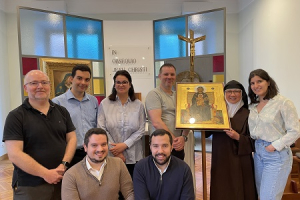
After having met six times online, the members of the Carmelite European Youth Committee (CEYC) were very grateful to be able to finally hold their first “in person” meeting in the General Curia (Rome) from March 25-27, 2023.
During the meeting, the members heard about some of the many initiatives that were taking place around Europe including the proposed arrangements by the General Commissariat of Portugal for World Youth Day, the online ‘Exploring Carmel’ programme in the United Kingdom, meetings in Salamanca and developments in the Italy-Malta Region. Some potential ecumenical aspects of our ministry with young people were discussed.
John Keating, O. Carm., joined the meeting and outlined the context of the previous European youth gatherings (the Pilgrimage of Hope and the Awakening Project) and led an exploration of what Carmel might have to offer to young people in Europe. After reflecting on this discussion, the Committee decided to organise a European youth gathering in the summer of 2024 and spent time on some of initial preparatory work. Details will be announced later this summer. At the end of the meeting, the members prayed with the Icon of the Pilgrimage of Hope (“Our Lady of Hope”) which was written by the Carmelite nuns in Ravenna (Italy).
The members of the Committee are Antonella Brincat, Christian Brincat, Richard Byrne, O. Carm., João Manuel Oliveira da Costa, O. Carm., Kurt Mizzi, O. Carm., Daniela Pereira, Alfredo Pisana, O. Carm., Sr M. Resurreccion Ronquillo Diamat, O. Carm., and John Toryusen.
M.A in Spiritual Companionship opens Registration
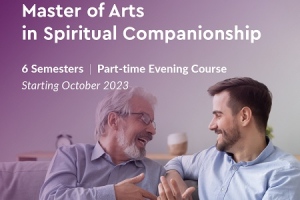
MA Spiritual Companionship
(being offered from October 2023)
The Faculty of Theology at the University of Malta, in collaboration with Carmelite Institute Malta, is offering again the Master of Arts in Spiritual Companionship a professional programme aiming to train and empower candidates in discovering and practising the art and profession of spiritual companionship. The course aims at responding to the need of ongoing formation of pastoral ministers and school religious counsellors.
The different study-units of the programme cover the following topics:
Introduction to spirituality;
Dynamics of growth and maturity in the spiritual life;
Foundations of spiritual companionship;
Foundational theories of psychology;
Principles of spiritual discernment;
Emerging contexts in spiritual companionship;
Practicum in spiritual companionship;
Psychospiritual growth;
Counselling in a pastoral setting;
Helping skills in spiritual companionship;
Supervision in spiritual companionship;
Ethical issues in spiritual companionship.
The third year is wholly dedicated to the writing of the dissertation.
The course is recommended for those wish to be involved in the spiritual formation of others by providing the service of spiritual companionship and direction. It is also recommended to those engaged in pastoral ministry, particularly family and youth ministers, chaplains, spiritual directors in schools, and group leaders.
Course duration: 6 semesters part-time (evening)
Study mode: taught (2 years) and research (1 year)
For more information go to: https://www.um.edu.mt/theology/prospective/mainspiritualcompanionship/ or contact the Course Co-ordinator: Rev. Dr Charló Camilleri, O.Carm. on
Esta dirección de correo electrónico está siendo protegida contra los robots de spam. Necesita tener JavaScript habilitado para poder verlo.
Lectio Divina June 2023
Lord,
guide the course of world events
and give your Church the joy and peace
of serving you in freedom.
You live and reign with the Father and the Holy Spirit,
one God, for ever and ever. Amen.
- pdf Lectio Divina June 2023 [PDF] Download here(977 KB)
- default Lectio Divina June 2023 [ePub] Download here(279 KB)
- default Lectio Divina June 2023 [Mobi] Download here(1.17 MB)
Celebrating At Home - Pentecost Sunday
Sent to be God’s love in the world
(John 20:19-23)
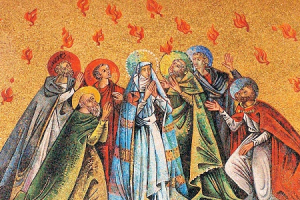
At Pentecost we celebrate the gift of the Holy Spirit to the first group of Christian believers - the disciples.
This gift of the Holy Spirit is the culmination of the life, death and resurrection of Jesus.
It would be wrong to think that this gift happened only once, in one moment of history. In fact, the gifting of the Holy Spirit is a continuing event in the life of every believing person and, therefore, in every age of human history. The Holy Spirit is the presence of God with us - the enduring way in which Jesus remains present in the Church and in the life of each person.
Today we do not pray to receive the Holy Spirit. The presence of the Holy Spirit in us has been affirmed and proclaimed in the sacraments of Baptism and Confirmation. Instead, we pray to grow more aware of the Spirit’s presence in our lives and to allow that Spirit to grow within us, gradually re-shaping our minds and hearts in the image of Jesus.
Pentecost brings to a close the fifty days of the Church’s Easter celebrations. Soon we will begin Ordinary Time again. So, our feast today helps us understand that we take the Holy Spirit with us into the ordinary events and tasks of each day. That is how we allow the sacred to touch, heal and transform us and the world around us.
The spiritual search is for the heart of God within our own. When we enter into relationship with Christ through the Spirit, the gifts begin to flow more abundantly. The Spirit is the source of reconciliation with ourselves and with each other. Reconciliation is essential if we are to ‘hold and guard’ each other in the midst of all that life throws at us, especially at the moment.
The Spirit brings gifts of wisdom, courage, understanding, right judgement, knowledge, reverence, wonder and awe in God’s presence. May we be graced by them all as we discern and decide how we can best work together to build up each other and to let God’s love be seen at work in each of us.
Carmelites' Archives and Library Opens to the Public
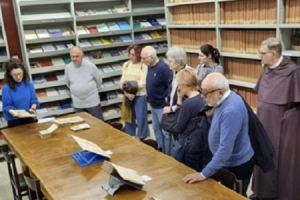
The Opening of the General Archives and Library of the Order of the Carmelites to the Public
The 2023 edition of the Days of Enhancement of Ecclesiastical Cultural Heritage was held on May 13-21. Its theme was "Beyond the Slide. Church Cultural Heritage: From Accessibility to Inclusion." The Carmelite General Archives and Library took part with an even on May 19 at Centro Internazionale San Alberto (CISA) in Rome. Both library and archives are houses at CISA.
Three rounds of tours were given. Some 50 people attended, including employees of the General Curia, professionals in the field, scholars, as well as people curious seeing the doors to the library on Via Sforza Pallavicini open for the first time in 40 years.
The tours consisted with the librarian and archivist, Mario Alfarano, O. Carm., giving an introduction to the history and organization of the archives and library. Sara Bischetti showed the library’s holdings and research tools, highlighting some of the older items preserved in the library, including incunabula (books printed before 1501) and cinquecentine (books printed in the 16th century. The visitors were then able to explore the three floors of the libraries holdings.
In the archives, Simona Serci provided a short history and evolution of the Order using a display of papal bulls and letters, records from both general chapters and provincial chapters, documentation on the Carmelite house at Traspontina which was relocated decades after the unification of Italy at what is now CISA but at the time was the International College of St. Albert.
The tours ended in the storeroom of the documentary section of the General Postulation. This department is involved with the processes for the causes of the Carmelite saints and blesseds.
The visits ended with the blessing of the library by Tadeusz Popiela, prior of CISA, inaugurating the new opening to the public. Refreshments in the houses main hall followed with music by Loredana Birocci on the piano.
For 2023, 136 events took place around Italy. Thirty-nine of these were done by museums, 33 by archives, 42 by libraries, 9 by churches, and 13 by dioceses. The days are promoted by the National Office for Ecclesiastical Cultural Heritage and Worship Buildings of the Italian Bishops' Conference together with AMEI - Association of Italian Ecclesiastical Museums, AAE - Association of Ecclesiastical Archivists and ABEI - Association of Italian Ecclesiastical Librarians and under the patronage of ICOM Italia (International Council of Museums), ANAI- Italian National Archival Association and AIB - Italian Library Association.