











O.Carm
General Chapter of Carmelite Sisters Held in Caracas
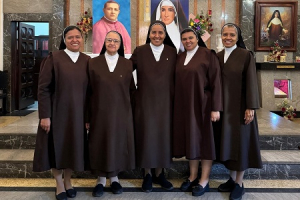
General Chapter of the Hermanas Carmelitas de Madre Candelaria Held in Caracas
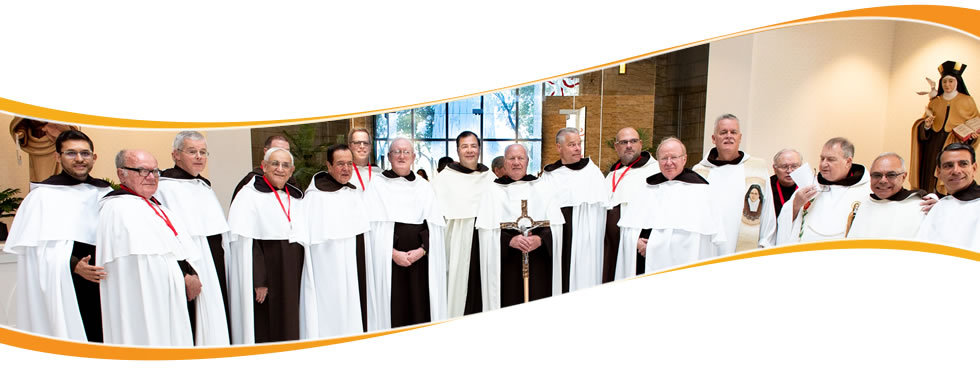
From August 30 to September 6, 2024, the Congregation of the 'Hermanas Carmelitas de Madre Candelaria' celebrated their XVII General Chapter. “Walking Together in Communion, Participation and Mission” was chosen as the theme of the gathering.
The General Chapter was held at the generalate in Caracas-DC, Venezuela, with the participation of 31 sisters from the congregation’s communities in Venezuela, Bolivia, and Brazil.
After a previous week of spiritual exercises, the chapter days were taken up with reflection on the experience of religious consecration in the institute. An agreement was arrived at on the courses of action to be taken in order to promote fraternal communion, and the spiritual and apostolic vitality of the congregation.
The Carmelite Family will celebrate 100 years of the congregation’s aggregation to the Carmelite Order on March 25, 2025.
The XVII General Chapter also elected the sisters who will form the general government of the congregation during the sexennium 2024-2030:
General Superior | Superiora General | Superiore generale:
Sr. M. Luisa América Córdova Cova
1st Councilor | 1ª Consejera | 1ª Consigliera:
Sr. Carmen Moreno García
2nd Councilor | 2ª Consejera | 2ª Consigliera:
Sr. Ana María Montilla
3rd Councilor | 3ª Consejera | 3ª Consigliera:
Sr. Yaritza Jackeline Rujano Durán
4th Councilor | 4ª Consejera | 4ª Consigliera:
Sr. Yusmilat Emenencio
Celebrating At Home - 27th Sunday in Ordinary Time

Gracious and Generous Love
(Mark 10:2-16)
No doubt, many will find this Sunday’s Gospel difficult reading.
One of the great themes of Mark’s Gospel is that, in Jesus, all things are being restored to God’s original purpose. That gives us a bit of context for the words of Jesus.
Among Jewish scholars and rabbis of Jesus’ time there was often fierce debate about the grounds for divorce permitted by Jewish Law (Deuteronomy 24:1). As the Gospel recalls, a man could draw up a ‘writ of dismissal’, give it to his wife and they would be considered divorced. At least one line of thought allowed the husband to do this for almost any reason whatever. In a way, the writ was meant as a kind of protection for the woman lest she be accused of infidelity.
When the Pharisees approach Jesus, they already seem to be aware of his teaching about divorce and may be trying to trap him into saying something against Moses and the Law. Something they could use against him.
Jesus, however, talks not about the Law, but about God’s original intention for marriage using quotes from the Book of Genesis.
The words of Jesus make clear that marriage is part of God’s design for human beings. The rich imagery of the husband being so drawn to his wife that he leaves home and family and the two become ‘one body’ implies great love, warmth, intimacy and companionship. When God draws human beings together like this, man must not divide them.
Later, the disciples question Jesus about his teaching. It is important to understand that Jesus’ reply is about a situation in which one party in the marriage divorces the other in order to marry someone else. It is not talking about a person fleeing an abusive relationship or one which has failed for some other reason. So, it is important not to take these words of Jesus and use them as a judgement on those who have divorced, or who have remarried some time later.
It is also worth remembering that the Church itself has a process to assist people whose marriages fail, often enabling them to marry again.
The reply that Jesus gives recognises husband and wife as equal partners in marriage. No longer, according to Jesus, is it permissible for a husband to divorce his wife ‘because he finds something displeasing about her’ (Deut 24:1) and neither can the wife.
Jesus does the same thing in the following story about the little children. When people (probably their mothers) bring the little children to Jesus for a blessing, the disciples, acting as minders, shoo them away. Once again, the disciples have got things wrong, and Jesus rebukes them. They seem to have forgotten already Jesus’ teaching in last week’s Gospel about welcoming the little child.
Jesus astounds the disciples by insisting that the Kingdom of God belongs to those who welcome it like little children, who open-heartedly embrace the Kingdom as sheer gift from a gracious God. The Kingdom cannot be earned, or bought, or bargained for. It is ours for the taking. All we need is the conversion of heart to believe in a God who is so good and so gracious as to give us the Kingdom freely and without measure.
In both parts of the Gospel today, Jesus teaches that married women and children are not to be treated as possessions or objects, but with dignity and respect. As well as recalling God’s initial intention for marriage, Jesus also recalls God’s initial intention about the treatment of other people including those thought to be of lesser or no account.
The disciples need to learn that only those who receive the kingdom of God with the openness and receptivity of a child will be able to enter into the mystery of God’s gracious and generous love.
- pdf Celebrating At Home - 27th Sunday in Ordinary Time [PDF](4.65 MB)
- default Celebrating At Home - 27th Sunday in Ordinary Time [ePub](5.24 MB)
- pdf Celebrando en Familia - XXVII Domingo del Tiempo Ordinario(894 KB)
- pdf Celebrando in Casa - XXVII Domenica del Tempo Ordinario(880 KB)
- pdf Celebrando em família - XXVII Domingo do Tempo Comum(903 KB)
The Congress of Lay Carmelites Held in Rome
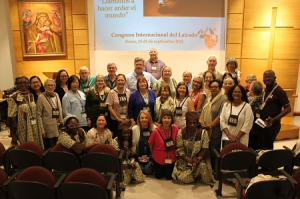
The Congress of Lay Carmelites was held in Rome from September 15-21, 2024 to Discuss Formation, Service, Fraternity and Prayer
The Carmelite retreat center Il Carmelo, located in Sassone, Italy, hosted 200 members of the Carmelite Laity from 30 nations for a week of conferences and sharing experiences about formation, service, fraternity and prayer in their lives and in their local communities. The theme of the Congress was Lay Carmelites: Called to ignite the world.
From October 15, 2023 to March 25, 2024, local communities reflected on a questionnaire, sent by the International Secretariat for the Laity. A total of 643 responses were received from all five continents. These responses were used to prepare an Instrumentum Laboris, a preparatory document that guided the discussions of the Congress.
At a later stage, the Congress was held in Sassone. The Lay Carmelites, in addition to the presentations and the sharing of experiences, had the opportunity to share meals and free time, as well as to participate in the papal audience and to visit the city of Rome.
The third phase will be to implement some of the ideas raised at the Congress and to present some proposals to the General Chapter of the Order to be held in 2025.
In addressing the theme of the Congress, the Congress agrees with the emphasis of Pope Francis on the need for openness of our Church; to go out to others to reach out to the human peripheries. One participant expressed: “We want to emphasize that we are mission, a laity in action, that we seek to go out of ourselves and out of the comfort of our communities, to set out on the road (...) the love of God, like the Prophet Elijah, burns our hearts and impels us to share that love with others to change the world”.
Luis José Maza Subero, General Councilor, who is the liaison between the General Council and the International Secretariat of the Carmelite Laity, expressed the following at the closing of the Congress: “The Carmelite Order is promoting the role of the laity, an example of which was this Congress, in which our laity expressed themselves in the final paper. “Our Order has much to offer to the world, as Carmelites we have been able to live this Congress as a transforming experience, we return different from how we came, prayer and shared fraternity gives us strength for the mission; we have seen how the Spirit in our diversity, acts and urges us to move forward. We are not building for today. We are not working for tomorrow. We are forging a path for eternity”.
A book is being prepared by Edizioni Carmelitane containing the presentations and other materials from the Congress, to make the ideas presented during the week available to those who could not attend, as well as to those who are interested in the latest developments in the Lay Carmelite communities.
Feast of St. Thérèse of Lisieux
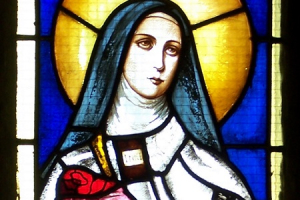
For the feast of St. Thérèse of Lisieux, the Communications Office is proud to present three reflections on her life and teaching by Fr. Giampiero Molinari, a member of the Italian Province. These three conferences were part of the ongoing formation program for the European region. The first conference was given in October 2023, the 150th anniversary of the birth of the saint and the 100th anniversary of her beatification by Pope Pius XI. The third and final conference was given on April 20, 2024.
Each conference includes questions for reflection.
We hope you enjoy these presentations on Thérèse’s life experiencing mercy and grace, Thérèse’s “Little Way,” and Thérèse and the Church and are drawn to a further reflection of them in your own life.
Conference 1: Mercy in Fragility and the Primacy of Grace
pdf Reflection Questions(365 KB)
Conference 2: The ‘little way’: a spirituality of the everyday
pdf Reflection Questions(365 KB)
Conference 3: “In The Heart of the Church” (ms B 3v): The Apostolic Horizon of Saint Thérèse of Lisieux
pdf Reflection Questions(366 KB)
To read more on the life of St. Therese of Lisieux, Virgin and Doctor of the Church
Third Conference: “In The Heart of the Church”
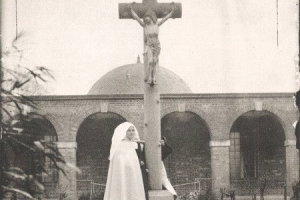
“In The Heart of the Church” (ms B 3v):
The Apostolic Horizon of Saint Thérèse of Lisieux
Third Ongoing Formation Meeting European Carmelite Family
20 April 2024
Giampiero Molinari, O. Carm.
pdf
Questions for Reflection(366 KB)
Bishop Combes, one of the pioneers of studies on the doctrine of Thérèse of Lisieux, has defined the saint’s vocation as essentially apostolic and, more precisely, missionary[1]. Indeed, her decidedly Christocentric spirituality leads her to openness to the Church, contemplated as the mystical body of Christ, and to a desire for salvation for all its members. What she writes to the seminarian Bellière, her first “spiritual brother”, is significant:
She knows, a Carmelite who was not an apostle would stray from the purpose of her vocation and cease to be a daughter of the Seraphic Saint Teresa, who wished to give a thousand times her life to save a single soul (LT 198, 21 October 1896)[2] .
Moreover, I believe it is sufficient to reread the famous pages of Manuscript B in which the saint manifests the series of vocations she perceives in the depths of her heart (cf. Ms B 2v-3r)[3] to fully grasp her apostolic ardour. In these pages, Thérèse is like a “river in flood”:
‘I would like to travel the earth, to preach your name,’ she writes, addressing Jesus, ‘one mission alone would not be enough for me: I would like at the same time to proclaim the Gospel in the five parts of the world and as far as the most distant islands...’ (Ms B 3r).
In this reflection, therefore, I will try to briefly outline some moments of Thérèse’s life and spiritual experience, which led to her maturity and contributed to her spousal union with the Master flowing into evangelising anxiety. Pope Francis, in the Exhortation C’est la confiance, in addition to recalling her proclamation as patroness of the missions, presents the Carmelite of Lisieux precisely with the interesting title of teacher of evangelisation (cf. no. 9), offering us a good key to interpretation:
Thérèse [...] did not conceive of her consecration to God without seeking the good of her brothers and sisters. She shared the merciful love of the Father for the sinful son and that of the Good Shepherd for the lost, distant, wounded sheep (n. 9).
“I Felt Devoured by the Thirst for Souls:”
the ‘Christmas Grace’ of 1886 and the Experience of July 1887
At the centre of Manuscript A we find the account of two crucial moments in Thérèse’s life and spiritual experience: the so-called “Christmas Grace” of 1886 and the participation in the mystery of the Redemption experienced on a Sunday in July 1887 (cf. Ms A 44v-46v). We have already highlighted how this phase is central to the maturation of the saint, as it marks the beginning of that process of liberation from infantilism in order to grow as a woman and mother[4] . The theologian Robert Cheib sums up these very fundamental pages of Manuscript A by defining them as “a paschal passage from self-abandonment to pro-existence”[5] , that is, a giving of oneself for others. Thérèse’s words at the conclusion of the account of the “Christmas Grace” leave no doubt about this:
[Jesus] made me a fisher of souls; I felt a great desire to work for the conversion of sinners, a desire I had never felt so strongly. In a word, I felt charity enter my heart (Ms A 45v).
Immediately after these lines, the saint goes on to recount the experience triggered by a glance of faith cast on an image of the Crucifix that she kept in her missalette (cf. Ms A 45v-46v): she was struck by the blood falling from one of his hands and the fact that no one bothered to pick it up. Therefore,’ she writes
I decided to keep myself at the foot of the Cross to receive the Divine dew that flowed from it, understanding that I would later have to sprinkle it on souls... Jesus’ cry on the Cross also echoed continuously in my heart: ‘I thirst! These words kindled in me an unknown and very vivid ardour. I wanted to give my Beloved a drink and I myself felt devoured by the thirst of souls (Ms A 45v. Bold mine. The italics correspond to the underlining made by Thérèse herself)[6].
In this background context, as we know, Thérèse refers to a news story of those days by narrating the conversion of Pranzini, who went from being a “great criminal” to becoming her “first son” (cf. Ms A 45v and 46v). The saint sees in all this a confirmation of her vocation:
After that unique grace, my desire to save souls grew daily! I seemed to hear Jesus saying to me as to the Samaritan woman: “Give me a drink!”. It was a true exchange of love: to souls I gave the blood of Jesus, to Jesus I offered those same souls refreshed by his Divine dew (Ms A 46v).
In my opinion, this well-known passage is central, as it shows the intimate link between the spousal chord of Thérèse’s heart and the maternal one, between the Christological dimension of her spirituality and the ecclesial horizon: the profound communion with Jesus in the mysteries of the Incarnation and the Passion expanded her heart, opening it to the Church.
This dynamic will be a constant throughout Thérèse’s short life. I will limit myself to a few examples. In the prayer she composed for the day of her religious profession (8 September 1890), distancing herself from the common opinion of the time that the damnation of many souls was taken for granted, she writes
Jesus, let me save many souls: may there not be a single damned soul today and may all the souls in purgatory be saved!... Jesus, forgive me if I say things that should not be said: I only want to rejoice and console you (Pr 2)[7] .
In her letter of 26 December 1896, addressing the seminarian Bellière, she states:
Let us work together for souls! We have but the one day of this life to save them and thus offer the Lord the proofs of our love (LT 213).
In her correspondence with her sister Celina and her two ‘missionary brothers’, this spiritual motherhood of Thérèse is manifested in a particular way, taking on the connotations of a desire that not even death will be able to extinguish. To Bellière she writes:
I promise to remain your little sister up there too. Our union, instead of being broken, will then become more intimate: there will be no more enclosure, there will be no more grilles and my soul will be able to fly with you to distant missions. Our roles will remain the same: to you the apostolic weapons, to me prayer and love (LT 220, 24 February 1897. Bold mine)[8] .
And to Father Roulland:
Ah, my brother, I feel it, I will be much more useful to you in Heaven than on earth [...] I really count on not remaining inactive in Heaven: my desire is to work again for the Church and for souls (LT 254, 14 July 1897).
“I Want to Be a Daughter of the Church” (Ms C 33v):
the 1887 Pilgrimage to Rome and Prayer for Priests
As we know, in November 1887 Thérèse participated in a pilgrimage to Rome on the occasion of the priestly jubilee of Leo XIII. For the saint it was a second stage in her journey of maturation, which produced a further movement of her heart. This is proven by the expression chosen to introduce the story: “I understood my vocation in Italy” (Ms A 56r). We read in Manuscript A:
For a month, I lived with many holy priests and realised that if their sublime dignity elevates them above the angels, this does not detract from the fact that they are weak and fragile men. If holy priests whom Jesus calls in his Gospel: ‘the salt of the earth’ show by their behaviour that they are in dire need of prayer, what is to be said of those who are lukewarm? (Ms A 56r).
The consequence Thérèse arrives at is obvious: the vocation of Carmel is to “keep the salt destined for souls” (Ms A 56r), that is, to accompany priests with prayer and the offering of one’s own cloistered life “as they evangelise souls with words and above all with examples” (Ms A 56r). How much Thérèse feels this vocation is perceived by how she concludes these considerations: ‘I must stop, if I went on talking about this subject I would never finish’ (Ms A 56v).
Indeed, prayer for priests would be a constant in the life of the saint, beginning with the answer given during the canonical examination that preceded her profession: ‘I came to save souls and above all to pray for priests’ (Ms A 69v). It is a theme that returns with some frequency in her correspondence with her sister Celina[9] and that will also be present in the last part of her life. This is shown by what she writes in the last pages of Manuscript C (drafted in June 1897) speaking of the two “missionary brothers”:
I hope with the grace of the Good Lord to be of use to more than two missionaries, and I could not forget to pray for all, without leaving aside the simple priests, whose mission is sometimes as difficult to fulfil as that of the apostles preaching to the infidels. In short, I want to be a daughter of the Church (Ms C 33v).
With regard to these two missionaries, entrusted to her spiritual care, Thérèse did not limit herself to prayer alone, but accompanied them under the banner of maternity and sorority, exercising a kind of ministry of consolation, encouraging them to walk in the furrow of the ‘little way’. She wrote to the seminarian Bellière a few months before her death:
[Jesus] allows that I may still write to you to try to console you and no doubt this is not the last time. [...] When I reach port I will teach you, dear little brother of my soul, how to navigate the stormy sea of the world with the abandonment and love of a child who knows that his Father loves him tenderly and would not know how to leave him alone in the hour of danger. Ah, how I would like you to understand the tenderness of the Heart of Jesus [...]. Please, my dear brother, try [...] to persuade yourself that instead of losing me you will find me and that I will never leave you again (LT 258, 18 July 1897).
“Lure Me, We Will Run to the Effusion of Your Perfumes” (Ms C 34r):
Thérèse’s Missionary Testament
In the last pages of Manuscript C we find a passage that proves to be of some importance for the theme we are reflecting on. Thérèse comments on a verse from the Song of Songs, which, of course, she reads according to the Vulgate version: “Draw me, we will run to the outpouring of your perfumes” (Ct 1:4)[10] , discovering in this short text a means to fulfil her mission (cf. Ms C 33r). Here is her reflection:
O Jesus, then it is not even necessary to say: Draw me, draw the souls I love. This simple word: ‘Draw me’ suffices. Lord, I understand, when a soul has allowed herself to be captivated by the intoxicating odour of your perfumes, she could not run alone, all the souls she loves are drawn behind her: this happens without compulsion, without effort, it is a natural consequence of her attraction towards you (Ms C 34r).
In the Exhortation C’est la confiance Pope Francis defines this page as a sort of “missionary testament”, glimpsing in it a theme very dear to him: evangelisation by attraction, and not proselytism (no. 10). In fact, even in this passage one can easily grasp the close link between the Christological dimension and the ecclesial horizon that characterises Thérèse’s spiritual experience: it is precisely living her nuptial vocation in depth in the silence and solitude of Carmel that allows her to experience a fruitful spiritual motherhood[11] .
On closer inspection, reflection on this verse from the Song of Songs is nothing other than the apostolic implication of the Offering to Merciful Love. Here too, in fact, the saint speaks of immersing oneself in the “ocean without shores” of God’s love (Ms C 34r) and chooses the symbol of fire, a symbol of the Holy Spirit:
I feel that the more the fire of love will inflame my heart, the more I will say to it: Draw me, the more the souls that will come close to me [...] will run swiftly to the effusion of the perfumes of their Beloved (Ms C 36r).
And she ends her reflection with a kind of ‘corollary’: ‘a soul inflamed with love cannot remain idle’ (Ms C 36r).
Conclusion:
The Apostolic Value of Prayer
Logically, Thérèse lives her love for the Church and the mission according to her vocation as a cloistered nun. I believe, however, that her testimony reminds everyone of the apostolic value of prayer and the offering up of one’s cross. There are times in life when one can continue to serve the Church by standing like Moses on the mountain (cf. Ex 17:8-13). The saint recalls this in a letter to CELINA, placing her conviction on the lips of Jesus:
you are my Moses praying on the mountain, ask me for workers and I will send them; I await only a prayer, a sigh from your heart! (LT 135, 15 August 1892)[12] .
A disciple of St John of the Cross, Thérèse understood perfectly well that one is more useful to the Church with a few moments of pure prayer than with many activities detached from this source[13] . The power of prayer, in fact, lies in making us docile to the transforming action of the Spirit, in “sanctifying us, making us luminous, kindling in us the fire of Christ’s Love, and this is the root of the Church’s missionary dynamism”[14].
[1] Cf. M. HerrÁiz, Apostolado, in Nuevo Diccionario de Santa Teresa de Lisieux, Editorial Monte Carmelo, Burgos 2003 ,2 87.
[2] I quote the saint's writings using the following edition: St Teresa of the Child Jesus and the Holy Face, Complete Works. Writings and Last Words, LEV-OCD, Vatican City-Rome 1997. I use the usual abbreviations: Ms. A, B, C: Autobiographical Manuscripts A, B, C; LT: Letters; P: Poems; Pr: Prayers; QG: Mother Agnes' Yellow Notebook (where the so-called 'Last Words' are collected, i.e. Thérèse 's sentences noted down by Mother Agnes in her notebook).
In the poem A Nostra Signora delle Vittorie Regina delle Vergini, degli Apostoli e dei Martiri, composed a few months earlier, Thérèse had already expressed this conviction: 'Helping to save a soul / mille volte morir vorrei!' (P 35, str. 4, of 16 July 1896).
[3] Cf. R. J. S. Centelles, "En el corazón de la Iglesia, mi madre, yo seré el Amor". Jesús y la Iglesia como misterio de amor en Teresa de Lisieux, Editrice Pontificia Università Gregoriana, Roma 2003, 203-206.
[4] Cf. R. Cheib, The Agapic and Nuptial Hermeneutics of the Night of Thérèse of Lisieux, in Teresianum 73 (2022/2), 539.
[5] Ibid. 540.
[6] During her time in the infirmary, Thérèse returned to the "Grace of the Crucifix". Here are her words noted down by Mother Agnes in the Yellow Notebook on 1 August 1897: "Oh! I do not want to let this precious blood be lost. I shall spend my life collecting it for souls' (QG 1.8.1. Bold mine).
[7] A desire already expressed on the occasion of her betrothal: 'Oh, I do not want Jesus to feel the slightest pain on the day of my betrothal: I would like to convert all sinners on earth and save all souls in purgatory' (LT 74, 6 January 1889).
[8] Referring to St. Thérèse of Jesus, the Carmelite of Lisieux expresses the same desire to Father Roulland in a letter written the following month: cf. LT 221, 19 March 1897.
[9] Cf. e.g. LT 94, dated 14 July 1889; LT 101, dated 31 December 1889; LT 108, dated 18 July 1890; LT 122, dated 14 October 1890.
[10] The current CEI translation sounds like this: 'Drag me with you, let us run' (Ct 1:4).
[11] Cf. R. Cheib, The Agapic Hermeneutic, 541.
[12] The saint took up the comparison again in a letter to Father Roulland: "Like Joshua, she fights on the plain. I am her little Moses and unceasingly my heart is turned towards Heaven to obtain victory" (LT 201, 1 November 1896).
[13] Cf. R. Fornara, Praying. The friendship that transforms. A practical introduction with the guidance of St Teresa of Jesus, Edizioni OCD, Rome 2023, 181. St John of the Cross addresses this theme in Spiritual Canticle 29.2-3, highlighting the ecclesial importance of contemplative love.
[14] R. Fornara, Praying. Friendship that transforms, 182.
Second Conference: The ‘Little Way’
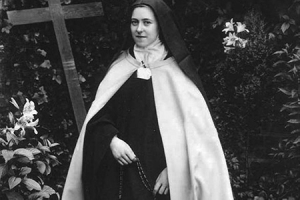
The ‘little way’: a spirituality of the everyday
Second Ongoing Formation Meeting European Carmelite Family
24 February 2024
Giampiero Molinari, O. Carm.
pdf
Questions for reflection - St Thérèse of Lisieux(365 KB)
“It is trust and nothing but trust that must lead us to Love” (LT 197)[1] : I find it significant that the incipit of the Apostolic Exhortation published on the occasion of the 150th anniversary of Teresa’s birth was taken from the letter of 17 September 1896 to Sister Mary of the Sacred Heart and that Pope Francis comments in these terms: “These words (...) say it all, they summarise the genius of her spirituality and would be sufficient to justify the fact that she was declared a Doctor of the Church” (no. 2).
This letter, in fact, is the complement to Manuscript B (drafted in September 1896 and described as a jewel of spiritual literature[2]), which we can consider the ‘manifesto’ of the ‘little way’, that is, the path to holiness that Thérèse intuited, lived personally and then proposed to her sisters, to the two missionary brothers and to anyone who approaches her writings.
The Discovery of the ‘Little Way
As we know, the saint narrates the discovery of the “little way” in the first pages of Manuscript C (cf. Ms C 2v-3r). We can date it, with a wide margin of certainty, shortly after 14 September 1894[3] : on that date, in fact, Sister Celine entered the monastery, bringing with her a notebook in which she had written some passages from the Old Testament, including Pr 9:4 and Is 66:12-13. These two texts were to constitute the biblical basis for the intuition and consequent formulation of “a little way that is entirely new” (Ms C 2v), given the impossibility of “climbing the hard ladder of perfection” (Ms C 3r). The young Carmelite, in fact, is aware of her own fragility to the point of considering herself a “grain of sand, obscure, trampled by the feet of passers-by” (Ms C 2v). Yet her desire for holiness is not diminished: for this she must find a path that conforms to her real possibilities, a sort of ‘lift’.
It is in this context of research that Thérèse comes across the above-mentioned texts, which she reads in the Latin translation of the Vulgate: “If anyone is very small, let him come to me” (Pr 9:4). We note that, in the manuscript, it is Teresa herself who emphasises the expression “very small”: a sign that this verse shows itself to her, at this particular juncture, as the Word of God for her. We can guess this from what she writes: “I had found what I was looking for” (Ms C 3r).
Continuing on, she comes across Is 66:13, 12: “As a mother caresses her child, so will I comfort you: I will carry you in my arms and cradle you in my lap”. Here she receives the key enlightenment:
Never have more tender, more melodious words gladdened my soul! The lift that must lift me up to Heaven are your arms, O Jesus! For this I do not need to grow, rather I need to remain small, to become more and more small (Ms C 3r).
Thérèse’s joy is based on this biblical ‘confirmation’ of the merciful face of God, who is Father and Mother, who takes us into his arms. The saint manifests before these verses all her astonishment full of gratitude: “after such language, there is nothing left to do but remain silent and weep with gratitude and love!...” (Ms B 1r), she writes in Manuscript B. It is from the contemplation of such paternity/maternity of God that trust springs forth, the backbone of the ‘little way’, presented to Sister Sister Maria of the Sacred Heart precisely as ‘the abandonment of the child who falls asleep without fear in the arms of his Father’ (Ms B 1r). Consequently, no one is precluded from the path of holiness:
If all weak and imperfect souls felt what the smallest of all souls, the soul of his little Thérèse, feels, not a single one of them would despair of reaching the top of the mountain of love! (Ms B 1v).
“Remaining small” and becoming “ever smaller” means precisely this: recognising one’s own creaturely frailty, accepting it and placing oneself confidently in the merciful arms of God[4] . Thus she writes to Fr. Roulland:
My path is one of trust and love [...] I take the Holy Scripture[5] . Then everything appears luminous to me: a single word unveils infinite horizons to my soul; perfection appears easy to me; I see that it is enough to recognise one’s own nothingness and abandon oneself like a child in the arms of the good God (LT 226, 9 May 1897. Bold mine).
We are in the area of the primacy of grace, on which we dwelt in the last meeting[6] . In the Apostolic Exhortation Pope Francis makes this clear: “In the face of a Pelagian idea of holiness (...) Teresina always emphasises the primacy of God’s action, of his grace” (no. 17). It is a matter of “placing the trust of the heart outside ourselves: in the infinite mercy of a God who loves without limits and who gave everything on the Cross of Jesus” (no. 20).
The ‘Little Way’ as an Enhancement of the Everyday
In Manuscript B, Thérèse uses the comparison of the child who, to show his love, knows nothing more than to ‘throw flowers’ to describe the ‘little way’:
the little child will throw flowers, infuse the royal throne with its perfumes, sing with its silvery voice the canticle of Love! (Ms B 4r).
This symbol has nothing romantic about it, as it concretely means
let no small sacrifice escape, no look, no word, take advantage of all the smallest things and do them out of love! (Ms B 4rv).
I find this passage fundamental, as in my opinion it gives us the right perspective to understand the essence of the ‘little way’: an appreciation of daily life as the main place of sanctification. It is a matter, in fact, of offering joys and labours, in generous fidelity to the duties of one’s state, performing all actions with a big heart, even the apparently more banal and almost monotonous ones that permeate everyday life. After all, what Thérèse proposes to us is nothing other than the holiness of the everyday or ‘next door’, to use the symbol chosen by Pope Francis in his Apostolic Exhortation Gaudete et exsultate on holiness in the contemporary world (nos. 6-9). For the topic at hand, I refer in particular to paragraph 7:
I like to see holiness in the patient people of God: in the parents who raise their children with so much love, in the men and women who work to bring bread home, in the sick, in the elderly religious who keep smiling. In this perseverance to go on day after day I see the holiness of the militant Church (...) the middle class of holiness (no. 7).
The valuing of the everyday already shines through in a letter to Celina in 1893. Here is an excerpt:
when I don’t feel anything, when I am incapable of praying, of practising virtue: it is then the moment to look for little occasions, little things that please [...] Jesus [...]: for example, a smile, a pleasant word when I would have wished to say nothing or to look grumpy, etc., etc. [...] I am not always faithful, but I am never discouraged; I abandon myself in the arms of Jesus (LT 143. Bold mine).
On closer inspection, it is the style that Titus Brandsma, still a novice, would later follow and recommend to others: ‘Do every day’s work to perfection, even the most mundane. It is very simple. Follow our Lord like a child. I jump after Him as best I can. I put my trust in Him and put aside all worries’[7] .
The ‘Little Way:’ A Low-Profile Spirituality?
A superficial reading of some passages might lead one to believe that the “little way” is basically a low-profile spirituality. But if we reflect on it calmly, we will realise that living the values of trust, abandonment and fidelity to daily life is anything but obvious! Rather, it is, in my opinion, a conscious choice of the “narrow gate” of which the Gospel speaks to us (cf. Mt 7:13-14). The pages of Manuscript C in which the saint reflects on charity as concrete fraternal love (cf. Ms C 11v-31r) are an eloquent testimony to this.
Secondly, trust requires an act of faith, since - the theologian Robert Cheib rightly points out - “the Other remains other and different from our projections of him. All the more so the Other who is God’[8]. Thérèse herself knows something of this at the moment in which, from Easter 1896, she finds herself experiencing the “trial against faith and hope” (cf. Ms C 4v-7v): her heart is invaded by the “thickest darkness” (cf. Ms C 5v) and the thought of the heavenly homeland is replaced by the “night of nothingness” (cf. Ms C 6v), “a wall that rises up to the heavens and covers the starry firmament” (Ms C 7v). Paradoxically, this time of trial makes Thérèse’s confidence even more granitic[9] : “I believe I have made more acts of faith from a year up to now than during my whole life” (Ms C 7r), she writes in Manuscript C, noting that since the Lord
has allowed me to suffer temptations against the faith, has greatly increased the spirit of faith in my heart (Ms C 11r. Bold mine).
In the last pages of Manuscript C, speaking directly to Jesus, the saint continues to sing of his mercy in these terms:
Your love has hindered me since childhood, it has grown with me, and now it is an abyss whose depth I cannot plumb (Ms C 35r. Bold mine).
These expressions are astonishing when one considers that they come from the lips of a 24-year-old woman who is seriously ill with tuberculosis and is experiencing the absence of God’s sensitive consolation.
The maturity that transpires from these words, I believe, is the best manifestation of the seriousness and depth of the spiritual path travelled and subsequently proposed by Thérèse: a total trust that springs from the awareness of being, in every case, in God’s hands and that translates into docility to the transforming action of his Merciful Love. The saint speaks of this clearly in the letter to Sister Mary of the Sacred Heart, already cited:
the weaker one is, without desires or virtue, the more suited one is to the operations of this Love that consumes and transforms! [...] we love our littleness, we prefer to feel nothing! Then we shall be poor in spirit and Jesus [...] will transform us into flames of love! (LT 197. Bold mine).
We are in the “heart” of the “little way” and the Offering to Merciful Love:
My very weakness gives me the audacity to offer myself as a victim to your Love, O Jesus! [...] for Love to be fully satisfied, it must lower itself, lower itself to nothingness and turn this nothingness into fire (Ms B 3v).
Concluding: Three Biblical Prototypes of the ‘Little Way’
In order to delineate the “little way” as a valorisation of the everyday, Thérèse resorts mainly to the Virgin Mary, presenting her as the one who practised the “humblest virtues” (P. 54:6). In the light of the Gospel and distancing herself from the preaching of her time (and anticipating, to some extent, the Second Vatican Council), the saint is fascinated by the ordinary life of Our Lady and contemplates her as the one who first trod the ‘common way’. This is what we read in stanza 17 of the poem Perché t’amo, Maria (May 1897):
I know that in Nazareth, Mother of full grace, / you were poor and wanted nothing more: / no miracles or ecstasies or raptures / adorn your life, Queen of Saints! / On earth the number of little ones is great / who can look at you without trembling. / The common way, incomparable Mother, / you want to take and lead them to Heaven (P 54:17).
In the penultimate folio of Manuscript C, Thérèse to some extent summarises the content of the “little way” using two biblical characters: the publican in the temple (cf. Lk 18:13) and the forgiven sinner, whom - according to the practice of the time - she identifies with the Magdalene (cf. Lk 7:36-38). Thus he writes:
It is not to the first place, but to the last that I rush. Instead of stepping forward with the Pharisee, I repeat, full of confidence, the humble prayer of the publican, but above all I imitate the behaviour of the Magdalene, her astonishing or, rather, loving audacity that captivates the heart of Jesus, seduces my own (Ms C 36v. Bold mine)[10] .
Here is the essence of the ‘little way’: trust, in the acceptance of one’s own vulnerability, and love. With these two words ends the unfinished Manuscript C, but which we could providentially read as the synthesis of the entire life of St. Therese of the Child Jesus of the Holy Face.
[1] I quote the writings of the saint using the following edition: St Teresa of the Child Jesus and the Holy Face, Complete Works. Writings and Last Words, LEV-OCD, Vatican City-Rome 1997. I use the usual abbreviations: Ms B, C: Autobiographical Manuscripts B, C; LT: Letters; P: Poems.
[2] Cf. C. De Meester, "Empty-handed". The Message of Teresa of Lisieux, Queriniana, Brescia 19975 , 78.
[3] Cf. Idem, Teresa of Lisieux. Dynamica della fiducia. Genesis and structure of the "way of spiritual childhood", San Paolo, Cinisello Balsamo 1996, 75-80.
[4] Cf. Idem, "Empty-handed", 61.
[5] This is in contrast to 'certain spiritual treatises, in which perfection is presented through a thousand obstacles' (LT 226) and which end up parching Teresa's heart and tiring her mind.
[6] As we pointed out on that occasion, Teresa summarises all this in this splendid passage from Manuscript A: 'I do not rely on my own merits, since I have none, but I hope in Him who is Virtue, Holiness Himself: it is He alone who, content with my feeble efforts, will elevate me to Him and, covering me with His infinite merits, will make me holy' (Ms A 32r).
[7] Quoted in S. Scapin - B. Secondin, Titus Brandsma. Maestro di umanità, martire della libertà, Edizioni Paoline, Milan 1990, 23.
[8] R. Cheaib, The Agapic and Nuptial Hermeneutics of the Night of Thérèse of Lisieux in Teresianum 73 (2022/2), 554.
[9] Ibid, 546.
[10] Teresa takes up the figure of Magdalene in her letter to the seminarian Bellière, dated 21 June 1897 (the same month in which Manuscript C was written): "When I see Magdalene advancing in the midst of the numerous guests, bathing with her tears the feet of her adored Master, whom she touches for the first time, I feel that her heart has understood the abysses of love and mercy of the Heart of Jesus and that, however much of a sinner she may be, this Heart of love is not only willing to forgive her, but also to lavish on her the benefits of its divine intimacy, to raise her up to the highest peaks of contemplation" (LT 247).
First Conference: The Journey of Thérèse of Lisieux
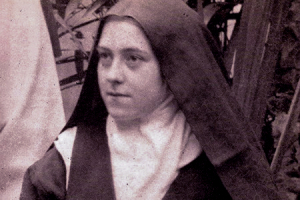
The Journey of Thérèse of Lisieux
As a conformation to Christ:
Mercy in fragility and primacy of grace
First Meeting of Ongoing Formation of European Carmelites
October 21, 2023
Giampiero Molinari, O. Carm.
pdf To read the Questions for Reflection - Mercy & Grace(365 KB)
Introduction
In this year we are celebrating the 150th anniversary of the birth of Saint Thérèse of Lisieux (2 January 1873) and the centenary of her beatification (29 April 1923). 2025 will be the centenary of the canonization (May 17, 1925). As we know, UNESCO has also placed Thérèse among the historically significant women. All this is a good reason to take up her writings and reread her doctrine, trying to bring it into life.
In approaching Thérèse we must not forget a fact: if on the one hand she is certainly a light for having recalled the perennial values of the Gospel, on the other (like each of us) she remains a daughter of her own time. Her writing is influenced by the romantic and somewhat honeyed atmosphere of the time and is characterized by a wide use of diminutives, prolonged punctuation marks, etc. All this may not facilitate reading and also create a certain annoyance! If, however, a little effort is made and we go beyond this “rind”, we will discover a very deep spiritual experience (substantially not understood when the saint was alive) and a doctrine, which we can define as a narrative and symbolic theology.
The Experience of Divine Mercy in the Root of One’s Own Fragility:
A Microhistory of Salvation
We can consider Thérèse of Lisieux as the Doctor of divine mercy. This theme appears, in fact, as the leitmotif of the two autobiographical manuscripts in which she rereads her own life (Manuscript A, whose drafting begins at the beginning of 1895, and Manuscript C, written from June 1897).
At the beginning of Manuscript A, Thérèse outlines the intended purpose:
I will do only one thing: begin to sing what I must repeat forever – “The mercies of the Lord” (Ms A 2r).[1]
Manuscript C is on the same wavelength; addressing the prioress, Mother Mary of Gonzaga, the saint writes: “Beloved Mother, she has expressed to me the desire that I complete with her my Song of the Mercies of the Lord” (Ms C, 1r).
In this regard, we must not underestimate the beginning “incipit” of Manuscript A: “Spring History of a White Flower” (Ms A 2r) – which would be better translated “small white flower” (respecting the original French) – since in Thérèse’s intention it contains a profound experience of God’s mercy. It is, in fact, the saxifrage[i] that her father gives her after he confided to him the desire to enter Carmel:
What I remember perfectly was the symbolic gesture that my beloved King made without knowing it. Approaching a wall not very high, he showed me some white flowers similar to miniature lilies and, taking one of those flowers, he gave it to me, explaining to me how carefully the good Lord had given birth to it and had kept it until that day. Hearing him speak, I thought I was listening to my story, such was the similarity between what Jesus had done for the little flower and the little Teresa” (Ms A, 50v. Bold mine).
In her Manuscripts, therefore, Thérèse rereads her own life as a micro-history of salvation: she is not the centre, but God’s merciful action in her. The saint is clear on this point: “it is not my real life that I will write, but my thoughts on the graces that the Good Lord has deigned to grant me” (Ms A, 3r). And shortly after: “The flower that will tell its story [...] he recognizes [...] that only his mercy has done all that is good in him” (Ms A, 3v).
- The Context of Fragility
The theme of divine mercy shines even more if we consider Thérèse’s experience, especially in the first years of her life. A period marked by various traumatic events, which produce not minor wounds, blocking, in a certain way, the natural affective maturation. Here they are in summary:
- The two separations experienced around the age of two months: from her mother, who cannot breastfeed her because of breast cancer and must entrust her to a nurse and, subsequently, from the latter following the return to the family.
- The illness and subsequent death of her mother in 1877 (cf. Ms A 12r-13r):
I don’t remember crying much and I didn’t talk to anyone about the deep feelings I felt... I watched and listened in silence... [...], yet I understood (Ms A 12v. Bold mine).
On the following page we read:
starting from the death of Mother, my happy character changed completely; I became so lively, so expansive, shy and sweet, sensitive to excess. One look was enough to make me melt into tears (Ms A 13r).
- The departure for Carmel of her sister Pauline, whom Thérèse had chosen as her second mother (cf. Ms A 13r):
I did not know what Carmel was, but I understood that Pauline would leave me to enter a convent, I understood [...] that I would lose my second Mother!... Ah, how can I tell the anguish of my heart?... In a moment I understood what life was [...] a continuous suffering and separation. I shed very bitter tears... (Ms A 25v. Bold mine).
- Narrating the departure for Carmel of his sister Mary – who, after the separation from Pauline, had taken as her only support (cf. Ms A, 41r) – Thérèse returns to the theme: “Pauline was far away, very far from me... [...]. Pauline was lost to me, almost as if she were dead” (Ms A, 41r-41v). These are very strong words, which reveal the drama she is experiencing.
- The Experience of Mercy with Marian and Christological Tones
As we know, all these traumatic situations cause the onset of a psychosomatic illness, characterized by symptoms such as insomnia, tremors, headaches, hallucinations, etc. It is a kind of neurosis and childhood regression. Paradoxically, it is precisely in this phase of extreme fragility and vulnerability that Thérèse experiences God’s mercy, to the point of affirming – rereading her own life – that the characteristic of love, of grace, is to humble oneself (cf. Ms A 2v). The saint can say this because she experienced at this particular juncture a God who bends down to her misery. For this reason, in writing Manuscript A, now “matured in the crucible of external and interior trials” (Ms A, 3r), she cites Psalm 22 (The Lord is my shepherd), highlighting with conviction: “The Lord has always been compassionate and full of sweetness towards me” (Ms A, 3v).
The healing journey lived by the saint (which we could define as a sort of personal “path of salvation”) is characterized by two fundamental stages with a Marian and Christological tone, respectively.
We all know the story of Our Lady’s “enchanting smile” (Cfr. Ms A 30v-30r), thanks to which Thérèse regains a substantial (although not complete) basic serenity: “all my sufferings vanished” (Ms A 30r), “the little flower was being reborn to life” (Ms C 30v), we read in Manuscript A. Reading this story carefully we will realize that the saint perceives the smile of the Virgin as the reflection of God’s tenderness. This can be guessed from the use of the symbol of the “sun” that is applied to God to emphasize his benevolence (cf. Ms A 3r), but later it is also extended to the Virgin Mary (cf. Ms A 29v) and to the creatures themselves at the moment in which they are perceived in the act of mediating the care of the divine Sun (cf. Ms A 24r).
Although restored, Thérèse is still distinguished by a remarkable hypersensitivity, which she defines as an “ugly defect” (cf. Ms A 44v). She describes as follows:
I was really unbearable for my excessive sensitivity; so, if I happened to unintentionally give a little displeasure to a person I loved [...] I wept like a Magdalene and, when I began to console myself with the thing itself, I cried for having cried... (Ms A 44v).
At this point the merciful action of the Father will take on a Christological connotation, centred on the abasement of the Son of God in the mystery of the Incarnation. This is the well-known “Christmas Grace” of 1886 (cf. Ms A 44v-45v), defined by the saint: “the grace of my complete conversion” (Ms A 45r). It constitutes, in fact, a real “watershed”: Thérèse perceives herself so transformed that she no longer recognizes herself; From that moment, she writes, “I walked from victory to victory and began, so to speak, ‘a enormous race!...’“ (Ms A 44v).
For the theme we are dealing with, the synthesis proposed by Thérèse herself is interesting:
In an instant the work that I had not been able to do in 10 years, Jesus did it by being content with my good will that I never lacked (Ms A 45v).
In this rereading of the event of Christmas 1886 I seem to grasp, in fact, how the saint is now aware of the primacy of grace: it is always the love of God that takes the first step, being content with our “good will”.
- The Underlying Message:
A Gaze of Faith that Opens to Hope
Through her experience, therefore, Thérèse opens us to hope: no wound, no limit can block our path of maturation towards holiness if we surrender ourselves to the transforming action of the Spirit. Limitations, wounds, psychophysical fragility, the ‘chiaroscuro` (light and shade] of life can become horizons of grace to[2] the extent that our daily life is given with trust to God.
Thérèse could very well turn in on herself, remain a prisoner of her wounds. Openness to grace, on the other hand, enables her to leave the “childhood phase” (cf. Ms A, 44) to live in the perspective of the gift of self: “I felt [...] the need to forget myself to please and since then I have been happy!” (Ms A 45v), she writes at the conclusion of the story of the “Christmas Grace”.
The saint invites us to refine our gaze of faith: despite all the setbacks that may arise, in the soil of our life there are many seeds of God’s mercy (cf. Dt 6:10-13). Pope Francis also reminds us of this in the Apostolic Exhortation Gaudete et exsultate: “Look at your history when you pray and in it you will find so much mercy. At the same time this will nourish your awareness that the Lord keeps you in his memory and never forgets you” (n. 153).
It is precisely this awareness, matured over the years, that leads Thérèse to a new vision of perfection. She talks about it in folio 32r of Manuscript A (which according to Conrad de Meester, ocd represents one of the best formulations of the “little way”[3]):
I always feel the same bold confidence to become a great Saint, because I do not rely on my merits, since I have none, but I hope in Him who is Virtue, Holiness Itself: it is He alone who, being content with my weak efforts, will raise me up to Him and, covering me with His infinite merits, will make me Holy (Ms A, 32r. Bold mine).
It is the primacy of grace, the awareness of the gratuitousness of salvation, to which the saint arrives through a gradual journey of conforming to Christ.
Conforming to the Face of Christ:
From voluntarism to the gratuitousness of salvation
Simplifying the debate a little, we can affirm that the dominant spirituality at the time of Thérèse is characterized by rigorism, asceticism, the offering to the Justice of God in reparation for sins and voluntarism. At the centre we find personal effort, the need to acquire merits.
This atmosphere is obviously also breathed in the Carmel of Lisieux (although the spiritual vision of St. Francis de Sales is also gaining ground) and we can also see it in Thérèse. On January 8, 1889, two days before the clothing, she wrote to her sister Sr. Maria of the Sacred Heart: “How thirsty I am for Heaven [...]. But it is necessary to suffer and weep to reach it... Well! I want to suffer whatever pleases Jesus” (LT 79). In the same year, reporting on the speech of a preacher, she wrote to Céline: “Holiness consists in suffering and suffering everything. “Holiness! it must be conquered with the unsheathed sword...” (LT 89).
- “The Mysteries of Love Hidden in the Face of our Bridegroom” (Ms A 71r):
Devotion to the Holy Face and the Illness of Louis Martin
Another traumatic moment in Thérèse’s life is represented by the illness of her father, to whom she was very close. A source of particular suffering will be his hospitalization, on February 12, 1889, in a psychiatric hospital in Caen, due to the intensification of senile dementia. The expressions with which the saint recalls the event are significant:
Ah, I didn’t say that day that I could suffer more!!! Words cannot express our anxieties, so I will not try to describe them (Ms A 73r).
Even with suffering (as also shown by the graphological examination of the letters written in this period), Thérèse faces the new trial with great spiritual maturity. Her father’s illness led her to deepen her devotion to the Holy Face, already lived in the family and later in the monastery. In fact, in the no longer recognizable face of the father she sees the features of the Suffering Servant described by the prophet Isaiah (cf. Is 53:1-5 and 63:1-5) and understands more deeply the abyss of humiliation into which the Son of God wished to descend.
The close link that Thérèse places between the trial that struck her father and the Passion of the Lord appears clearly in a Holy Face that she draws in a chasuble shortly after the death of her father, which took place on July 29, 1894. Observing it even superficially, in fact, the similarity of this image of the Holy Face with the somatic features of Louis Martin does not escape[4].
In the light of Scripture and her father’s illness, Thérèse discovers the essence of the Holy Face: she speaks of “mysteries of love” (cf. Ms A 71r), of “hidden beauties” (cf. LT 108). In her letter of 4 April 1889 she wrote to Céline: “Jesus burns with love for us [...] Look at Jesus in his Face and there you will see how he loves us (LT 87).
In the disfigured Face of the Lord, Thérèse contemplates God’s crazy and gratuitous love for each one of us, beyond our merits. Before that Face there is no longer room for optional, for titanic effort or for the search for merits, but gratitude for an ever anticipated divine grace. Suffering itself acquires meaning only if it is the consequence of love and fidelity to the Gospel. In the letter of July 6, 1893, the saint addresses Céline with these significant words:
He [Jesus] teaches her to play at the bank of love; but, no, rather it is He who plays with her, without telling her how He does, since this is her business and not Thérèse’s; what concerns her is to abandon herself, to give herself without reserving anything, not even the satisfaction of knowing how much the bank yields (LT 142. Bold mine).
And in the Act of Offering to Merciful Love, of 9 June 1895, she writes: “In the evening of this life, I will appear before you empty-handed, because I do not ask you, Lord, to count my works” (Pr 6. Bold mine).
Significant is what the saint reports in the last pages of Manuscript C (written in June 1897, therefore three months before her death): “here below I cannot conceive of an immensity of love greater than that which you were pleased on my part to lavish freely without any merit on my part” (Ms C, 35r. Bold mine).
Conrad De Meester summarizes Thérèse’s journey in these terms:
Holiness [...] is no longer a conquest but a grace received. Man, before the God of love, becomes more passive, more receptive. [...] man’s first commitment is to open himself completely to the Redeemer, while his effort becomes collaboration[5].
And further on: “The will to conquer has been completely transformed into receptivity to the gift”.[6] Obviously this does not mean a low-profile spirituality: Thérèse in fact – De Meester underlines – “does not neglect any effort to be faithful [...] to the will of God as it is manifested in concrete life.”[7] The difference lies in a greater peace of mind in the face of powerlessness and one’s own fragility. Letter 142 of 6 July 1893, which we have already quoted in part, constitutes a sort of “manifesto” in this regard.
- “Let Me Resemble You, Jesus!” (Pr 11)
At this point in her journey, therefore, Thérèse sees holiness from a radically new perspective: it is a question of growing ever more in likeness to the Face of Christ. This is what she expresses in a very short prayer, written on a small parchment in which the Holy Face was depicted. The text sounds like this: “Make me resemble you, Jesus!” (Pr 11). Significant is the fact that the saint always carried this prayer with her, together with others, in a bag pinned with a pin on the side of the heart: almost a visible manifestation of the desire to live the gift of self as a response to the gratuitousness of salvation.
[1] I quote the writings of the saint using the following volume: S. Teresa di Gesù Bambino, Opere complete. Scritti e ultime parole, LEV-Edizioni OCD, Città del Vaticano-Roma 1997. [Quotations in the original Italian text are translated in this English version unofficially.]
[2] A. Piccirilli, Fragile come tutti, felice come pochi. Teresa di Lisieux e le nostre ferite, San Paolo, Cinisello Balsamo 2019, 14. [English translation of book title: Fragile as everyone, happy as few. Thérèse of Lisieux and our wounds.]
[3] C. De Meester, Teresa di Lisieux. Dinamica della fiducia. Genesi e struttura della «via dell’infanzia spirituale», San Paolo, Cinisello Balsamo 1996, 208-210.
[4] The image is visible in P. Descouvemont – H. N. Loose, Teresa e Lisieux, LEV, Vatican City 1995, 207.
[5] C. De Meester, A mani vuote. Il messaggio di Teresa di Lisieux, Queriniana, Brescia 19975, 44.
[6] Ibid., 52.
[7] Ibid., 53.
[i] Translator: Saxifrage, also known as rockfoil, any of the flowering plants of the family of Saxifragaceae.
Carmelite Student Retreat at Nocera Umbra
Carmelite Student Retreat at Nocera Umbra Brings Together Europeans for Week of Prayer and Fraternity
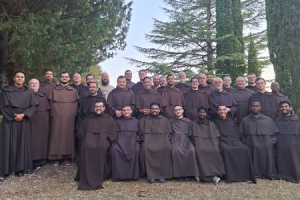
The retreat of the simply professed from the provinces, commissariats and delegations of Italy, France, Spain (Catalunia, Betica), Britain, La Bruna, Poland, Naples and Ireland, gathered in Nocera Umbra on July 29th until Sunday August 4th for a week of prayer, retreat, and fraternity. Some recently solemnly professed also joined the week. We are very grateful to the community in Nocera Umbra, and to our brothers in the Italian Province for hosting this wonderful retreat. We must also thank the hard work of the organising committee led by the General Councillor for Europe, Richard Byrne, O. Carm., and his team for pulling together the excellent team of speaker (Pat Mullins, O. Carm.) and translators (Matteo Antollini, O. Carm., and Eduardo Agosta, O. Carm.)
With each day beginning in prayer, led by a different language group, the group gathered for the first of many excellent talks. These took the form of an exploration of the readings of the day, the ‘sword of the spirit’ for our lives. With great skill, Pat wove in the deep traditions of our Carmelite charism, highlighting not only the importance of scripture as the foundation of prayer, but also how the themes and messages of the daily readings can be read constantly through the eyes of our own Formula of Life. We were reminded that the scriptures should be that tool by which we are called aside from our own ideas and plans for the day and to turn our attention towards the presence of God. At noon each day was the celebration of Eucharist with a variety of languages being used in the celebration.
After some time in the afternoons for personal reflection or group activities, we met together in the cooler evenings to hear Pat speak once more. Here he challenged us to reflect our calling as Carmelites in our world, our church and in our own provinces. Asking how can we be authentic witnesses to Carmelite life, and how can we be prophets for the world today? These sessions were followed by sharing in small language groups. An opportunity to share with one another the fruits of our personal reflection. Listening and learning from the witness of our Carmelite brothers.
The Friday of the retreat consisted of a pilgrimage to Assisi, some 30 minutes drive from Nocera Umbra itself. The pilgrimage began with in interesting tour of the city and the major basilicas by Matteo Antollini, O. Carm., followed by a wonderful meal and free time around the city.
The retreat ended with a final session in the small groups evaluating the retreat and looking ahead to the future. Asking ourselves the questions: How will I live out my Carmelite identity when I return to my home province/delegation? What will support me in my Carmelite formation in the future? The retreat ended on the Saturday evening with a wonderful meal, provided by the parishioners of the parish served by the friars in Nocera Umbra, and music and dance celebrating the many cultures and countries represented by the group.
Once again, the participants of the retreat thank Richard Byrne, O. Carm., and his team for their organisation of the retreat, and for their attentiveness to making it an atmosphere of fraternity and generosity in which all participants were enabled to share their experiences of Carmel, and Carmelite life. To Pat Mullins, O. Carm., thanks for his insightful talks and sessions. And finally, thanks to the community of Nocera Umbra for opening their house to the simply professed friars of Europe.
By Matthew Janvier, O. Carm. (Brit)
The Prior General's Schedule for October 2024
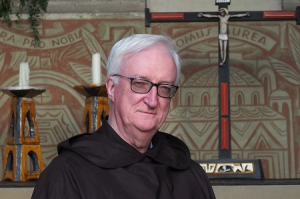
Fr. Míċeál O’Neill, the prior general, has the following schedule planned for the month of October 2024:
October 1-4: General Council, plenary session
October 6-11: Canonical Visitation in Tanzania
October 11: Lecture via zoom to the Ongoing Formation Course on Titus Brandsma
October 11-19: Canonical Visitation in Kenya
October 17: Conference via zoom with the Assembly of the Italian Federation of Carmelite Nuns
October 21-November 1: Canonical Visitation in Germany
World Communications Day 2025
World Communications Day 2025: Create the Condition for Dialogue
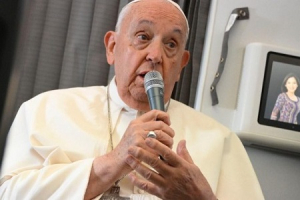
The Vatican Press Office released the theme of the Catholic Church’s 59th World Communications Day, celebrated on the Sunday before Pentecost. In 2025 the day will be celebrated on June 1. Pope Francis chose the theme Share with Gentleness the Hope that is in Your Hearts, communication that creates the condition for dialogue. The theme comes from the First Letter of Peter (3:15-16).
The theme aims to bring attention to the fact that in today's world, "too often communication is violent, aimed at striking and not at establishing the conditions for dialogue." This theme calls for efforts "to disarm communication, to cleanse it of aggression."
According to reports in Vatican News, the notes describing the theme holds that the prevailing standard seems to be that of competition, opposition, and domination as can be seen in television talk shows to verbal wars on social media. It adds that for Christians, "hope is a person, and He is Christ." This hope is tied to community, since "when we speak of Christian hope, we cannot disregard a community that lives the message of Jesus in such a credible way as to give a glimpse of the hope that it brings, and is capable of communicating the hope of Christ with deeds and words even today."
World Communications Day was established by Pope St. Paul VI in 1967 following the Second Vatican Council as an annual celebration that encourages reflection on the opportunities and challenges that the media offer and how the Church can better communicate the Gospel message.