


O.Carm
Bl. Jacques Retouret, Priest and Martyr
26 August Optional Memorial
Bl. Jacques Retouret was born at Limoges in France on 15th September 1746 to a merchant family. He was a serious young man, a lover of books and greatly gifted. At fifteen years of age, he entered the Carmelite house in his native city. After ordination, his zeal and learning were widely admired and large crowds of people were attracted by his way of preaching. Unfortunately, he was often unable to fulfil all his engagements, due to his persistent bad health which plagued him throughout his life.
The French Revolution did not spare him. Like the majority of his fellow clergy, Jacques refused to accept the civil law, unilaterally introduced by the state, which decreed, among other things, the election of bishops and parish priests by the people, only afterwards to be approved by the hierarchy and the pope. In addition to this refusal, Jacques was accused of siding with a group of political emigres who had invaded the country against the revolutionaries. He was arrested and condemned, together with many other priests and religious, and sentenced to exile in French Guinea in South America. Taken to Rochefort, he was held there in a prison ship. The British navy, at this time, was blockading the French coast and so preventing the departure of the prison ships. The conditions for the prisoners were beyond description: they were crowded together, hungry, plagued by sickness, and suffered from either the heat or the cold in overpowering smells, and persecuted by their gaolers.
Jacques died at Madame Isle, some miles distant from Rochefort, on 26th August 1794 at the age of 48 years. He was beatified, together with 63 other priests and religious, as martyrs for the faith, on 1st October 1995 by Pope John Paul II.
St. Mary of Jesus Crucified (OCD), Virgin
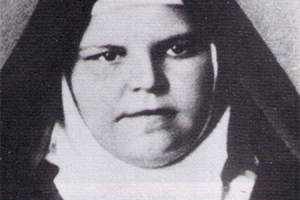
25 August Optional Memorial
Mariam Baouardy was born at Abellin in Galilee on 5th January 1846 to very poor parents who were good living and devoted Greek-rite Catholics. She was left an orphan after the death of her parents at only three years of age when, together with her brother Paul, she was entrusted to the care of an uncle,who had moved to Alexandria in Egypt a few years earlier. She never received any formal education and remained unable to read. At thirteen years of age, wanting to give herself only to God, she firmly refused the marriage which her uncle, according to the Eastern custom, had arranged for her.
Blessed Angelus Augustine Mazzinghi, Priest
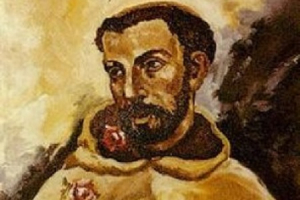
17 August Optional Memorial
The year of birth of Bl. Angelus Mazzinghi in Florence, Italy, or nearby, is unknown but it was certainly before 1386.
He was received into the Order in 1413 and was the first member of the reform at Santa Maria delle Selve.
He was prior there from 1419-30 and again in 1437, and in Florence from 1435-37. A lector in theology, he was particularly noted for his preaching of the word of God.
He died in Florence in 1438.
Blessed Isidore Bakanja, Martyr
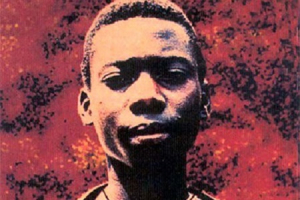
12 August Optional Memorial
Bl. Isidore Bakanja, a member of the Boangi tribe, was born in Bokendela (Congo) between 1880 and 1890.
In order to survive, even as a boy, he had to work as bricklayer or in farms. He was converted to Christianity in 1906. He was working in a plantation run by a colonialist in Ikili and was forbidden by the owner to spread Christianity among his fellow-workers.
On 22 April 1909, the superintendent of the business tore off the Carmelite Scapular, which Isidore was wearing as an expression of his Christian faith, and had him severely beaten even to drawing blood.
He died on 15 August of the same year as a result of the wounds inflicted in "punishment" for his faith and which he bore patiently while forgiving his aggressor.
He was beatified by Pope John Paul II on 24 April 1994.
St. Teresa Benedicta of the Cross (OCD)
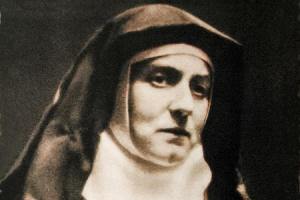
9 August Memorial (Feast in the provinces of Europe: Patron of Europe)
Edith Stein was born at Breslau on 12th October 1891 to German Jewish parents, and after her secondary education, she enroled in the department of philosophy in the city university.
She read the autobiography of Teresa of Avila and became aware of being called to become a Catholic; she was baptized on 1st January 1922. She made her First Communion the same day and was confirmed on the following 2nd February. After her conversion, she felt herself attracted to the religious life but circumstances forced her to delay this decision until 1933. When in 1933 she lost her teaching post as a result of the anti-Jewish laws, she entered into the Carmel at Cologne on 14th October 1933, taking the name of Teresa Benedict of the Cross.
On 31st December 1938 she was moved to the Carmel at Echt in Holland so as to escape the Nazi persecution of the Jews.
Sister Teresa, accompanied by her sister Rosa who had also become a Catholic, was taken to Amersfort on 2nd August 1942. On 3rd August, she was transferred to Westerbork. On 7th August, she and her sister together with other deportees were locked in railway wagons and taken by train to the extermination camp at Auschwitz, a voyage which took two days.
Sister Teresa Benedict of the Cross died in the gas chamber the same day that she arrived at the camp at Auschwitz, Sunday 9th August 1942, and her body was burned in one of the crematoria there. She was beatified on 1 May 1987 and canonized on 11 October 1998 by Pope John Paul II. On 2 October 1999 the same Pope proclaimed her co-patron of Europe.
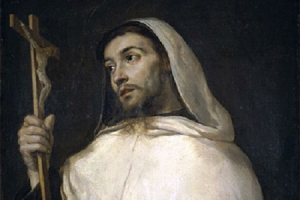
St. Albert of Trapani, Priest
7 August Feast
Born in Trapani (Scilia) in the 13th century. He distinguished himself for his dediction to mendicant preaching and the notoriety of his miracles. In the years 1280 and 1289 he was in Trapani and shortly afterwards in Messina. In the year 1296 he was prior provincial of the Carmelite Province of Sicily. He was celebrated for his passionate love for purity and prayer. He died in Messina most likely in 1307.
Lectio Divina September, 2024
Opening Prayer
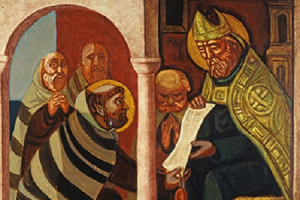
Lord Jesus, send your Spirit to help us to read the Scriptures with the same mind that you read them to the disciples on the way to Emmaus. In the light of the Word, written in the Bible, you helped them to discover the presence of God in the disturbing events of your sentence and death. Thus, the cross that seemed to be the end of all hope became for them the source of life and of resurrection.
Create in us silence so that we may listen to your voice in Creation and in the Scriptures, in events and in people, above all in the poor and suffering. May your word guide us so that we too, like the two disciples from Emmaus, may experience the force of your resurrection and witness to others that you are alive in our midst as source of fraternity, justice, and peace. We ask this of you, Jesus, Son of Mary, who revealed to us the Father and sent us your Spirit. Amen.
Celebrating At Home - 18th Sunday in Ordinary Time
I am the Bread of Life
(Jn 6:24-35)
Our journey through Chapter 6 of St John’s Gospel continues. Two weeks ago, Jesus showed himself the true shepherd-king, feeding the inner hunger of the people for the Word of God. Last week, Jesus fed the physical hunger of a great multitude with a simple meal of bread and fish. The people, impressed by what they saw, wanted to make him their warrior-king, one who would lead them in a revolt against the occupying Romans and satisfy their every desire. Jesus escaped into the hills.
This Sunday, the crowd has caught up with Jesus. He accuses them of looking for him only because he gave them all the bread they wanted to eat, not because they had understood that the bread was a sign of the real food Jesus was offering: himself. Jesus urges them to work for ‘food that endures to eternal life’. Working for this food means to believe in the one God has sent: Jesus himself.
The crowd asks for a sign to prove that they should believe in Jesus. After all, they say, Moses gave our ancestors bread to eat in the desert; what will you do? Their request underlines their failure to really see the sign that they had already been given. Jesus reformulates their quote from scripture: It is God who gives the true bread from heaven, the bread of God which gives life to the world. In that case, they say, give us that bread always.
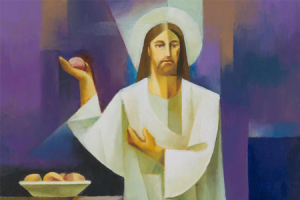
Jesus replies: I am the bread of life, those who come to me will never be hungry; those who believe in me will never thirst. Jesus is real food for the hungers and thirsts of the human heart.
To be nourished by Jesus one must believe (have faith) in him. This implies a personal relationship with Jesus. Once this personal relationship has been established everything else finds its proper place and true purpose. Our relationships feed and sustain us as human beings. They are born of the food of love, compassion and forgiveness. Being in a relationship is to be drawn into communion with another person. We always draw life from those we love and those who love us. It is the same with Jesus. In order to draw life from him, to be fed by him, we have to be in loving relationship with him.
- pdf Celebrating At Home - 18th Sunday in Ordinary Time [PDF](3.22 MB)
- default Celebrating At Home - 18th Sunday in Ordinary Time [ePub](4.88 MB)
- pdf Celebrando en Familia - XVIII Domingo del Tiempo Ordinario(512 KB)
- pdf Celebrando in Casa - XVIII Domenica del Tempo Ordinario(509 KB)
- pdf Celebrando em família - Décimo Oitavo Domingo do Tempo Comum(509 KB)
Lectio Divina August, 2024
Opening Prayer
God our Father and protector, without you nothing is holy, nothing has value.
Guide us to everlasting life by helping us to use wisely the blessings you have given to the world.
We ask this through our Lord Jesus Christ, your Son, who lives and reigns with you and the Holy Spirit, one God, for ever and ever. Amen.
Our Lady of Mount Carmel Celebrated Around the World
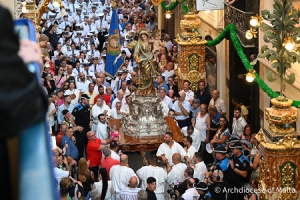
July is a busy month for the Carmelite Order with celebrations of many of its saints and blesseds. The month also includes celebrations of both Our Lady of Mount Carmel and the Prophet Elijah. Each has a particular resonance with members of the Order and are celebrated in a variety of ways around the world. Here are a few of the celebrations we learned about over the past several days. We appreciate members sending a short summary as well as pictures of their celebrations.
Carmel in Albacete, Spain
From July 7 to 15, a novena to Our Lady of Mount Carmen was solemnly celebrated in the Cathedral of Albacete. Presiding and preaching the novena was Matias Tejerina, O. Carm.
There was a large crowd of the faithful and people devoted to the Virgin of Mount Carmel. There is a group of Carmelite Tertiaries and Confreres in Albacete who keep the Carmelite charism alive. They prepare the novena every year and have an oratory in the middle of the city which is open every day for prayer. Eucharist is celebrated there three times a month presided by Fr. Alfonso Herrera, O. Carm., the spiritual director of the Tertiaries. Also in Albacete is a community of Carmelite sisters of the Sacred Heart of Jesus who minister in the parish of San Pablo. They also lead a very active and pastorally committed group of Carmelite Laity.
Huesca, Spain
The Carmelite nuns of the Monastery of the Encarnation San Miguel in Huesca, Spain, provided a film of their celebration of Our Lady of Mount Carmel in 2024. The monastery dates to 1622. (Sor Mª Blanca de la Eucaristía Barril, O. Carm.)
To watch the video
St. Thomas Province, India
The celebration of Our Lady of Mount Carmel in St. Thomas Province (India), especially within its communities, is a deeply cherished event. Community members gather together-- in unity and reverence-- to commemorate this special occasion. Neighboring religious communities are invited, fostering bonds of friendship and solidarity. As a symbol of faith and protection, scapulars are ceremoniously distributed to everyone who attends, signifying devotion to Our Lady of Mount Carmel. The celebrations highlight the spiritual significance of the occasion through songs and homilies and prayers. Traditional rituals and processions enhance the solemnity and cultural richness of the event. Special meals are prepared and then shared among the gathered community, reinforcing bonds of camaraderie and fellowship. The celebrations serve not only as a religious observance but also as a joyful expression of our cultural heritage and communal identity. Ultimately, these celebrations deepen devotion to Our Lady of Mount Carmel and reaffirm the participants' faith and commitment. Overall, the festivities reflect a deep-seated reverence and devotion that resonate throughout the Indian province and their local communities. (Deepak Aracka, O. Carm.)
Province of Malta
The Carmelite feast in Valletta on the July 16 is a major event. Many streets are decorated. Bands march in the streets over a four day period. There is a musical concert and a fireworks display. The religious celebration includes a 2 hour Solemn Mass in the morning and an evening Mass lead by the Archbishop Scicluna. This Mass is followed by a procession with the statue of Our Lady of Mount Carmel.
The Carmelite community also hosted a lunch with guests including the prior provincial of the Discalced Carmelites of Malta, the Canon and his wife from the Anglican Cathedral of St. Paul in Valletta, the parish priests of Valletta, the Suore Carmelitane Missionarie di S. Teresa del Bambino Gesù, two Domincans, and all the Carmelites of the Maltese Province who could attend.
General Delegation of Kenya
On July 16, 2024 the Kenyan Delegation gathered at the newly formed Carmelite community in central Kenya (the priory at Our Lady of Mt. Carmel Retreat Centre). The celebration was attended by many of the faithful as well as friars, religious sisters, Third Order Carmelites, and diocesan clergy.
Before the celebration of Mass, we held with a procession carrying a five foot (152.4 cm) statue of Our Lady of Mt. Carmel, to a newly constructed grotto on the property.
We continue to seek Her intercession as a Kenyan delegation especially as we continue the construction of the retreat centre to serve the people. (Daniel Kyalo, O. Carm.)
Malaga (Spain) Area
The city of Malaga in southern Spain and many of the towns and villages along the Costa del Sol celebrated Our Lady of Mount Carmel, the patron of seafarers, special festivities and processions on July 16. Even some inland towns and villages join in on the celebrations.