






O.Carm
Chapter Held in the Spanish Province of Bética
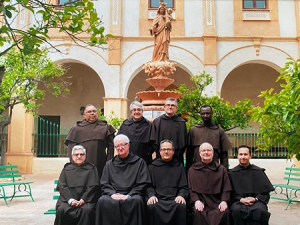
The Bética Province held their triennial provincial chapter April 3-5, 2023 in the Carmelite monastery of Osuna, 90 km from Seville, Spain.
The Bética Province was erected on February 26, 1499 by a bull of Pope Alexander VI. It was established from the dismembered houses of the Province of Castille. In 1835, the civil authorities closed all the houses. The restoration began when the Carmelite house of Jerez de la Frontera was reestablished on April 10, 1880.
In 1889 a Province of Spain was erected but in 1906 was divded into the Province of Arago-Valencia and the Province of Bética. However, from 1894 Carmelites from the Province of Spain worked to restore the Provinces of Rio de Janeiro and Pernambuco in Brazil. Work in Bahia continued even after the division in 1906. From 1925 until 1939, the members of the Bética Province worked to rebuild the Polish Province and from 1930 until 1954, Carmel in Portugal. In 1954, the province established the order in Venezuela and Colombia, eventually becoming a Provincial Commissariat. In 1974-1978 the houses in Colombia were closed. In 2000, members went to Burkina Faso in Africa to establish Carmel.
The following were elected to leadership:
. . .
Provincial | Provincial | Provinciale
P. David Del Carpio Horcajo, O. Carm.
1st Councilor | 1er Consejero | 1o Consigliere
P. Alejandro Peñalta Mohedano, O. Carm.
2nd Councilor | 2do Consejero | 2o Consigliere
P. José Manuel Granados Rivera, O. Carm.
3rd Councilor | 3er Consejero | 3o Consigliere
P. Francisco Daza Valverde, O. Carm.
4th Councilor | 4to Consejero | 4o Consigliere
P. José Ramón Medina Madueño, O. Carm.
Commissary Provincial of Venezuela | Comisario Provincial de Venezuela | Commissario Provinciale del Venezuela
P. Alexio Ordóñez Añez, O. Carm.
Vitam Coelo Reddiderunt

|
Ortus |
P. Temp |
P. Soll. |
Ord. |
|
|
05-03-23 |
|
|
|
|
|
11-03-23 |
|
|
|
|
|
20-03-23 |
|
|
|
|
|
02-04-23 |
|
|
|
|
Provincial Chapter of the Catalonian Province Held
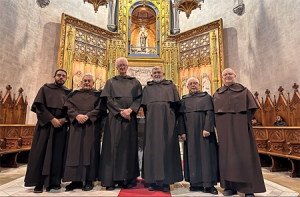
During the Provincial Chapter of the Catalonian Province held in Olot on March 29-31, the leadership was confirmed for the next three years.
The oldest foundations in the Catalonian province date to the middle of the 13th century. Perpini dates to around 1265 and Narbonne to 1321 were part of the Province of Spain. This are also became known as the Province of Aragon since the majority of the houses were located in the kingdoms or the territories of the so-called "Crown of Aragon." In 1336, the Vicariate of Perpinani was established which three years later became called "Perpiniani et Maioricarum." In 1342 it was erected into a province under the name of Majorica and from 1354 it was called the Province of Catalonia.
In 1580, three houses located in Sardinia were united to the Province of Catalonia but that union lasted only a few years. In 1835 all the houses of the Province of Catalonia were suppressed by the civil authorities. Restoration of the "Province of Spain" began towards the end of the 19th century with the help of the Majorica in particular. In 1906 the area was divided into the Baetica and Arago-Valentine Province. In 1932, the General Commissariat of Catalonia was established and in 1950 it began a province again.
Before the restoration of the province, members were involved in the restoration of the Provinces of Rio de Janeiro, Bahia, and Pernambuco in Brazil and the Polish Province. The members of the province have also worked to establish the Order in Puerto Rico and Venezuela.
The following were elected to leadership:
. . .
Provincial | Provincial | Provinciale
P. Javier Domingo Garmón Calvo, O. Carm.
1st Councilor | 1er Consejero | 1o Consigliere
Fr. Joan Güell i Casademont, O. Carm.
2nd Councilor | 2do Consejero | 2o Consigliere
P. Nicolás Carrizalez Castillo, O. Carm.
3rd Councilor | 3er Consejero | 3o Consigliere
P. Onesimus Muthini Muthoka, O. Carm.
4th Councilor | 4to Consejero | 4o Consigliere
P. Manuel Bonilla Gutiérrez, O. Carm.
Celebrating At Home - Good Friday
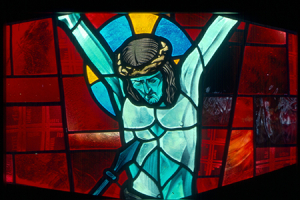
Love revealed in the passion
(John 18:1 - 19:42)
The Passion of Jesus according to John
Simon Peter, with another disciple, followed Jesus. This disciple, who was known to the high priest, went with Jesus into the high priest’s palace, but Peter stayed outside the door. So the other disciple, the one known to the high priest, went out, spoke to the woman Jesus left with his disciples and crossed the Kedron valley. There was a garden there, and he went into it with his disciples. Judas the traitor knew the place well, since Jesus had often met his disciples there, and he brought the cohort to this place together with a detachment of guards sent by the chief priests and the Pharisees, all with lanterns and torches and weapons. Knowing everything that was going to happen to him, Jesus then came forward and said, ‘Who are you looking for?’ They answered, ‘Jesus the Nazarene.’ He said, ‘I am he.’ Now Judas the traitor was standing among them. When Jesus said, ‘I am he’, they moved back and fell to the ground. He asked them a second time, ‘Who are you looking for?’ They said, ‘Jesus the Nazarene.’ Jesus replied, ‘I have told you that I am he. If I am the one you are looking for, let these others go.’ This was to fulfil the words he had spoken: ‘Not one of those you gave me have I lost’.
Simon Peter, who carried a sword, drew it and wounded the high priest’s servant, cutting off his right ear. The servant’s name was Malchus. Jesus said to Peter, ‘Put your sword back in its scabbard; am I not to drink the cup that the Father has given me?’
Pause for quiet reflection
The cohort and its captain and the Jewish guards seized Jesus and bound him. They took him first to Annas, because Annas was the father-in-law of Caiaphas, who was high priest that year. It was Caiaphas who had suggested to the Jews, ‘It is better for one man to die for the people’.
Simon Peter, with another disciple, followed Jesus. This disciple, who was known to the high priest, went with Jesus into the high priest’s palace, but Peter stayed outside the door. So the other disciple, the one known to the high priest, went out, spoke to the woman who was keeping the door and brought Peter in. The maid on duty at the door said to Peter, ‘Aren’t you another of that man’s disciples?’ He answered, ‘I am not.’ Now it was cold, and the servants and guards had lit a charcoal fire and were standing there warming themselves; so Peter stood there too, warming himself with the others.
The high priest questioned Jesus about his disciples and his teaching. Jesus answered, ‘I have spoken openly for all the world to hear; I have always taught in the synagogue and in the Temple where all the Jews meet together: I have said nothing in secret.
But why ask me? Ask my hearers what I taught: they know what I said.’ At these words, one of the guards standing by gave Jesus a slap in the face, saying, ‘Is that the way to answer the high priest?’ Jesus replied, ‘If there is something wrong in what I said, point it out; but if there is no offense in it, why do you strike me?’ Then Annas sent him, still bound, to Caiaphas, the high priest.
As Simon Peter stood there warming himself, someone said to him, ‘Aren’t you another of his disciples?’ He denied it saying, ‘I am not.’ One of the high priest’s servants, a relation of the man whose ear Peter had cut off, said, ‘Didn’t I see you in the garden with him?’ Again Peter denied it; and at once a cock crew.
Pause for quiet reflection
They then led Jesus from the house of Caiaphas to the Praetorium. It was now morning. They did not go into the Praetorium themselves or they would be defiled and unable to eat the Passover. So Pilate came outside to them and said, ‘What charge do you bring against this man?’ They replied, ‘If he were not a criminal, we should not be handing him over to you.’ Pilate said, ‘Take him yourselves, and try him by your own Law.’ The Jews answered, ‘We are not allowed to put a man to death.’ This was to fulfil the words Jesus had spoken indicating the way he was going to die. So Pilate went back into the Praetorium and called Jesus to him, and asked, ‘Are you the king of the Jews?’ Jesus replied, ‘Do you ask this of your own accord, or have others spoken to you about me?’ Pilate answered, ‘Am I a Jew? It is your own people and the chief priests who have handed you over to me: what have you done?’ Jesus replied, ‘Mine is not a kingdom of this world; if my kingdom were of this world, my men would have fought to prevent me being surrendered to the Jews. But my kingdom is not of this kind.’ Pilate said, ‘So you are a king then?’ Jesus answered, ‘It is you who say it. Yes, I am a king. I was born for this, I came into the world for this; to bear witness to the truth, and all who are on the side of truth listen to my voice.’ Pilate said, ‘Truth? What is that?’ And with that he went out again to the Jews and said, ‘I find no case against him. But according to a custom of yours I should release one prisoner at the Passover; would you like me, then, to release the king of the Jews?’ At this they shouted, ‘Not this man, but Barabbas.’ Barabbas was a brigand.
Pilate then had Jesus taken away and scourged; and after this, the soldiers twisted some thorns into a crown and put it on his head, and dressed him in a purple robe. They kept coming up to him and saying, ‘Hail, king of the Jews!’ and they slapped him in the face.
Pause for quiet reflection
Pilate came outside and said to them, ‘Look, I am going to bring him out to you to let you see that I find no case.’ Jesus then came out wearing the crown of thorns and the purple robe. Pilate said, ‘Here is the man.’ When they saw him the chief priests and the guards shouted, ‘Crucify him! Crucify him!’ Pilate said, ‘Take him yourselves and crucify him: I can find no case against him.’ The Jews replied, ‘We have a Law, and according to the Law he ought to die, because he has claimed to be the son of God.’ When Pilate heard them say this his fears increased. Re-entering the Praetorium, he said to Jesus, ‘Where do you come from?’ But Jesus made no answer. Pilate then said to him, ‘Are you refusing to speak to me? Surely you know I have power to release you and I have power to crucify you?’ Jesus replied, ‘You would have no power over me if it had not been given you from above; that is why the one who handed me over to you has the greater guilt.’
From that moment Pilate was anxious to set him free, but the Jews shouted, ‘If you set him free you are no friend of Caesar’s; anyone who makes himself king is defying Caesar.’ Hearing these words, Pilate had Jesus brought out, and seated himself on the chair of judgement at a place called the Pavement, in Hebrew Gabbatha. It was Passover Preparation Day, about the sixth hour. Pilate said to the Jews, ‘Here is your king.’ They said, ‘Take him away, take him away. Crucify him!’ Pilate said, ‘Do you want me to crucify your king?’ The chief priests answered, ‘We have no king except Caesar.’ So in the end Pilate handed him over to them to be crucified.
Pause for quiet reflection
They then took charge of Jesus, and carrying his own cross he went out of the city to the place of the skull, or, as it was called in Hebrew, Golgotha, where they crucified him with two others, one on either side with Jesus in the middle. Pilate wrote out a notice and had it fixed to the cross; it ran: ‘Jesus the Nazarene, King of the Jews’. This notice was read by many of the Jews, because the place where Jesus was crucified was not far from the city, and the writing was in Hebrew, Latin and Greek. So the Jewish chief priests said to Pilate, ‘You should not write ‘King of the Jews’, but ‘This man said: I am King of the Jews’. Pilate answered, ‘What I have written, I have written.’
When the soldiers had finished crucifying Jesus they took his clothing and divided it into four shares, one for each soldier. His undergarment was seamless, woven in one piece from neck to hem; so they said to one another, ‘Instead of tearing it, let’s throw dice to decide who is to have it.’ In this way the words of scripture were fulfilled: They shared out my clothing among them. They cast lots for my clothes. This is exactly what the soldiers did.
Near the cross of Jesus stood his mother and his mother’s sister, Mary the wife of Clopas, and Mary of Magdala. Seeing his mother and the disciple he loved standing near her, Jesus said to his mother, ‘Woman, this is your son.’ Then to the disciple he said, ‘This is your mother.’ And from that moment the disciple made a place for her in his home.
After this, Jesus knew that everything had now been completed, and to fulfil the scripture perfectly he said, ‘I am thirsty.’ A jar full of vinegar stood there, so putting a sponge soaked in vinegar on a hyssop stick they held it up to his mouth. After Jesus had taken the vinegar he said, ‘It is accomplished’; and bowing his head he gave up the spirit.
Pause for quiet reflection
It was Preparation Day, and to prevent the bodies remaining on the cross during the Sabbath - since the Sabbath was a day of special solemnity - the Jews asked Pilate to have the legs broken and the bodies taken away. Consequently the soldiers came and broke the legs of the first man who had been crucified with him and then the other. When they came to Jesus, they found that he was already dead, and so instead of breaking his legs one of the soldiers pierced his side with a lance; and immediately there came out blood and water. This is the evidence of one who saw it - trustworthy evidence, and he knows he speaks the truth - and he gives it so that you may believe as well. Because all this happened to fulfil the words of scripture: Not one bone of his will be broken, and again, in another place scripture says: They will look on the one whom they have pierced.
After this, Joseph of Arimathaea, who was a disciple of Jesus though a secret one because he was afraid of the Jews asked Pilate to let him remove the body of Jesus. Pilate gave permission, so they came and took it away. Nicodemus came as well - the same one who had first come to Jesus at night-time and he brought a mixture of myrrh and aloes, weighing about a hundred pounds. They took the body of Jesus and wrapped it with the spices in linen cloths, following the Jewish burial custom. At the place where he had been crucified there was a garden, and in the garden a new tomb in which no one had yet been buried. Since it was the Jewish Day of Preparation and the tomb was near at hand, they laid Jesus there.
Pause for quiet reflection.
Celebrating At Home - Holy Thursday
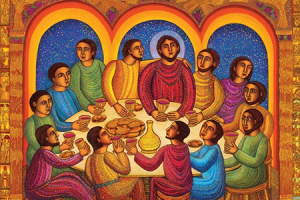
Washing feet, sharing bread and wine:
Love poured out in service
The liturgy on Holy Thursday is a meditation on the essential connection between the Eucharist and Christian love expressed in serving one another. Christ is not only present in the Eucharist but also in the deeds of loving kindness offered to others through us.
We are the ones who make ‘real’ the presence of Jesus in every smile, kind word and loving action.
Celebrating At Home - Palm Sunday of the Passion of the Lord
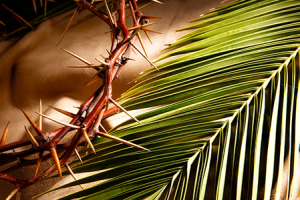
Love revealed
(Matthew 27:11-54)
The Passion of Jesus according to Matthew
Matthew presents the passion, not as a gruesome act, but as the means of salvation. The cross is part of God’s plan, not a tragic mistake.
Jesus was brought before Pontius Pilate, the governor, who asked him: ‘Are you the king of the Jews?’ ‘It is you who say it’. But when he was accused by the chief priests and the elders he refused to answer them. So Pilate said to him: ‘Do you hear how many charges they have brought against you?’ But to the governor’s amazement Jesus offered no reply to any of the charges.
At festival time it was the governor’s practice to release a prisoner for the people, anyone they chose. Now there was at that time a notorious prisoner whose name was Barabbas. So when the crowd had gathered, Pilate said to them: ‘Which do you want me to release for you: Barabbas, or Jesus who is called Christ?’
The chief priests and the elders had persuaded the crowd to demand the release of Barabbas and the execution of Jesus. So when Pilate asked them, ‘Which of the two do you want me to release for you?’, they said, ‘Barabbas’. ‘In that case what am I to do with Jesus who is called Christ?’ They all shouted, ‘Let him be crucified!’ ‘But why? What harm has he done?’ But they shouted all the louder, ‘Let him be crucified!’
Then Pilate saw that he was making no impression.
In fact a riot was imminent. So he took some water, washed his hands in front of the crowd, saying, ‘I am innocent of this man’s blood.’ And the people shouted, ‘His blood be on us and on our children!’ Then Pilate released Barabbas and ordered Jesus to be scourged and then handed over to be crucified.
The Governor’s soldiers took Jesus with them into the Praetorium and collected the whole cohort round him. They stripped him and made him wear a scarlet cloak, and having twisted some thorns into a crown they put this on his head and placed a reed in his right hand. To make fun of him, they knelt to him saying, ‘Hail, king of the Jews!’ And they spat on him and took the reed and struck him on the head with it. And when they had finished making fun of him, they took off the cloak and dressed him in his own clothes and led him away to crucify him.
On their way out, they came across a man from Cyrene, Simon by name, and enlisted him to carry his cross. When they had reached a place called Golgotha, that is, the place of the skull, they gave him wine to drink mixed with gall, which he tasted but refused to drink. When they had finished crucifying him, they shared out his clothing by casting lots, and then sat down and stayed there keeping guard over him.
Above his head was placed the charge against him: it read ‘This is Jesus, the King of the Jews’. At the same time, two robbers were crucified with him, one on the right and one on the left.
The passers-by jeered at him; they shook their heads and said, ‘So you would destroy the Temple and rebuild it in three days! Then save yourself! If you are God’s son, come down from the cross!’
The chief priests with the scribes and elders mocked him in the same way. ‘He saved others, he cannot save himself. He is the king of Israel; let him come down from the cross now, and we will believe him. He put his trust in God; now let God rescue him if he wants to. For he did say, “I am the son of God”.’
Even the robbers who were crucified with him taunted him in the same way.
From the sixth hour there was darkness over all the land until the ninth hour. And about the ninth hour, Jesus cried out in a loud voice, ‘Eli, Eli, lama sabachthani!’ that is, ‘My God, my God, why have you deserted me!’
When some of those who stood there heard this, they said, ‘The man is calling on Elijah,’ and one of them quickly ran to get a sponge which he dipped in vinegar and putting it on a reed, gave it to him to drink. ‘Wait!’ said the rest of them ‘and see if Elijah will come to save him’. But Jesus again crying out in a loud voice, yielded up his spirit.
[All pause for a moment]
At that, the veil of the temple was torn in two from top to bottom; the earth quaked; the rocks were split; the tombs opened and the bodies of many holy people rose from the dead, and these, after his resurrection, came out of the tombs, entered the Holy City and appeared to a number of people.
Meanwhile the centurion, together with the others guarding Jesus, had seen the earthquake and all that was taking place, and they were terrified and said, ‘In truth this was a son of God’.
Quiet time for reflection
- pdf Celebrating At Home - Palm Sunday of the Passion of the Lord [PDF](2.57 MB)
- default Celebrating At Home - Palm Sunday of the Passion of the Lord [ePub](2.74 MB)
- pdf Celebrando en Familia - Domingo de Ramos Pasión de Nuestro Señor Jesucristo(216 KB)
- pdf Celebrando in Casa - Domenica delle Palme Passione di Nostro Signore Gesù Cristo(219 KB)
- pdf Celebrando em familia - Domingo da Ramos Paixão de Nosso Senhor Jesus Cristo(217 KB)
Celebrating At Home - 5th Sunday in Lent

Let him go free
(John 11:1-45)
The final of the three Great Gospels of Lent is ours today - a Gospel story of life and freedom. Like the gospels of the last two Sundays, the dramatic story of Jesus raising his friend Lazarus from the dead is a story of love, faith and belief.
There are three different groups of believers in the story: those who believe that Jesus could have prevented Lazarus’ death (Jesus is already known to be a healer); those who came to believe in him because they see Lazarus rise, and those, like Martha, who believe in Jesus even though Lazarus died.
In this Gospel Jesus proclaims himself ‘the resurrection and the life’. We see him deeply moved by the death of his friend. We find him in earnest prayer with God.
We see him full of strength as he commands Lazarus to come out of the tomb.
One thing that is rarely commented on about this story is the image of love that pervades it. Jesus has treated the Samaritan woman with dignity, respect, gentleness and love, and reached out in love to heal the blind man without being asked. In this story his love for Martha, Mary and Lazarus, and the grief he feels because of that love, are very clearly seen.
For me, it brings together once again the connection between faith and love. If John intended this story to reassure his community (those who have faith in Jesus) then he makes clear that they are also loved by Jesus, and suggests in a certain manner Jesus, too, weeps when harm (illness and death) come to his friends (believers). The ultimate reassurance is that this loving, faith-filled relationship we have with Jesus not only sustains us in life but also sees us through the dark moments of suffering and death – ultimately to life beyond the restrictions (binding cloths) we find in this world. Finally, we will be free.
For me, the most powerful words in the Gospel are: Unbind him, let him go free.
Freedom is one of the deepest aspirations of the human heart. We long to be free – from illness, worry, fear, (especially at the moment) the expectations of others, guilt, our faults and so on. The ultimate freedom is freedom from eternal death.
We know we can be physically alive and spiritually dead through envy, greed, fear, hatred. We know we can bring death to others through lies, gossip, meanness, cruelty, withholding forgiveness and so on.
By living the life of Christ we bring life, love and freedom to ourselves and each other.
Quiet time for reflection
- pdf Celebrating At Home - 5th Sunday in Lent [PDF](5.57 MB)
- default Celebrating At Home - 5th Sunday in Lent [ePub](4.25 MB)
- pdf Celebrando en Familia - Quinto Domingo del Tiempo de Cuaresma(521 KB)
- pdf Celebrando in Casa - V Domenica di Quaresima(522 KB)
- pdf Celebrando em familia - Quinto Domingo da Quaresma(521 KB)
Lectio Divina April 2023
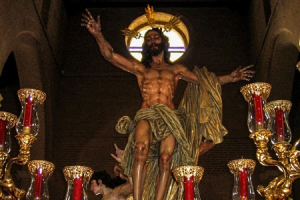
Lord God, creator and Father of all, your sons and daughters are still scattered and divided: Christians and non-Christians, various Churches and sects claiming exclusive rights on your Son, and each of them full of factions.
Make us dream again the dream which you alone can make possible: that we can all be one if we believe and follow him who died to unite all that is scattered, Jesus Christ, our Lord forever.
Elective Chapter of the Monastery in Palangkaraya
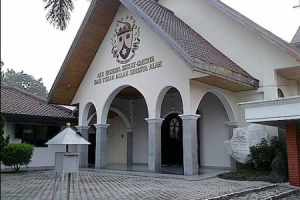
On March 12, 2023, the Monastery of St. Joseph in the Diocese of Palangkaraya, Indonesia, held its second elective chapter.
Upon the request of the bishop of the Diocese of Banjarmasin in 1993, five nuns fom the Flower of Carmel monastery in Batu founded the monastery of St. Joseph. In 1993, when the Diocese of Palangkaraya was established, the monastery became part of the new diocese. The monastery was dedicated on October 7, 2001. The decree of canonical establishment was received on November 18, 2019.
The results of the elective chapter were as follows:
Prioress | Priora | Priora:
Sr. M. Dorothea Yekti Handayani Edi Soediono, O. Carm.
1st Councilor | 1ª Consejera | 1ª Consigliera:
Sr. Yosepha Tinawati Kamsani, O. Carm.
2nd Councilor | 2ª Consejera | 2ª Consigliera:
Sr. Bernadetta Nurahdiyati Soeharjo, O. Carm.
Formator | Formadora | Formatrice:
Sr. Bernadetta Nurahdiyati Soeharjo, O. Carm.
Treasurer | Ecónoma | Economa:
Sr. Yosepha Tinawati Kamsani, O. Carm.
Sacristan| Sacristana | Sacrestana:
Sr. Stefana Sugiyanti, O. Carm.
Elective Chapter of the Monastery in Huesca, Spain
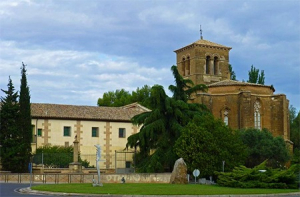
On March 15, 2023, the Monastery of the Incarnation-San Miguel in Huesca, Spain, held their triennial elective chapter.
The sisters wrote that "the Holy Spirit was clearly present in the communion manifested in the elections. We continue to ask for your prayers so that ... the community may be open to the inspirations of the Holy Spirit and faithful to the mission entrusted by God through his Church. May we enrich Carmel with our life and may everything be for the greater glory of God, the Church, Carmel, and our diocese ... of the whole world."
The monastery was founded by the Carmelite Peter Sobrino in 1622. From Incarnation, another monastery, the Assumption of the Blessed Virgin Mary, was founded in 1656.
The results of the elective chapter were as follows:
Prioress | Priora | Priora:
Sor Ma Gloria de Dios Caballero, O. Carm.
1st Councilor | 1ª Consejera | 1ª Consigliera:
Sor Ma Blanca de la Eucaristía, O. Carm.
2nd Councilor | 2ª Consejera | 2ª Consigliera:
Sor Ma Pilar Borau, O. Carm.
Director of Novices | Maestra de Novicias | Maestra delle Novizie
Sor Ma Blanca de la Eucaristía, O. Carm.
Treasurer | Ecónoma | Economa:
Sor Ma Blanca de la Eucaristía, O. Carm.
Sacristan | Sacristán | Sacrestana:
Sor Ma Pilar Borau, O. Carm.